Custom, Excise & Service Tax Tribunal judgments

454 Custom, Excise & Service Tax Tribunal judgments explained in plain English: what was decided, the law applied and why it matters. Page 4 of 19.

Section 123 Customs Act 1962 | Reasonable Belief Required to Trigger Presumption of Smuggling in Gold Seizures : CESTAT Kolkata
Case Law Analysis
|Custom, Excise & Service Tax Tribunal

Section 123 Customs Act 1962 | Reasonable Belief Required to Trigger Presumption of Smuggling in Gold Seizures : CESTAT Kolkata

CESTAT Kolkata rules that mere possession of unmarked gold, without any corroborating intelligence or border-crossing context, cannot invoke the Section 123 presumption of smuggling. The burden remains squarely on the Revenue to prove intent and illicit movement, reinforcing procedural safeguards for travelers and traders against speculative seizures.


Section 112(a)(i) Customs Act | Penalty Requires Direct Link to Goods Rendered Confiscable Under Section 111, Not Just CBLR Breach : CESTAT Chandigarh
Case Law Analysis
|Custom, Excise & Service Tax Tribunal

Section 112(a)(i) Customs Act | Penalty Requires Direct Link to Goods Rendered Confiscable Under Section 111, Not Just CBLR Breach : CESTAT Chandigarh

CESTAT Chandigarh has ruled that penalties under Section 112(a)(i) of the Customs Act cannot be imposed solely for violations of Customs Broker Liability Rules unless the act or omission directly renders the goods liable for confiscation under Section 111. This decision shields customs brokers from punitive action for procedural lapses that do not facilitate smuggling or concealment of prohibited goods, reinforcing the principle that penalty must flow from substantive harm, not technical non-compliance.

POPS Rules | Direct Contract with Overseas Principal Excludes Intermediary Status, Entitles Cenvat Credit: CESTAT Chandigarh
Case Law Analysis
|Custom, Excise & Service Tax Tribunal

POPS Rules | Direct Contract with Overseas Principal Excludes Intermediary Status, Entitles Cenvat Credit: CESTAT Chandigarh

CESTAT Chandigarh rules that Genpact Services LLC, providing BPO services directly to an overseas principal under a single contract, does not qualify as an 'intermediary' under the Place of Provision of Services Rules. The ruling entitles the appellant to Cenvat credit refunds worth ₹14.55 crore, setting a precedent for service exporters with direct overseas contracts.

Section 111(l) & 114A Customs Act | Marginal Measurement Discrepancy Without Mens Rea Cannot Sustain Redemption Fine & Penalty : CESTAT Mumbai
|Custom, Excise & Service Tax Tribunal

Section 111(l) & 114A Customs Act | Marginal Measurement Discrepancy Without Mens Rea Cannot Sustain Redemption Fine & Penalty : CESTAT Mumbai

CESTAT Mumbai quashes redemption fine and penalty under Sections 111(l), 111(m), and 114A of the Customs Act, ruling that a 13% excess in declared surface area-attributable to measurement methodology-does not constitute deliberate misdeclaration. The Tribunal emphasized that penalties require proof of mens rea, offering relief to importers facing disproportionate liabilities for minor discrepancies.

CESTAT Upholds CTH 8708 94 00 Classification for EPS-ECU & Automotive Parts Under General Interpretative Rules : Delhi Bench
Case Law Analysis
|Custom, Excise & Service Tax Tribunal

CESTAT Upholds CTH 8708 94 00 Classification for EPS-ECU & Automotive Parts Under General Interpretative Rules : Delhi Bench

The Customs, Excise and Service Tax Appellate Tribunal (CESTAT), Delhi, affirmed the classification of Electronic Control Units for Electronic Power Steering (EPS-ECU) and related parts under CTH 8708 94 00, dismissing appeals challenging differential duty demands. The ruling reinforces binding precedent on tariff classification under the General Interpretative Rules, impacting automotive manufacturers and importers.

SEZ Unit Refund Claims Exempt from 1-Year Limitation under Notification 40/2012-ST | CESTAT Chandigarh
Case Law Analysis
|Custom, Excise & Service Tax Tribunal

SEZ Unit Refund Claims Exempt from 1-Year Limitation under Notification 40/2012-ST | CESTAT Chandigarh

CESTAT Chandigarh holds that Special Economic Zone units are not bound by the one-year limitation period in Finance Act notifications for service tax refunds, as their entitlement arises from statutory exemption provisions under the SEZ Act. This clarifies that SEZ-specific refund rights operate independently of general time bars, benefiting exporters and SEZ-based service recipients with delayed claims.

Section 65(105)(zzzm) Finance Act | Municipal Corporations Exempt from Service Tax on Advertisement Space Sales Pre-2012: CESTAT Chandigarh
Case Law Analysis
|Custom, Excise & Service Tax Tribunal

Section 65(105)(zzzm) Finance Act | Municipal Corporations Exempt from Service Tax on Advertisement Space Sales Pre-2012: CESTAT Chandigarh

CESTAT Chandigarh ruled that municipal corporations do not qualify as 'persons' under Section 65(105)(zzzm) of the Finance Act, 1994, for the period before 01.07.2012, exempting them from service tax on advertisement space sales. The decision sets a precedent for statutory interpretation of taxable entities, impacting revenue disputes involving constitutional bodies.

Service Tax Exemption for Railway Projects | Notification 25/2012 Covers Both Public and Private Use: CESTAT Chandigarh
Case Law Analysis
|Custom, Excise & Service Tax Tribunal

Service Tax Exemption for Railway Projects | Notification 25/2012 Covers Both Public and Private Use: CESTAT Chandigarh

CESTAT Chandigarh has ruled that services related to railway infrastructure qualify for exemption under Notification 25/2012 regardless of whether the project serves public or private interests, clarifying that the exemption is not contingent on ownership or end-use. This decision shields project consultants and agents from service tax liability in railway development, offering critical relief to private contractors and public-sector partners alike.

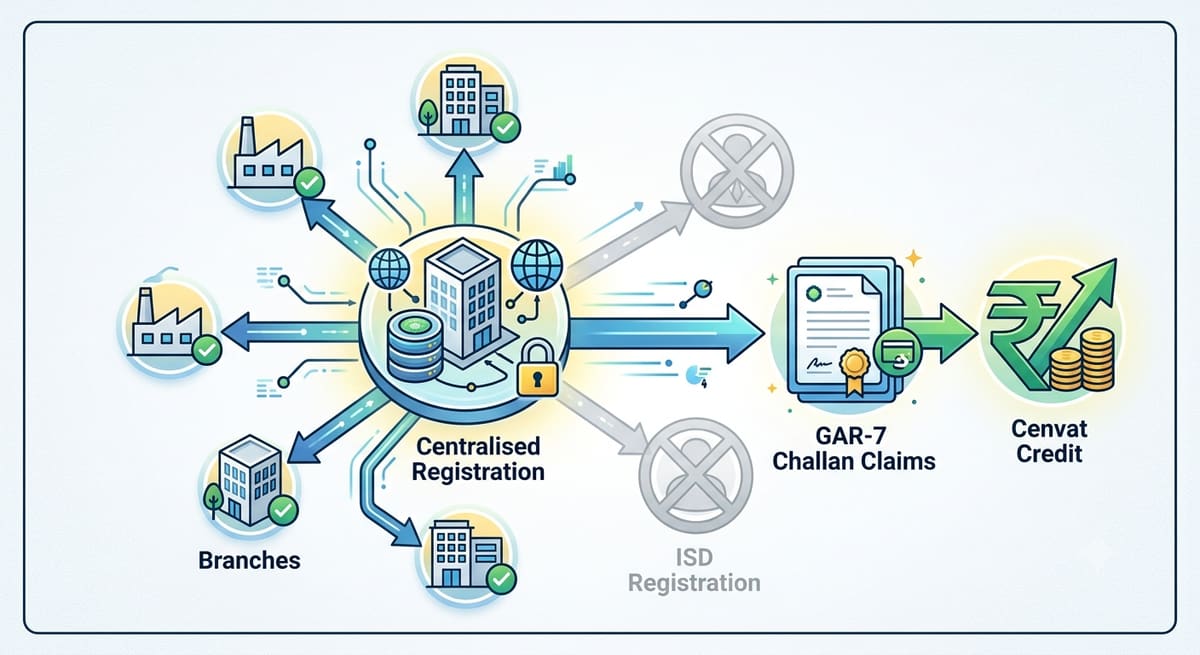
Cenvat Credit | Centralised Registration Allows GAR-7 Challan Claims Without ISD Registration: CESTAT Chandigarh
Case Law Analysis
|Custom, Excise & Service Tax Tribunal

Cenvat Credit | Centralised Registration Allows GAR-7 Challan Claims Without ISD Registration: CESTAT Chandigarh

Taxpayers with centralised registration can claim Cenvat credit using GAR-7 challans even without ISD registration, as CESTAT Chandigarh prioritises substantive entitlement over procedural compliance. This ruling empowers large multi-unit businesses to streamline input tax credit claims without the added burden of separate ISD setup, significantly reducing administrative friction under the erstwhile service tax regime.

Service Tax | Ocean Freight Markup Not Taxable as 'Business Support Service' Under Finance Act, 1994 : CESTAT Chandigarh
Case Law Analysis
|Custom, Excise & Service Tax Tribunal

Service Tax | Ocean Freight Markup Not Taxable as 'Business Support Service' Under Finance Act, 1994 : CESTAT Chandigarh

CESTAT Chandigarh holds that when a freight forwarder purchases ocean freight on a principal-to-principal basis and resells it with a markup, the transaction does not constitute a taxable 'Business Support Service' under the Finance Act, 1994. This clarifies the scope of taxable auxiliary services in logistics and benefits freight forwarders operating as principals, not agents, in international shipping arrangements.

HSN Chapter Note 4 | Crushing and Screening of Iron Ore Not 'Manufacture' - Exemption for Ores Upheld : CESTAT Kolkata
Case Law Analysis
|Custom, Excise & Service Tax Tribunal

HSN Chapter Note 4 | Crushing and Screening of Iron Ore Not 'Manufacture' - Exemption for Ores Upheld : CESTAT Kolkata

The CESTAT Kolkata rules that mere size reduction and segregation of iron ore through crushing and screening do not amount to manufacture under HSN Chapter Note 4, preserving the unconditional exemption for raw ores under Notification No. 12/2012-CE. This clarifies the boundary between mining activities and taxable production, directly impacting miners, contractors, and tax authorities handling ore-based supply chains.

Customs Act Section 111(d) | Invalid PSIC Due to Unauthorized Agency Jurisdiction Does Not Render Goods 'Prohibited' If Post-Shipment Inspection Confirms Compliance : CESTAT Chandigarh
Case Law Analysis
|Custom, Excise & Service Tax Tribunal

Customs Act Section 111(d) | Invalid PSIC Due to Unauthorized Agency Jurisdiction Does Not Render Goods 'Prohibited' If Post-Shipment Inspection Confirms Compliance : CESTAT Chandigarh

CESTAT Chandigarh rules that a Pre-Shipment Inspection Certificate issued by an unauthorized agency does not automatically classify imported goods as 'prohibited' under Section 111(d), provided a subsequent DGFT-approved post-shipment inspection verifies safety and regulatory compliance. This shields importers from confiscation where goods are legally sound but administratively misdocumented, reinforcing that procedural flaws cannot override substantive safety verification.

Service Tax on Export of Services | Recipient’s Location Outside India Determines Tax Exemption : CESTAT Kolkata
Case Law Analysis
|Custom, Excise & Service Tax Tribunal

Service Tax on Export of Services | Recipient’s Location Outside India Determines Tax Exemption : CESTAT Kolkata

CESTAT Kolkata rules that services rendered in India to a foreign recipient qualify as 'export of services' and are exempt from service tax if payment is received in foreign exchange. The ruling sets aside a ₹4.55 crore tax demand, reinforcing that taxability hinges on the recipient’s location, not the place of performance.

HSN 7314 vs. 8436 | GI Welded Wire Mesh for Poultry Cages Classifiable as Iron/Steel Article, Not Poultry Machinery: CESTAT Hyderabad
Case Law Analysis
|Custom, Excise & Service Tax Tribunal

HSN 7314 vs. 8436 | GI Welded Wire Mesh for Poultry Cages Classifiable as Iron/Steel Article, Not Poultry Machinery: CESTAT Hyderabad

CESTAT Hyderabad rules that galvanized iron welded wire mesh used in poultry cages falls under HSN 7314 (iron/steel articles) rather than HSN 8436 (poultry machinery), directly impacting customs duty liability. The decision clarifies classification disputes for manufacturers and importers of similar industrial materials.

ELFA Diagnostic Kits Qualify as ELISA for Customs Duty Exemption Under Notification No. 50/2017-Cus : CESTAT Chennai
Case Law Analysis
|Custom, Excise & Service Tax Tribunal

ELFA Diagnostic Kits Qualify as ELISA for Customs Duty Exemption Under Notification No. 50/2017-Cus : CESTAT Chennai

CESTAT Chennai ruled that ELFA diagnostic kits, operating on the ELISA principle, are eligible for concessional customs duty under Notification No. 50/2017-Cus, overturning a ₹68.20 crore demand. The decision underscores purposive interpretation of tax laws to accommodate technological advancements in diagnostic methods, impacting importers of similar medical devices.

Central Excise Act Section 11A | Burden of Proof for Clandestine Removal Requires Tangible Evidence, Not Presumptions or Private Records: CESTAT Ahmedabad
Case Law Analysis
|Custom, Excise & Service Tax Tribunal

Central Excise Act Section 11A | Burden of Proof for Clandestine Removal Requires Tangible Evidence, Not Presumptions or Private Records: CESTAT Ahmedabad

CESTAT Ahmedabad has ruled that revenue authorities cannot sustain excise duty demands based solely on handwritten notes or unverified challans. The burden lies squarely on the department to produce concrete, corroborated evidence of clandestine removal-rejecting speculative inferences from incomplete records. This sets a vital precedent for manufacturers facing arbitrary tax assessments under the Central Excise Act.

Section 68 Finance Act 1994 | RCM Applicable Only on GTA Services with Consignment Note: CESTAT Ahmedabad
Case Law Analysis
|Custom, Excise & Service Tax Tribunal

Section 68 Finance Act 1994 | RCM Applicable Only on GTA Services with Consignment Note: CESTAT Ahmedabad

CESTAT Ahmedabad holds that service tax under Reverse Charge Mechanism (RCM) for Goods Transport Agency (GTA) services cannot be imposed unless a consignment note is issued. The ruling clarifies that cargo handling contracts cannot be artificially split to attract RCM, impacting businesses relying on GTA services without proper documentation.

Notification 12/2012-CE Sr. No. 203 | Hot Rolling of SS Flats into Pattas/Pattis Qualifies for Nil Duty, Even Without Further Processing: CESTAT Ahmedabad
Case Law Analysis
|Custom, Excise & Service Tax Tribunal

Notification 12/2012-CE Sr. No. 203 | Hot Rolling of SS Flats into Pattas/Pattis Qualifies for Nil Duty, Even Without Further Processing: CESTAT Ahmedabad

CESTAT Ahmedabad clarifies that hot-rolled stainless steel pattas/pattis are eligible for nil excise duty under Sr. No. 203 of Notification 12/2012-CE, even when no process beyond hot rolling is applied. This resolves long-standing ambiguity for manufacturers, affirming that cold rolling is the only excluded step - not mere slitting or shaping - significantly impacting SS flat product manufacturers across Gujarat and beyond.

Revenue Sharing with Food Outlets Not Business Support Service Under Service Tax : CESTAT Chennai
Case Law Analysis
|Custom, Excise & Service Tax Tribunal

Revenue Sharing with Food Outlets Not Business Support Service Under Service Tax : CESTAT Chennai

CESTAT Chennai rules that revenue-sharing payments from licensees operating food and beverage outlets within a property do not constitute taxable Business Support Services under the Finance Act, 1994. This clarifies a critical boundary for mall operators and entertainment complexes, shielding them from service tax demands on ancillary commercial partnerships that lack direct operational control or support functions.

Voyage Charter = Transportation Service, Not Supply of Tangible Goods | Reverse Charge Not Triggered Under Section 65(105)(zzzzj) : CESTAT Chennai
Case Law Analysis
|Custom, Excise & Service Tax Tribunal

Voyage Charter = Transportation Service, Not Supply of Tangible Goods | Reverse Charge Not Triggered Under Section 65(105)(zzzzj) : CESTAT Chennai

CESTAT Chennai rules that payments under voyage charter agreements for coastal cargo transport constitute taxable transportation services, not supply of vessels for use, thereby excluding them from reverse charge under service tax law. This clarifies the tax treatment for shipping intermediaries and manufacturers relying on third-party vessels, ending ambiguous classification of freight-based payments as goods rental.

Legitimate Expectation | Misstatement of Limitation Period in Adjudication Order Bars Summary Dismissal of Appeal : CESTAT Mumbai
Case Law Analysis
|Custom, Excise & Service Tax Tribunal

Legitimate Expectation | Misstatement of Limitation Period in Adjudication Order Bars Summary Dismissal of Appeal : CESTAT Mumbai

CESTAT Mumbai rules that when an adjudication order incorrectly states the limitation period for filing an appeal, the taxpayer’s reliance on that error constitutes a legitimate expectation that overrides procedural dismissal for non-filing of condonation application. This protects taxpayers from punitive outcomes arising from official legal misstatements, reinforcing administrative accountability in tax proceedings.

Customs Supervision Charges | MOT Basis Mandatory for Services Under Half-Day Under Circular 32/2016-Cus : CESTAT Kolkata
|Custom, Excise & Service Tax Tribunal

Customs Supervision Charges | MOT Basis Mandatory for Services Under Half-Day Under Circular 32/2016-Cus : CESTAT Kolkata

CESTAT Kolkata has ruled that customs supervision fees for special bonded warehouse operators must be calculated on Merchant Over Time (MOT) basis when services last less than half a day, invalidating Cost Recovery Charges (CRC) demands under Circular 32/2016-Cus. This sets a critical precedent for duty-free retailers and warehouse operators across India, ensuring fair cost allocation based on actual time rendered, not arbitrary daily billing.

Binding Precedent in Tariff Classification | Revenue Barred from Re-litigating Tribunal's Final Classification After Supreme Court Affirmation : CESTAT Allahabad
Case Law Analysis
|Custom, Excise & Service Tax Tribunal

Binding Precedent in Tariff Classification | Revenue Barred from Re-litigating Tribunal's Final Classification After Supreme Court Affirmation : CESTAT Allahabad

CESTAT Allahabad has ruled that once a tariff classification is finally settled by the Tribunal and upheld by the Supreme Court, revenue authorities cannot reopen or challenge it in subsequent assessments. This reinforces the principle of finality in tax adjudication, providing certainty to importers and curbing repetitive litigation by tax authorities.