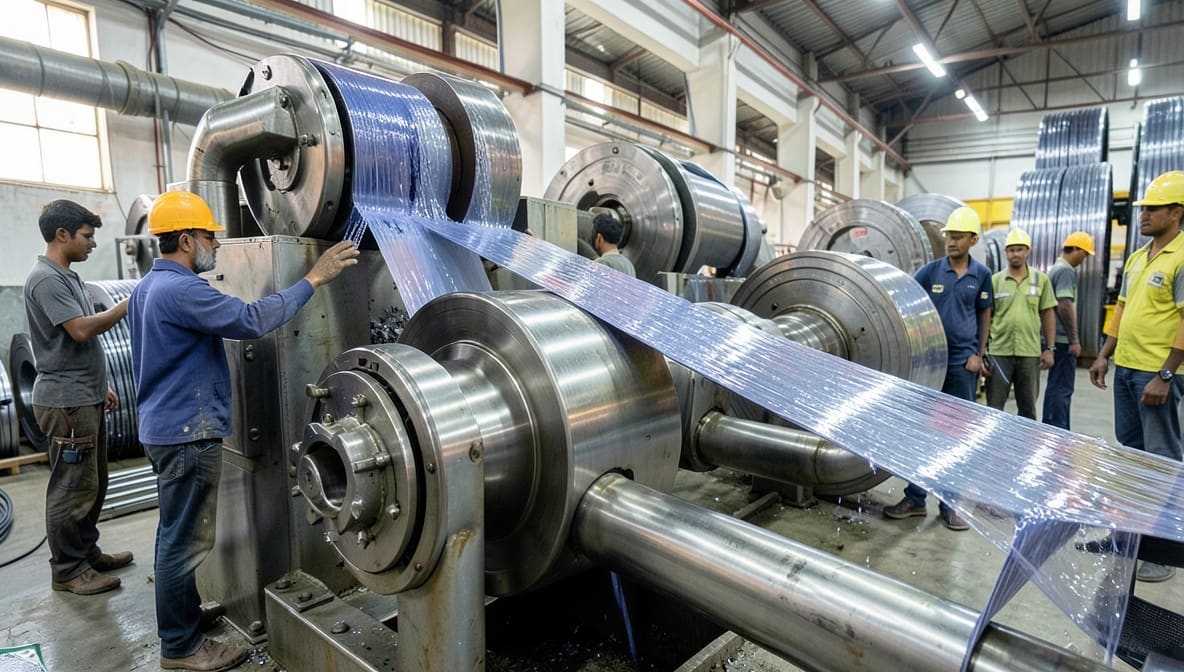
The Customs, Excise & Service Tax Appellate Tribunal (CESTAT) has clarified that the hot rolling of stainless steel flats into pattas and pattis qualifies for nil duty under Sr. No. 203 of Notification No. 12/2012-CE, overturning the Revenue’s strict interpretation that only post-hot-rolling processes like annealing or pickling were eligible. This ruling resolves a long-standing ambiguity in excise duty applicability and affirms that the exemption covers all manufacturing stages preceding cold rolling.
Background & Facts
The Dispute
M/s Abhinay Steel, the respondent, manufactures stainless steel hot rolled pattas/pattis and cold rolled pattas/pattis under CTH 7220 1290 and 7220 2090 respectively. The company procures stainless steel flats (10mm to 25mm thickness) from suppliers and sends them to job workers for hot rolling into pattas/pattis of 1.62mm thickness. A portion of these hot rolled pattas/pattis is cleared without any further processing, while the remainder undergoes cold rolling, which includes annealing, pickling, washing, and leveling. The company claims exemption under Sr. No. 203 of Notification No. 12/2012-CE dated 17.03.2012, which provides nil duty for pattas/pattis "subjected to any process other than cold rolling".
Key Facts
- The respondent purchases SS flats (raw material) from various suppliers
- SS flats are sent to job workers for hot rolling into pattas/pattis of 1.62mm thickness
- Hot rolled pattas/pattis are cleared either as-is or after cold rolling
- No further process (e.g., annealing, pickling) is performed on hot rolled pattas/pattis before clearance
- The Revenue contends that exemption under Sr. No. 203 requires a process other than cold rolling to be applied to the pattas/pattis, and since hot rolling is the initial manufacturing stage, it does not qualify
- The respondent has consistently availed the exemption since 2008
Procedural History
- April 2008 - March 2013: Revenue issues Show Cause Notice (SCN) dated 30.04.2013 demanding duty of Rs. 40,40,607/-
- April 2013 - March 2014: SCN dated 25.08.2014 issued
- April 2014 - March 2015: SCN dated 06.11.2015 issued
- April 2015 - December 2015: SCN dated 29.04.2016 issued
- January 2016 - November 2016: SCN dated 22.01.2018 issued
- December 2016 - July 2017: SCN dated 24.10.2018 issued (subject of present appeal)
- 2018 - 2019: Assistant Commissioner confirms duty demand of Rs. 40,40,607/- and imposes penalty of Rs. 4,04,060/-
- 22.10.2019: Commissioner (Appeals) sets aside the order, relying on M/s Metweld Industries and Bharatbhai B Gala
- 22.11.2024: CESTAT, in Abhinay Steel (Appeal Nos. E/11092, 13518/2014 etc.), ruled in favor of the assessee, relying on CBIC Circular F. No. 96/85/2015-CX.I dated 07.12.2015
- 29.06.2026: Present appeal decided by CESTAT, West Zonal Bench, Ahmedabad
The Parties' Positions
For the Appellant (Revenue)
- Argues that exemption under Sr. No. 203 requires a process other than cold rolling to be applied to pattas/pattis
- Contends that hot rolling is not a process applied to pattas/pattis, but rather the process by which pattas/pattis are created from SS flats
- Relies on Circular F. No. B/31/8/94-TRU dated 04.05.1994, which mentions "hot rolling of pattas and patties" as exempt, but argues this refers to processes like annealing and pickling performed after hot rolling
- Invokes UOI v. M/s Ganesh Metal Processors Industries and Dharmendra Textiles Mills Ltd to argue for strict interpretation of exemptions and mandatory penalty
- Seeks to uphold duty demand of Rs. 40,40,607/-, interest under Section 11AA, and penalty of Rs. 4,04,060/-
For the Respondent (Abhinay Steel)
- Argues that hot rolling is a process preceding cold rolling and falls squarely within the scope of Sr. No. 203
- Relies on CBIC Circular F. No. 96/85/2015-CX.I dated 07.12.2015, which explicitly clarifies that "all stages prior to the stage of cold rolling" are exempt
- Cites CESTAT’s own prior decision in Abhinay Steel (Final Order No. 12770-12773/2024) and Multi Metal Industries (Order No. A/12245-12247/2023)
- Points out that the term "pattas/pattis" must be interpreted in trade parlance, which includes SS flats transformed into rolled sheets
- Opposes penalty imposition, citing that no duty is payable and therefore no violation exists
Relief Sought
The Revenue seeks to set aside the Commissioner (Appeals)’s order and uphold the Assistant Commissioner’s order, demanding:
- Central Excise duty of Rs. 40,40,607/-
- Interest under Section 11AA of the Central Excise Act, 1944
- Penalty of Rs. 4,04,060/- under Section 11AC(1)(a)
- Confiscation of goods valued at Rs. 323.25 lakhs
The respondent seeks dismissal of the appeal and confirmation of the exemption.
The Legal Issue
The central question was whether the hot rolling of stainless steel flats into pattas and pattis constitutes a process "other than cold rolling" under Sr. No. 203 of Notification No. 12/2012-CE, thereby qualifying for nil duty, or whether the exemption applies only to subsequent processes like annealing or pickling performed on already hot-rolled pattas/pattis.
Arguments Presented
For the Appellant
The Revenue argued that the exemption under Sr. No. 203 requires a process to be applied to pattas/pattis after their formation. Since hot rolling transforms SS flats into pattas/pattis, it is a manufacturing step, not a process applied to the finished product. The Revenue relied on the 1994 TRU circular, which mentions annealing and pickling as exempt processes, implying that hot rolling was not intended to be included. It further cited UOI v. Ganesh Metal Processors to argue that exemptions must be strictly construed and all conditions must be met. The Revenue also invoked Dharmendra Textiles to assert that penalty under Section 11AC is mandatory when duty is evaded.
For the Respondent
The respondent contended that the CBIC Circular dated 07.12.2015 explicitly clarified that "all stages prior to cold rolling" are exempt, including hot rolling. It emphasized that the term "pattas/pattis" in the notification must be understood in trade usage, which includes the product at the stage immediately after hot rolling. The respondent relied on CESTAT’s own binding precedent in Multi Metal Industries and its recent decision in Abhinay Steel (2024), which held that the exemption applies to hot rolled pattas/pattis regardless of whether further processing occurs. It also argued that penalty cannot be imposed where no duty is payable.
The Court's Analysis
The Tribunal conducted a detailed analysis of the exemption notification, the CBIC circular, and its own prior rulings. It noted that the language of Sr. No. 203 does not specify that the process must occur after the formation of pattas/pattis, but only that they must not be cold rolled. The Tribunal emphasized that the CBIC Circular dated 07.12.2015, issued after consultation with field officers and technical experts, explicitly states: "All stages prior to the stage of cold rolling have been exempted from excise duty. This would cover hot rolling of pattas and patties processes such as annealing, pickling etc."
"The conference examined the tariff heading involved, exemption notification and the clarification issued by TRU and concluded that clarification was clearly worded with no room for doubt. All processes prior to cold rolling are eligible for exemption from duty under Sr. No. 203 of Notification No. 12/2012-CE dated 17.03.2012."
The Tribunal held that the Revenue’s interpretation was inconsistent with the Board’s authoritative clarification, which is binding on field officers under Principle of Delegated Legislation. The Tribunal further observed that the Revenue’s reliance on the 1994 circular was misplaced, as the 2015 circular superseded prior interpretations and was issued after comprehensive deliberation.
The Tribunal also rejected the Revenue’s argument that hot rolling is not a process applied to pattas/pattis, noting that in trade parlance, the product emerging from hot rolling is indeed termed "pattas/pattis". The Tribunal affirmed that the exemption is not conditional on additional post-hot-rolling processes, but on the stage of manufacture relative to cold rolling.
Regarding penalty, the Tribunal held that since the goods were eligible for exemption under the notification, no duty was payable and therefore no violation of Section 11AC occurred. The Tribunal also noted that penalty on partners cannot be imposed separately where the firm is the assessee, citing Praveen N Shah.
The Verdict
The Revenue’s appeal is dismissed. The impugned order of the Commissioner (Appeals) dated 22.10.2019 is upheld. The demand for Central Excise duty of Rs. 40,40,607/-, interest under Section 11AA, and penalty of Rs. 4,04,060/- are set aside. The confiscation proposal under Rule 25(1) of the Central Excise Rules, 2002 is also rejected. The respondent is entitled to the benefit of exemption under Sr. No. 203 of Notification No. 12/2012-CE for all clearances of hot rolled pattas/pattis, irrespective of whether further processing is undertaken.
What This Means For Similar Cases
All Pre-Cold Rolling Processes Are Exempt
- Practitioners can now confidently claim exemption under Sr. No. 203 for any product falling under Chapter 72 that has undergone hot rolling, annealing, pickling, or any other process prior to cold rolling
- The burden shifts to the Revenue to prove that a process occurred after cold rolling, not before
- Assessments based on the pre-2015 interpretation of the notification are now legally untenable
Circulars Bind Field Officers; Strict Interpretation Is Overruled
- CBIC clarifications issued after consultation are binding on adjudicating authorities
- The doctrine of strict interpretation of exemptions is now subordinate to authoritative administrative clarifications
- Revenue cannot rely on outdated circulars (e.g., 1994) to override newer, comprehensive Board directives
Penalty Cannot Be Imposed Where Exemption Applies
- No penalty under Section 11AC is applicable if the assessee has acted in good faith under a valid exemption
- The Tribunal’s rejection of penalty reinforces that liability requires a violation of law, not merely a different interpretation
- Practitioners should challenge penalty notices where the underlying duty demand is quashed on exemption grounds