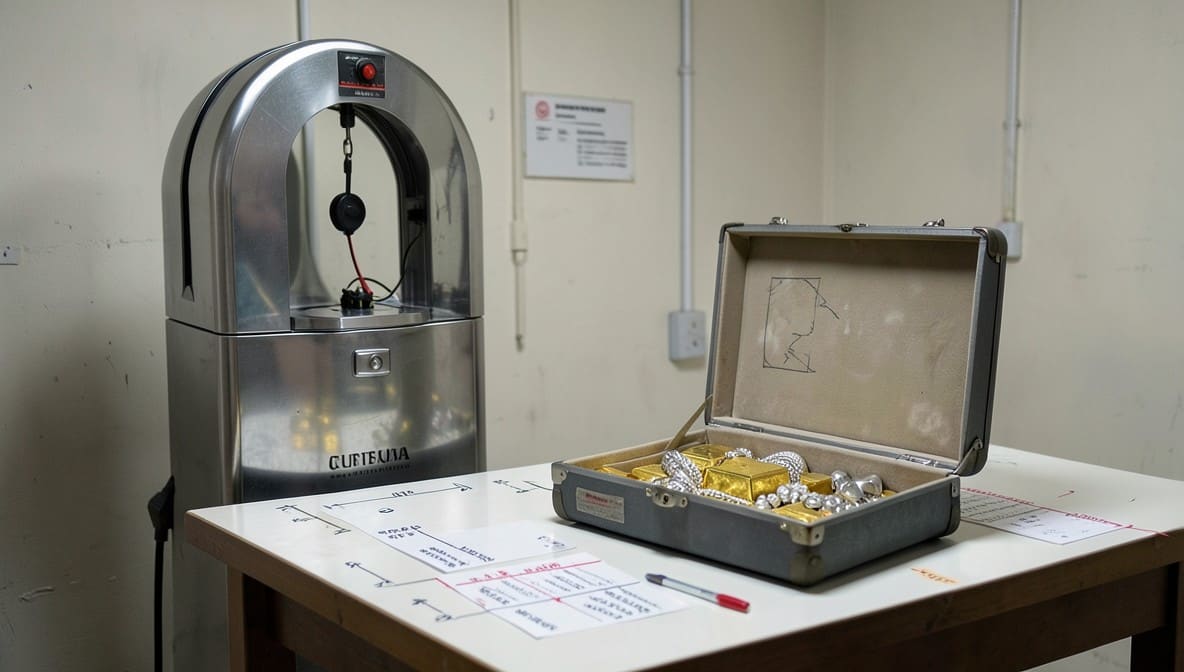
The Customs Appellate Tribunal has delivered a significant ruling clarifying the threshold for invoking the statutory presumption under Section 123 of the Customs Act, 1962. The judgment underscores that mere possession of a large quantity of gold, without objective indicia of foreign origin or seizure at a notified customs point, cannot justify shifting the burden of proof to the accused. This decision reinforces the necessity of a demonstrable, contemporaneous reasonable belief at the time of seizure.
Background & Facts
The Dispute
The dispute arose from the seizure of two gold bars weighing 1758.390 grams from Shri Dinesh Prasad, a resident of Ballia, Uttar Pradesh, on 17.07.2022 while he was travelling by train from Kolkata to Ballia. The Directorate of Revenue Intelligence (DRI) intercepted him based on intelligence suggesting he was carrying smuggled gold. The gold was recovered from his person, wrapped in carbon paper, newspaper, and adhesive tape, and concealed using a specially tailored waist belt. No foreign markings, refinery stamps, serial numbers, or other distinguishing features indicative of import were found on the bars.
Key Facts
- The gold bars weighed 937.220 grams and 821.170 grams respectively, aggregating to 1758.390 grams.
- The Chemical Laboratory, Kolkata, confirmed the purity of the gold as 99.8% in its report dated 05.09.2022.
- The DRI recorded Shri Dinesh Prasad’s statements under Section 108 of the Customs Act on 17.07.2022 and 18.07.2022.
- On 26.07.2022, Shri Raj Kumar Soni, proprietor of M/s. R.S. Jewellers, Ballia, claimed ownership of the seized gold, asserting it was lawfully procured and entrusted to Shri Dinesh Prasad for transportation to Kolkata for jewellery crafting.
- Shri Soni submitted the following documents: GST Registration Certificate, PAN details, GSTR-1 and GSTR-3B returns, Stock Summary (01.04.2022 - 23.07.2022), Stock Item Register, and Melting Invoices No. 53 and 54 dated 14.07.2022.
- The melting invoices showed procurement of 299.500 grams from M/s. Brij Jewellery and 1563.490 grams (565.448 + 998.042) from M/s. Mahalaxmi Dharamkanta, totaling 1862.990 grams.
- The aggregate weight of the two melted bars (1758.390 grams) exactly matched the seized gold.
- Searches at Shri Dinesh Prasad’s residence and M/s. R.S. Jewellers’ premises yielded no incriminating material.
- The Revenue alleged the gold was of Bangladeshi origin, but no physical, documentary, or forensic evidence supported this claim.
Procedural History
- 17.07.2022: Seizure of gold bars at Kolkata Railway Station, Coach S-3, Seat 51, on Train No. 13121 (KOAA-GCT Express).
- 17.07.2022: Shri Dinesh Prasad served with summons under Section 108 of the Customs Act.
- 18.07.2022: Second statement recorded under Section 108.
- 26.07.2022: Claim letter submitted by Shri Raj Kumar Soni with supporting documents.
- 05.09.2022: Chemical Laboratory report confirming 99.8% purity.
- 09.01.2023: Show Cause Notice issued proposing confiscation under Sections 111(b), 111(d), 119 and penalties under Sections 112(a)/(b) and 114AA.
- 21.03.2025: Order-in-Original passed by Assistant Commissioner of Customs, Kolkata, ordering absolute confiscation and penalties of Rs. 9,00,000 each under Section 112 and Rs. 9,00,000 under Section 114AA against Shri Raj Kumar Soni.
- 30.03.2026: Commissioner of Customs (Appeals) upheld confiscation but reduced penalties to Rs. 2,00,000 (Shri Dinesh Prasad) and Rs. 6,00,000 + Rs. 3,00,000 (Shri Raj Kumar Soni).
- 24.06.2026: Hearing before CESTAT Eastern Zonal Bench, Kolkata.
- 02.07.2026: Final order passed by CESTAT.
The Parties' Positions
Appellants (Shri Dinesh Prasad and Shri Raj Kumar Soni):
- Argued that the seizure lacked reasonable belief under Section 110, as the gold bore no foreign markings.
- Contended that the purity of 99.8% does not indicate foreign origin, as domestic gold can attain similar purity.
- Asserted that the documentary evidence (GST returns, invoices, stock registers) established lawful acquisition and legitimate business activity.
- Emphasized that the burden under Section 123 could not be triggered without a valid foundation of reasonable belief.
- Challenged the admissibility of statements under Section 108 and Section 138B, citing lack of cross-examination and corroboration.
- Relied on Om Sai Trading Company v. Union of India, Madhukar Sonaba Bhagat v. Commissioner of Customs, and Samir Kumar Roy v. Commissioner of Customs.
Respondent (Commissioner of Customs):
- Contended that the quantity of gold, concealment method, and absence of documents at the time of seizure indicated smuggling.
- Alleged that the invoices and stock records were fabricated, based on uncorroborated statements from third parties.
- Asserted that the gold’s origin was Bangladeshi, citing intelligence inputs.
- Relied on Commissioner of Customs v. Anil Kumar Soni and State of Gujarat v. Mohanlal Jitamalji Porwal.
- Argued that the burden under Section 123 was discharged by the appellants’ failure to prove lawful origin.
Relief Sought
The appellants sought:
- Setting aside of the confiscation order under Sections 111(b), 111(d), and 119.
- Quashing of penalties imposed under Sections 112 and 114AA.
- Return of the seized gold bars.
- Costs of litigation.
The Legal Issue
The central question was whether the Revenue had established a reasonable belief under Section 110 of the Customs Act, 1962 to trigger the statutory presumption under Section 123, where the seized gold bore no foreign markings, was intercepted in a town area, and no independent evidence linked it to smuggling.
Arguments Presented
For the Appellant
The appellants contended that the foundational requirement for invoking Section 123 - a reasonable belief at the time of seizure - was absent. The gold had no foreign inscriptions, the seizure occurred in a non-border town, and the purity report (99.8%) did not establish foreign origin. The documentary evidence - GST returns, invoices, stock registers - established a legitimate business chain. The Revenue’s reliance on uncorroborated statements under Section 108 and Section 138B violated natural justice. The Tribunal’s own precedents in Madhukar Sonaba Bhagat and Om Sai Trading Company held that mere suspicion cannot substitute objective evidence.
For the Respondent
The Revenue argued that the large quantity of gold, its concealment, and the failure to produce documents at the time of interception raised a strong inference of smuggling. The statements from third-party gold suppliers, though untested, were sufficient to discredit the appellants’ documents. The Revenue relied on the intelligence input and the absence of any legitimate export-import documentation to infer illicit import. It contended that the burden under Section 123 had shifted and remained unmet.
The Court's Analysis
The Tribunal conducted a meticulous review of the legal and factual prerequisites for invoking Section 123. It held that the statutory presumption under Section 123 is not automatic; it is contingent upon the existence of a reasonable belief at the precise moment of seizure. The Court emphasized that such belief must be grounded in objective, contemporaneous facts, not retrospective assumptions.
"The existence of such reasonable belief is, therefore, not a matter of formality but a foundational fact, the absence whereof would render the statutory presumption incapable of being invoked."
The Court noted that the gold bars bore no foreign markings, refinery stamps, or serial numbers. The seizure occurred at a railway station in Kolkata, not at a notified port or border checkpoint. The Chemical Laboratory’s report confirming 99.8% purity was held to be neutral - domestic gold can achieve the same purity, and no evidence was presented to show that 99.8% purity is exclusive to smuggled gold.
The Tribunal further held that the Revenue’s reliance on statements under Section 108 and Section 138B was legally defective. Section 138B mandates that statements of third parties must be recorded as evidence, the maker must be examined as a witness, and the accused must be afforded cross-examination. None of these safeguards were followed. The statements from the proprietors of M/s. Brij Jewellery and M/s. Mahalaxmi Dharamkanta, while expressing reservations, did not deny the underlying transactions. The invoices were corroborated by the stock registers and the exact match of weights (1758.390 grams) between the melted gold and seized bars.
"The mathematical correspondence between the contemporaneous commercial records and the seized goods constitutes a relevant circumstance lending prima facie support to the appellants' explanation, which, in our considered view, cannot be ignored."
The Court rejected the Revenue’s allegation of a "systematic smuggling syndicate" as unsupported by any independent evidence - no financial trail, call data, or forensic analysis was presented. The Tribunal cited Om Sai Trading Company to affirm that suspicion cannot substitute proof, especially in confiscatory proceedings.
The Court also held that penalties under Section 112 are consequential upon confiscation. Since the confiscation order failed, the penalties could not survive. Similarly, Section 114AA requires proof of deliberate falsification, which was not established.
The Verdict
The appeals were allowed. The order of absolute confiscation of 1758.390 grams of gold under Sections 111(b), 111(d), and 119 of the Customs Act, 1962, was set aside. The penalties of Rs. 2,00,000 imposed on Shri Dinesh Prasad and Rs. 6,00,000 and Rs. 3,00,000 imposed on Shri Raj Kumar Soni under Sections 112 and 114AA respectively were also set aside. The seized gold bars are to be returned to the appellants. The order dated 30.03.2026 of the Commissioner of Customs (Appeals) and the order dated 21.03.2025 of the Assistant Commissioner of Customs are quashed.
What This Means For Similar Cases
Reasonable Belief Must Be Objective and Contemporaneous
- Practitioners must challenge seizures where no physical indicia of smuggling (e.g., foreign markings, customs stamps, import documents) exist at the time of seizure.
- The burden under Section 123 cannot be invoked based on quantity alone, concealment, or post-seizure intelligence.
- Courts will scrutinize whether the belief was formed at the moment of seizure, not retrospectively.
Documentary Evidence Must Be Evaluated on Its Own Merits
- GST returns, stock registers, and invoices with matching weights and dates carry substantial evidentiary weight.
- Mere suspicion of forgery without forensic testing, handwriting analysis, or expert opinion is insufficient to reject documents.
- Mathematical correspondence between procurement records and seized goods is a powerful corroborative factor.
Section 138B Compliance Is Mandatory
- Statements of third parties under Section 138B cannot be used as substantive evidence unless the maker is examined as a witness and cross-examination is permitted.
- Failure to comply renders such statements inadmissible and invalidates the Revenue’s case.
- Practitioners must raise this objection at the earliest opportunity to preserve the right to challenge evidentiary admissibility.
Penalty Under Section 114AA Requires Proven Intent
- Section 114AA is quasi-criminal and requires proof of deliberate falsification.
- Absence of forensic evidence of forgery negates the application of this provision.
- The Revenue must prove conscious intent - mere inconsistency or delay in document production is not enough.