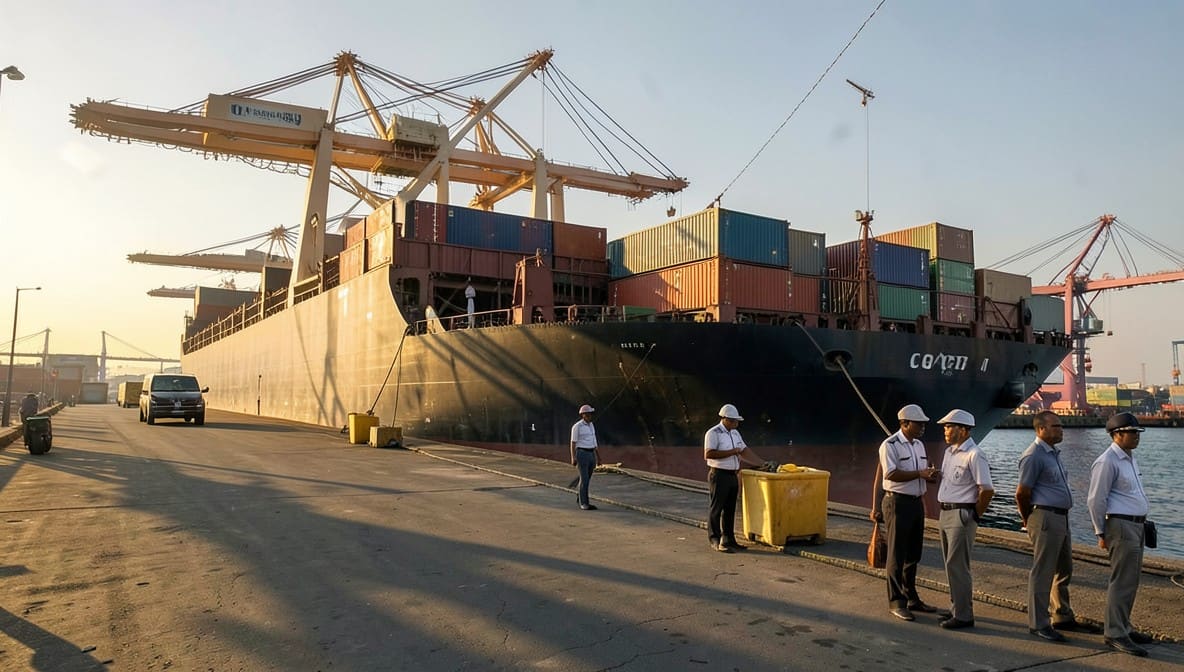
The Chennai Regional Bench of the Customs, Excise and Service Tax Appellate Tribunal has delivered a pivotal ruling clarifying the classification of voyage charter agreements under the Finance Act, 1994. The decision definitively excludes such arrangements from the taxable category of 'Supply of Tangible Goods for Use Service', reinforcing that the essence of the transaction must govern classification, not contractual form.
Background & Facts
The Dispute
The Appellant, M/s. Vedanta Ltd. (formerly Sesa Sterlite Ltd.), is engaged in the manufacture of copper cathodes and related products. During the period from 16.05.2008 to 31.08.2009, the Appellant entered into 23 voyage charter agreements with foreign vessel owners for the transportation of coastal goods between Indian ports, and in five instances, from foreign ports to India. The Department of Central Excise assessed service tax under the reverse charge mechanism, treating these arrangements as 'Supply of Tangible Goods for Use Service' under Section 65(105)(zzzzj) of the Finance Act, 1994. The demand, confirmed in the Impugned Order dated 29.05.2015, amounted to Rs. 2,42,70,786/-, along with interest and penalties under Section 78.
Key Facts
- The Appellant engaged in 23 voyage charter arrangements between 16.05.2008 and 31.08.2009
- Five voyages originated from foreign ports and were not taxable under Indian service tax law during the period
- Eighteen voyages were coastal, transporting goods between Indian ports
- Consideration was paid as freight, calculated per metric ton of cargo transported
- Vessels were operated by owners' crews; Appellant had no control over navigation, crew, or vessel operations
- Bills of Lading were issued by vessel owners for each cargo shipment
- No separate hire charges for vessel use were invoiced or paid
- The Appellant maintained proper books of account and disclosed transactions in statutory records
- The Department conducted multiple audits between 2005 and 2011, including by the Accountant General (CERA) and Internal Audit Division (IAD)
- The Show Cause Notice was issued on 18.10.2013, over four years after the end of the relevant period
Procedural History
- 16.05.2008 to 31.08.2009: Period of voyage charter agreements
- 18.10.2013: Show Cause Notice issued under Section 73(1) invoking extended period of limitation
- 29.05.2015: Impugned Order passed by Commissioner of Central Excise, Tirunelveli, confirming service tax demand of Rs. 2,42,70,786/-, interest and penalties
- 2015: Appeal filed before the Customs, Excise and Service Tax Appellate Tribunal (CESTAT), Chennai Regional Bench
- 19.03.2026: Hearing concluded
- 25.06.2026: Final Order pronounced
Relief Sought
The Appellant sought: (1) quashing of the Impugned Order dated 29.05.2015; (2) deletion of service tax demand of Rs. 2,42,70,786/-; (3) cancellation of interest and penalties; and (4) declaration that voyage charter arrangements constitute transportation of goods and are not taxable under 'Supply of Tangible Goods for Use Service'.
The Legal Issue
The central question was whether voyage charter agreements for coastal transportation of goods, where the vessel owner retains operational control and crew, constitute 'Supply of Tangible Goods for Use Service' under Section 65(105)(zzzzj) of the Finance Act, 1994, or whether they fall within the exempt category of 'Transportation of Goods' under Section 65(105)(zzzzl).
Arguments Presented
For the Appellant
The Appellant contended that the agreements were voyage charters, not time charters, and thus constituted contracts of carriage. It emphasized that the vessels were never placed at its disposal, no right to use or control was transferred, and consideration was strictly freight-based on cargo tonnage. Reliance was placed on Union of India v. Gosalia Shipping Pvt. Ltd. and Core Minerals v. CST, Chennai, both holding that voyage charters are transportation services. It further argued that the Department had consistently treated similar arrangements as transportation services in subsequent periods, making the classification inconsistent and arbitrary. On limitation, it asserted that the issue was interpretational, with no suppression or intent to evade, rendering the extended period inapplicable.
For the Respondent
The Revenue contended that the contractual terms - demurrage, dead freight, exclusive use clauses, and port expenses - indicated that the vessel was effectively made available to the Appellant. It relied on BSNL v. Union of India to argue that the five-fold test for 'supply of tangible goods for use' was satisfied, even without transfer of legal possession. It further alleged suppression of facts due to non-disclosure in returns and invoked extended limitation under Section 73(1) proviso, seeking to uphold penalties under Sections 77 and 78.
The Court's Analysis
The Tribunal undertook a detailed examination of the statutory framework, contractual terms, and judicial precedents. It emphasized that Section 65(105)(zzzzj) requires the transfer of the right to use tangible goods without transfer of possession or effective control. The Tribunal held that the decisive test is whether the recipient obtains the ability to use the goods to the exclusion of the owner.
"The vessels remained under the command, possession and operational control of the owners, who provide the crew and are responsible for navigation, seaworthiness and overall management. The appellant does not acquire any independent right to use, deploy, sub-let or otherwise commercially exploit the vessels."
The Tribunal noted that Bills of Lading, freight-based invoicing, and the absence of any hire charges confirmed the transaction's nature as carriage of goods. It distinguished BSNL v. Union of India, observing that the case concerned transfer of right to use telecommunication equipment, not maritime transport. The Tribunal further held that incidental clauses such as demurrage and dead freight are standard in maritime contracts and do not alter the fundamental character of a voyage charter.
"In order to understand, entire contract has to be analyzed and such an analysis would clearly indicate that the service provided is transportation of goods and not a vessel for use. These vessels were never kept at the disposal of the appellant."
The Tribunal also relied on its own precedent in Core Minerals v. CST, Chennai, which directly addressed identical facts and held that voyage charters are transportation services. It rejected the Revenue's reliance on Caravel Logistics, noting that container leasing involves different factual matrix and control dynamics.
On limitation, the Tribunal held that the Department failed to establish suppression or wilful misstatement. The Appellant’s transactions were disclosed in books and subject to multiple audits. The issue was one of statutory interpretation, not concealment. Since the Show Cause Notice was issued on 18.10.2013, beyond the normal limitation period of one year from the end of the financial year, and the extended period was not applicable, the entire demand was barred by limitation.
The Verdict
The Appellant succeeded. The Impugned Order dated 29.05.2015 is set aside. The service tax demand of Rs. 2,42,70,786/-, along with all interest and penalties under Sections 77 and 78 of the Finance Act, 1994, is cancelled. The Tribunal held that voyage charter agreements for coastal transportation of goods constitute 'Transportation of Goods' under Section 65(105)(zzzzl) and are not taxable as 'Supply of Tangible Goods for Use Service'. The demand is barred by limitation under Section 73(1) and no extended period applies. No further relief is required.
What This Means For Similar Cases
Voyage Charters Are Not Supply of Goods
- Practitioners must now argue that any arrangement where the vessel owner retains operational control, provides crew, and charges freight based on cargo tonnage is a transportation service, not a supply of tangible goods
- Contracts with demurrage, dead freight, or exclusive use clauses do not automatically convert into 'supply of goods' if control remains with the owner
- The burden lies on the tax authority to prove transfer of right to use, not merely the existence of commercial terms
Limitation and Suppression Require Clear Evidence
- Mere non-declaration in returns does not constitute suppression if transactions are recorded in books and subject to audit
- Interpretational disputes, even if later resolved against the assessee, cannot trigger extended limitation unless wilful evasion is proven
- Tax authorities must produce specific evidence of concealment - not just non-disclosure - to invoke Section 73(1) proviso
Classification Must Be Consistent Over Time
- Tax authorities cannot reclassify the same activity differently for past periods without a change in law or facts
- Past acceptance of a classification by the Department (e.g., treating similar voyages as transportation in later years) creates estoppel and undermines retrospective reclassification
- Consistency in classification is a principle of natural justice and fair administration