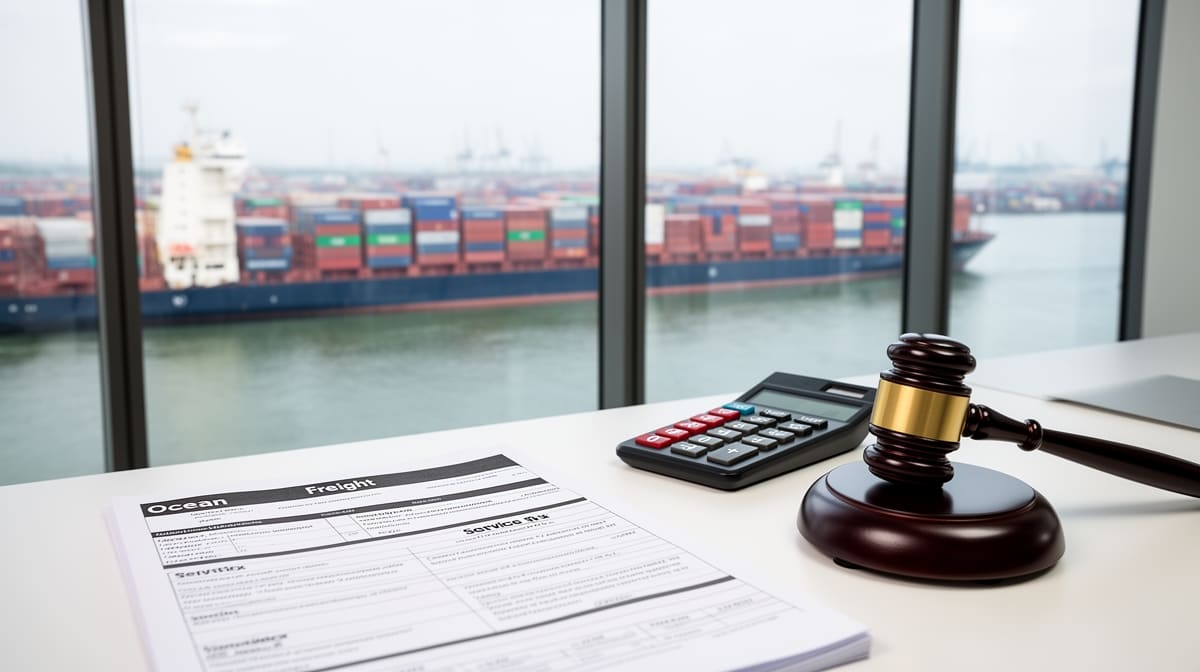
The Customs, Excise and Service Tax Appellate Tribunal (CESTAT), Chandigarh, has delivered a significant ruling clarifying that markup earned on purchase and resale of ocean freight space on a principal-to-principal basis does not constitute a taxable 'Business Support Service' under the Finance Act, 1994. The judgment reinforces that mere profit from trading activity cannot be artificially classified as a service, particularly when the statutory framework excludes ocean freight from taxable services.
Background & Facts
The Dispute
The appellant, M/s Freightways, a freight forwarder based in Jalandhar, Punjab, was engaged in the business of booking cargo space, freight forwarding, and logistics services. The appellant purchased cargo space from shipping lines in bulk and resold it to exporters at a marked-up price, taking responsibility for coordinating logistics, ensuring timely loading, and delivery of cargo. The appellant was registered under the Service Tax department and regularly filed returns.
Key Facts
- The appellant’s income was categorized under four heads: Freight Inwards, Freight Inwards (Service Tax), Commission Received (Service Tax), and Rent Received
- Service tax was duly discharged on three heads: Commission Received, Rent Received, and Freight Inwards (Service Tax) (covering Terminal Handling Charges, Inland Haulage Charges, and Bill of Lading Charges)
- Revenue disputed the income under Freight Inwards, which represented the purchase and subsequent sale of ocean freight at a marked-up value
- Revenue alleged this markup constituted consideration for Business Support Service (pre-01.07.2012) or a declared service (post-01.07.2012), leading to non-payment of service tax
Procedural History
The dispute arose from an audit conducted for the period September 2008 to September 2013, during which Revenue observed discrepancies between the appellant’s ST-3 returns and balance sheets. Three Show Cause Notices were issued:
- 03.04.2014: Covering September 2008 to September 2013
- 17.04.2015: Covering October 2013 to September 2014
- 21.09.2016: Covering October 2014 to June 2015
The proposals in these notices were confirmed, along with penalties, vide Order-in-Original No. JAL-EXCUS-000-COM-003-005-20-21 dated 22.05.2020 passed by the Commissioner of CGST, Ludhiana. Aggrieved, the appellant filed Service Tax Appeal No. 60243 of 2020 before CESTAT, Chandigarh.
The Parties' Positions
Appellant’s Contentions
- The transaction was conducted on a principal-to-principal basis, and the markup represented business profit, not consideration for a service
- Ocean freight was never classified as a taxable service under Section 65(105) of the Finance Act, 1994, either before or after the negative list regime (effective 01.07.2012)
- Under the Place of Provision of Services Rules, 2012, the place of provision for transportation of goods (other than mail/courier) was the destination of goods; since the destination was outside India, the service was not taxable
- Circular No. 197/7/2016-Service Tax dated 12.08.2016 clarified that no service tax was leviable on ocean freight for export cargo when the freight forwarder acted as a principal
- The impugned order contradicted itself by alleging the appellant was both not a pure agent (due to markup) and rendering ancillary services (to justify the markup)
- Revenue had dropped proceedings against similarly placed assessees (M/s Allianz Sea Air Logistics Company and M/s Immaculate Logistics) in the same Commissionerate, leading to discriminatory treatment
- The invocation of extended limitation under Section 73(1) was unsustainable, as the issue was interpretational and lacked willful suppression of facts
Respondent’s Contentions
- The markup charged by the appellant constituted consideration for composite support services, including door-step pickup, local transportation, cargo handling, and facilitation activities
- The appellant was not a pure agent, as it issued independent invoices to clients and availed Cenvat credit on input services
- Section 67(1) of the Finance Act, 1994, provided that the gross amount charged for a service was the taxable value, and Rule 5(2) of the Service Tax (Determination of Value) Rules, 2006 excluded only pure agents from this ambit
- CBEC Circular No. 119/13/2009-ST dated 21.12.2009 clarified that if a Customs House Agent (CHA) included any markup, the entire charge (not just the markup) was taxable
Relief Sought
The appellant sought setting aside of the impugned order and a declaration that:
- The markup on ocean freight was not taxable as it represented business profit, not consideration for a service
- The demand of service tax, interest, and penalties was unsustainable
- The invocation of extended limitation was bad in law
The Legal Issue
The central question was whether the markup earned on purchase and resale of ocean freight space on a principal-to-principal basis constituted consideration for a taxable service (specifically Business Support Service or a declared service) under the Finance Act, 1994, thereby attracting service tax liability.
Arguments Presented
For the Appellant
-
Principal-to-Principal Transaction: The appellant submitted that it purchased cargo space from shipping lines and resold it to exporters on its own account, not as an agent. The invoices raised by shipping lines on the appellant and the corresponding invoices raised by the appellant on exporters (with markup) established this. Had the appellant acted as an agent, shipping lines would have directly invoiced exporters, and the appellant would have earned only agency commission.
-
Statutory Exclusion of Ocean Freight: Under the pre-negative list regime, the Finance Act, 1994, specified taxable services for transportation of goods by air (Section 65(105)(zzn)), road (Section 65(105)(zzp)), pipeline/conduit (Section 65(105)(zzz)), rail (Section 65(105)(zzzp)), and inland water (Section 65(105)(zzzzl)). Ocean freight was conspicuously absent, and thus could not be artificially brought under general categories like Business Support Service.
Under the negative list regime (post-01.07.2012), Section 66B made only services provided in the taxable territory taxable. Rule 10 of the Place of Provision of Services Rules, 2012 provided that for transportation of goods (other than mail/courier), the place of provision was the destination of goods. Since export cargo’s destination was outside India, the service was deemed provided outside the taxable territory and thus non-taxable.
-
Clarificatory Circulars: The appellant relied on Circular No. 197/7/2016-Service Tax dated 12.08.2016, which clarified that when a freight forwarder acted as a principal for transportation of goods outside India, no service tax was leviable as the destination was outside India. The Taxation of Services: An Education Guide (Para 5.9.6) further clarified that bundled services (e.g., domestic transportation + international freight) were treated as transportation of goods, and since the destination was outside India, they were non-taxable.
-
No Business Support Service: The appellant argued that Business Support Service (BSS) required outsourcing of services by the client (exporter). Since exporters were not engaged in transportation services, they could not have outsourced such services to the appellant. The department’s allegation that the appellant provided logistics, cargo handling, and facilitation services was baseless and unsupported by evidence.
-
Discriminatory Treatment: The appellant highlighted that the same Commissionerate had dropped proceedings against M/s Allianz Sea Air Logistics Company (Order dated 12-13.02.2020) and M/s Immaculate Logistics (Order dated 04.06.2020), leading to violation of Article 14 of the Constitution (Damodar J. Malpani v. CCE, 2002 (146) ELT 483 (SC)).
-
Extended Limitation Unjustified: The appellant contended that the invocation of extended limitation under Section 73(1) was unsustainable, as the issue was interpretational and lacked willful suppression of facts. Reliance was placed on:
- Anand Nishikawa Co Ltd v. CCE, 2005 (188) ELT 149 (SC)
- Uniworth Textiles Ltd v. CCE, 2013 (288) ELT 161 (SC)
- Tamil Nadu Housing Board v. CCE, 1994 (74) ELT 9 (SC)
- Uniflex Cables Ltd v. CCE, 2011 (271) ELT 161 (SC)
- Vijay Television (P) Ltd v. CCE, CMA No. 3292 of 2009 (Madras HC)
The Commissioner’s acceptance of reasonable cause under Section 80 (refraining from imposing penalty under Section 78) further undermined the allegation of suppression with intent to evade tax.
For the Respondent
-
Composite Service Provision: The respondent argued that the markup charged by the appellant was consideration for composite support services, including local transportation, cargo handling, and facilitation activities. These services were not billed separately but included in the ocean freight markup.
-
Not a Pure Agent: The appellant was not a pure agent, as it issued independent invoices to clients and availed Cenvat credit on input services. Section 67(1) of the Finance Act, 1994, provided that the gross amount charged for a service was the taxable value, and Rule 5(2) of the Service Tax (Determination of Value) Rules, 2006 excluded only pure agents from this ambit.
-
CBEC Circular: The respondent relied on CBEC Circular No. 119/13/2009-ST dated 21.12.2009, which clarified that if a CHA included any markup, the entire charge (not just the markup) was taxable.
The Court's Analysis
The Tribunal conducted a multi-pronged analysis, examining the nature of the transaction, statutory provisions, clarificatory circulars, and precedents.
Principal-to-Principal Basis
The Tribunal observed that the appellant’s transaction was undisputedly on a principal-to-principal basis. The appellant:
- Purchased cargo space in bulk from shipping lines
- Sold the space to exporters at a marked-up price
- Issued independent invoices to clients
- Availed Cenvat credit on input services
- Bore the risk of unsold space (no recovery of losses from exporters)
The Tribunal emphasized that profit is the inherent motive in buying and selling, and the markup could not be artificially construed as consideration for a service. The impugned order’s assumption that the markup was attributable to ancillary services (e.g., local transportation, cargo handling) was unsupported by evidence.
Statutory Framework and Circulars
The Tribunal reiterated that ocean freight was never classified as a taxable service under the Finance Act, 1994. Under the negative list regime, Section 66B taxed only services provided in the taxable territory, and Rule 10 of the Place of Provision of Services Rules, 2012 deemed the place of provision as the destination of goods. Since export cargo’s destination was outside India, the service was non-taxable.
The Tribunal relied on Circular No. 197/7/2016-Service Tax dated 12.08.2016, which clarified that when a freight forwarder acted as a principal for transportation of goods outside India, no service tax was leviable. The Taxation of Services: An Education Guide (Para 5.9.6) further supported this, stating that bundled services (e.g., domestic transportation + international freight) were treated as transportation of goods, and since the destination was outside India, they were non-taxable.
Precedents Applied
The Tribunal placed heavy reliance on binding precedents, including:
"Seagull Maritime Agencies Pvt Ltd, 2024 (12) TMI 677 - CESTAT New Delhi: The Principal Bench held that buying and selling of cargo space does not amount to rendering a service, and any profit/income from such transactions is not leviable to service tax."
"Blue Moon Logistics (P) Ltd, 2024 (3) TMI 285 - CESTAT Allahabad: The Allahabad Bench held similarly, and the Supreme Court upheld the order, settling the issue.
"Phoenix International Freight Service Pvt. Ltd.: The Tribunal held that buying and selling space on ships does not amount to rendering a service, and any profit/income from such transactions is not taxable.
The Tribunal also cited CBEC Circular No. 197/7/2016, which distinguished between:
- Agent/Intermediary: Facilitates transportation but does not provide it on its own account (taxable under Rule 9 of POPS Rules, 2012)
- Principal: Provides transportation service on its own account (non-taxable for export cargo)
The appellant fell under the latter category, as it purchased and sold space on its own behalf, not as an intermediary.
Contradictions in the Impugned Order
The Tribunal highlighted multiple contradictions in the impugned order:
- Markup as Profit vs. Service: The order assumed the markup was for ancillary services without evidence, defying basic business logic that profit is the motive in trading.
- Status of Appellant: The order vacillated between alleging the appellant was not a pure agent (due to markup) and rendering ancillary services (to justify the markup).
- Bundled Services: If the services were bundled, the principal service (ocean freight) was non-taxable, and ancillary services assumed its character.
- Intermediary vs. Principal: The order failed to establish that the appellant was an intermediary (as defined under Rule 2(1) of POPS Rules, 2012), which excludes a person providing services on their own account.
- Discriminatory Treatment: The same Commissionerate had dropped proceedings against similarly placed assessees, leading to arbitrary treatment.
Extended Limitation
The Tribunal noted that the invocation of extended limitation was unsustainable, as the issue was interpretational and lacked willful suppression of facts. The Commissioner’s acceptance of reasonable cause under Section 80 further weakened the allegation of suppression with intent to evade tax.
The Verdict
The Tribunal allowed the appeal and set aside the impugned order dated 22.05.2020. The key holdings were:
- The markup on ocean freight purchased and resold on a principal-to-principal basis did not constitute consideration for a taxable service
- Ocean freight was never classified as a taxable service under the Finance Act, 1994, and the Place of Provision of Services Rules, 2012 excluded export cargo from taxability
- The appellant’s transaction was not an intermediary service, and the markup represented business profit, not service consideration
- The demand of service tax, interest, and penalties was unsustainable and liable to be set aside
What This Means For Similar Cases
Principal-to-Principal Transactions Are Not Taxable Services
- Trading Activity ≠ Service: Mere purchase and resale of goods/services (e.g., cargo space) on a principal-to-principal basis does not constitute a taxable service, even if a markup is earned. The Tribunal reiterated that profit is the inherent motive in trading, and Revenue cannot artificially reclassify it as service consideration.
- Evidentiary Burden: Revenue must prove with evidence that ancillary services (e.g., cargo handling, local transportation) were actually rendered and billed separately. Assumptions without evidence (as in the impugned order) will not suffice.
Ocean Freight and Export Cargo: Non-Taxable Under POPS Rules
- Destination-Based Taxability: Under Rule 10 of the Place of Provision of Services Rules, 2012, the place of provision for transportation of goods (other than mail/courier) is the destination of goods. For export cargo, the destination is outside India, rendering the service non-taxable.
- Circulars Binding: Circular No. 197/7/2016-Service Tax dated 12.08.2016 and the Taxation of Services: An Education Guide (Para 5.9.6) clarify that freight forwarders acting as principals for export cargo are not liable for service tax. Revenue cannot ignore binding circulars in proceedings.
Precedents and Consistency in Adjudication
- Binding Precedents: The Tribunal’s reliance on Seagull Maritime Agencies, Blue Moon Logistics, and Phoenix International Freight Service establishes that buying and selling cargo space is not a taxable service. Assessees can directly cite these precedents to challenge similar demands.
- Non-Discrimination: Revenue cannot discriminate between similarly placed assessees. If proceedings are dropped against one assessee, consistency demands that others in identical situations should also benefit. Arbitrary treatment violates Article 14 of the Constitution.
Extended Limitation: Interpretational Issues Cannot Invoke Section 73(1)
- No Willful Suppression: Where the issue is interpretational (e.g., whether ocean freight markup is taxable), extended limitation under Section 73(1) cannot be invoked without proof of willful suppression. The Tribunal relied on Anand Nishikawa, Uniworth Textiles, and Tamil Nadu Housing Board to underscore this.
- Section 80 and Reasonable Cause: If the Commissioner accepts reasonable cause under Section 80 (refraining from imposing penalty under Section 78), the allegation of suppression with intent to evade tax cannot simultaneously survive for invoking extended limitation.