The Customs, Excise and Service Tax Appellate Tribunal (CESTAT), Delhi has dismissed seventeen appeals filed by M/s Mitsubishi Electric Automotive India Pvt. Ltd., upholding the classification of Electronic Control Unit for Electronic Power Steering (EPS-ECU) and its parts under Customs Tariff Heading (CTH) 8708 94 00. The Tribunal relied on its earlier binding precedent involving the same appellant, rejecting arguments for classification under alternative headings such as CTH 8537, 8543, or 9032. This judgment reinforces the principle that automotive electronic components designed specifically for use in vehicle steering systems must be classified under the specific tariff heading for automotive parts, rather than general electronic apparatus headings.
Background & Facts
The Dispute
The appellant, M/s Mitsubishi Electric Automotive India Pvt. Ltd., imported Electronic Control Units for Electronic Power Steering (EPS-ECU) and parts thereof between April 2025 and July 2025 under various Bills of Entry. The appellant classified these goods under CTH 8708 94 00, 8504 5090, or alternative headings, while the customs department assessed them under CTH 8708 94 00, resulting in differential duty demands. The appellant paid the demanded duty under protest and filed appeals before the Commissioner of Customs (Appeals), which were dismissed, leading to the present appeals before CESTAT.
Key Facts
- The appellant imported EPS-ECU and parts during April 2025 to July 2025 under 17 Bills of Entry, details of which are tabulated below:
| Sr. No. | Appeal Number | Bill of Entry and Date | Total Duty Paid | Duty Paid Under Protest |
|---|---|---|---|---|
| 1 | C/50049/2026 | 9890936 dt 06.05.2025 | 404,784 | 176,227 |
| 2 | C/50050/2026 | 3100083 dt 07.07.2025 | 436,921 | 190,219 |
| 3 | C/50051/2026 | 9872745 dt 05.05.2025 | 1,423,484 | 822,885 |
| 4 | C/50052/2026 | 3188426 dt 11.07.2025 | 339,392 | 206,189 |
| 5 | C/50053/2026 | 2298963 dt 06.05.2025 | 872,755 | 552,934 |
| 6 | C/50054/2026 | 2471425 dt 06.05.2025 | 80,258 | 34,941 |
| 7 | C/50055/2026 | 3330518 dt 18.07.2025 | 261,190 | 113,712 |
| 8 | C/50056/2026 | 2674211 dt 16.06.2025 | 3,796 | 1,652 |
| 9 | C/50057/2026 | 9307110 dt 05.04.2025 | 687,382 | 392,244 |
| 10 | C/50058/2026 | 2880810 dt 01.07.2025 | 89,721 | 39,061 |
| 11 | C/50059/2026 | 2298374 dt 27.05.2025 | 377,154 | 164,199 |
| 12 | C/50060/2026 | 9307095 dt 05.04.2025 | 760,722 | 420,597 |
| 13 | C/50061/2026 | 9821789 dt 02.05.2025 | 1,304,300 | 800,018 |
| 14 | C/50062/2026 | 3188432 dt 11.07.2025 | 2,063,786 | 1,307,512 |
| 15 | C/50063/2026 | 9581873 dt 19.04.2025 | 259,461 | 112,959 |
| 16 | C/50064/2026 | 2673487 dt 16.06.2025 | 828,477 | 519,803 |
| 17 | C/50068/2026 | 9472172 dt 14.05.2025 | 261,854 | 114,001 |
- The appellant initially classified the goods under CTH 8708 94 00/8504 5090, but the department reclassified them under CTH 8708 94 00.
- The appellant argued for classification under CTH 8537 10 00, 8543 70 99, or 9032 89 10, citing the goods' electronic nature and function.
- The department contended that EPS-ECU and its parts are integral to the Electric Power Steering system of automobiles and thus classifiable under CTH 8708 94 00 (Steering wheels, steering columns, steering boxes, and parts thereof).
Procedural History
- 30.06.2017: Department issued a letter pointing out misclassification.
- April 2025 - July 2025: Appellant imported EPS-ECU and parts under various Bills of Entry.
- Assessment Orders: Differential duty demanded under CTH 8708 94 00.
- Duty Payment: Appellant paid differential duty under protest.
- 03.10.2025: Commissioner of Customs (Appeals) dismissed the appeals (Order-in-Appeal No. CC(A) CUS/D-II/ICD-PPG/710-726/2025-26).
- 22.06.2026: Hearing before CESTAT.
- 01.07.2026: CESTAT dismissed all seventeen appeals.
The Parties' Positions
For the Appellant
- Argued that EPS-ECU and its parts are electronic apparatus and should be classified under CTH 8537 10 00 (electrical control boards), CTH 8543 70 99 (electrical machines with individual functions), or CTH 9032 89 10 (automatic regulating instruments).
- Relied on the Chennai Bench of CESTAT decisions in Hyundai Motors Ltd. vs Commissioner of Customs (Final Order No. 41308-41310/2024 dated 21.10.2024) and Commissioner of Customs, Chennai vs M/s. Mobis India Ltd. (Final Order No. 40800/2025 dated 07.08.2025), which held that ECUs are classifiable under CTH 9032.
- Contended that the New Delhi Bench of CESTAT decision in M/s Continental Automotive Brake Systems India Pvt. Ltd. vs Commissioner of Customs (Final Order dated 19.03.2024) was distinguishable on facts, as the ECUs in that case were different.
For the Respondent (Department)
- Argued that EPS-ECU and its parts are integral parts of the Electric Power Steering system and thus classifiable under CTH 8708 94 00 (Steering wheels, steering columns, steering boxes, and parts thereof).
- Relied on the New Delhi Bench of CESTAT decision in the appellant's own case (Final Order No. 50420-50615/2026 dated 30.03.2026), which upheld the classification under CTH 8708 94 00.
- Contended that the goods have no independent function and are designed solely for use in automobiles, meeting the criteria under Section Note 2 and 3 of Section XVII of the Customs Tariff Act, 1975.
- Argued that the Chennai Bench decisions were not binding on the New Delhi Bench and were distinguishable on facts.
Relief Sought
The appellant sought quashing of the Commissioner (Appeals)'s order dated 03.10.2025 and a direction to classify EPS-ECU and its parts under CTH 8537 10 00, 8543 70 99, or 9032 89 10, thereby setting aside the differential duty demand.
The Legal Issue
The central question before CESTAT was whether Electronic Control Units for Electronic Power Steering (EPS-ECU) and their parts are classifiable under CTH 8708 94 00 (parts of steering systems of motor vehicles) or under alternative headings such as CTH 8537 10 00 (electrical control boards), CTH 8543 70 99 (electrical machines with individual functions), or CTH 9032 89 10 (automatic regulating instruments).
Arguments Presented
For the Appellant
- EPS-ECU and its parts are electronic apparatus with individual functions, warranting classification under CTH 8537, 8543, or 9032.
- Relied on Chennai Bench decisions (Hyundai Motors and Mobis India), which held that ECUs are classifiable under CTH 9032.
- Argued that the New Delhi Bench decision in Continental Automotive was distinguishable, as the ECUs in that case were different and lacked independent functions.
- Contended that each ECU must be considered on its own merits, as ECUs vary in function and application across different machines and vehicles.
For the Respondent
- EPS-ECU and its parts are integral to the Electric Power Steering system and thus classifiable under CTH 8708 94 00.
- Relied on the binding precedent in the appellant's own case (Final Order No. 50420-50615/2026 dated 30.03.2026), which upheld the classification under CTH 8708 94 00.
- Argued that the goods lack independent function and are designed solely for automotive use, meeting the criteria under Section Note 2 and 3 of Section XVII of the Customs Tariff Act.
- Contended that the Chennai Bench decisions were not binding and were distinguishable on facts.
The Court's Analysis
The Tribunal conducted a detailed analysis of the classification dispute, relying heavily on its earlier decision in the appellant's own case (Final Order No. 50420-50615/2026 dated 30.03.2026). The key observations and reasoning are as follows:
-
Binding Precedent: The Tribunal noted that the issue had already been adjudicated in the appellant's own case, where 127 prior appeals involving identical goods were dismissed. The earlier decision held that EPS-ECU and its parts are classifiable under CTH 8708 94 00, and this decision was binding unless overturned by a higher court.
"It is observed that this Tribunal vide Final Order No. 50420-50615/2026 dated 30.03.2026 has already dealt with the identical issue. The relevant paragraphs of the said order is hereby reproduced below..."
-
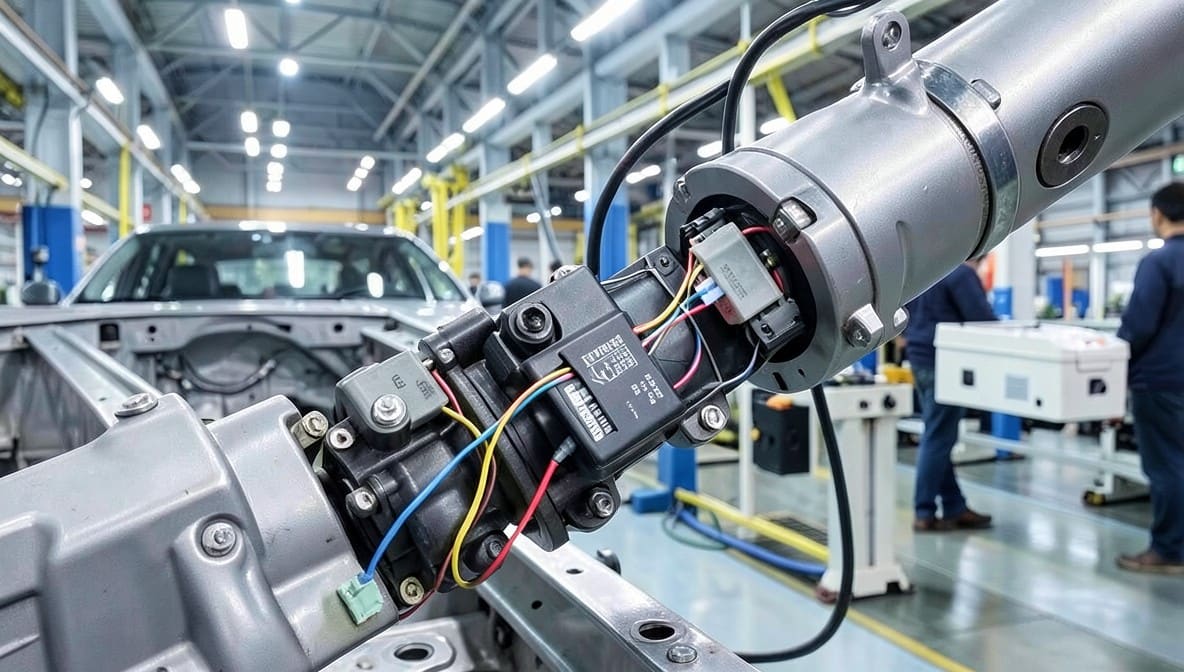
Function and Use: The Tribunal emphasized that EPS-ECU is not an independent instrument or apparatus but a part of the power steering system of automobiles. Its function is to process data from speed and torque sensors and regulate the assistance provided by the power steering, making it an integral part of the vehicle's steering system.
"EPS-ECU is not an instrument or an apparatus but is a part of the power steering system. Merely because it is in the form of a PCB and other electronic components does not change it from a part of an automobile into an instrument or apparatus."
-
Rejection of Alternative Classifications: The Tribunal rejected the appellant's arguments for classification under CTH 8537, 8543, or 9032 on the following grounds:
-
CTH 8537 10 00: EPS-ECU is not designed for electricity distribution or control, which is the primary function of goods under this heading. The Tribunal held that the mere fact that EPS-ECU processes data and interacts with a motor does not qualify it as an electrical control board.
"EPS-ECU is not designed for electricity distribution or electric control. It is a part of an automobile - specifically a part of the power steering system to decide how much assistance should be provided to the driver in steering. The mere fact that it makes this determination and intervenes between the 12-volt car battery and a small motor does not, in our considered view, make EPS-ECU into an electrical board, panel, etc."
-
CTH 8543 70 99: This heading covers electrical machines and apparatus with individual functions not specified elsewhere. The Tribunal noted that CTH 8543 includes a residual category for "other" machines, but EPS-ECU, being a specific part of an automobile with no other function, does not merit classification under this general residual entry.
"We do not find that EPS-ECU, which is essentially a part of an automobile specifically designed to be a part of power steering and which has no other function, can be classified in the general residual entry of electrical machines and equipment."
-
CTH 9032 89 10: This heading covers automatic regulating instruments. The Tribunal held that EPS-ECU does not regulate electrical quantities or control non-electrical quantities dependent on electrical phenomena. Instead, it is a microprocessor-based part of the power steering system, and thus does not qualify under this heading.
-
-
Classification of Parts: The Tribunal also addressed the classification of parts of EPS-ECU, such as covers, housings, spacers, and circuit assemblies. It rejected the appellant's arguments for classification under CTH 8538 90 00, 8538 10 90, or 8543 90 00, holding that since the EPS-ECU itself is not classifiable under the alternative headings, its parts cannot be classified under those headings either.
-
Distinguishing Chennai Bench Decisions: The Tribunal examined the Chennai Bench decisions in Hyundai Motors and Mobis India, which had classified ECUs under CTH 9032. It noted that:
- The Hyundai Motors decision was passed after the New Delhi Bench's decision in the appellant's case but without considering it, as it was not brought to the Chennai Bench's notice.
- The Hyundai Motors decision distinguished the Continental Automotive case on the ground that ECUs are generic and must be considered on their own merits, as they vary in function across different machines and vehicles.
- However, the Tribunal observed that the ECUs in the present case are identical to those in its earlier decision involving the same appellant, and thus the Chennai Bench decisions were not applicable.
-
Section Notes and General Interpretative Rules: The Tribunal relied on Section Note 2 and 3 of Section XVII of the Customs Tariff Act, which provide that:
- Parts must not be excluded by Note 2 of Section XVII.
- Parts must be suitable for use solely or principally with articles of Chapter 86 to 88.
- Parts must not be more specifically included elsewhere in the tariff.
The Tribunal held that EPS-ECU and its parts meet all three conditions, as they are designed principally for use in automobiles and are not more specifically covered elsewhere. It further applied General Interpretative Rule 2(a), which mandates that a specific heading (such as CTH 8708 94 00) should be preferred over a general heading.
"As per General Interpretative Rule 2(a), a specific heading should be preferred over a general heading. CTH 8708 94 00 under which the department classified the EPS-ECU is a more specific heading and it covers `Steering wheels, steering columns, steering boxes and parts thereof'."
-
Supreme Court Appeal: The Tribunal noted that the appellant had appealed its earlier decision to the Supreme Court, but no stay had been granted, meaning the earlier decision remained binding.
The Verdict
The Tribunal dismissed all seventeen appeals, upholding the Commissioner (Appeals)'s order dated 03.10.2025. The key holdings are:
- EPS-ECU and its parts are classifiable under CTH 8708 94 00 (Steering wheels, steering columns, steering boxes, and parts thereof).
- The differential duty demands raised by the department were correctly assessed under this heading.
- The appellant's arguments for classification under CTH 8537, 8543, or 9032 were rejected.
- The binding precedent in the appellant's own case (Final Order No. 50420-50615/2026 dated 30.03.2026) was upheld.
What This Means For Similar Cases
Specific Classification Over General Headings
- Practitioners must prioritize specific tariff headings over general ones when classifying automotive electronic components. CTH 8708 94 00 is a specific heading for parts of steering systems, and General Interpretative Rule 2(a) mandates its preference over general headings like CTH 8537, 8543, or 9032.
- Automotive parts designed for specific use in vehicles (e.g., power steering systems) cannot be classified under general electronic apparatus headings merely because they contain electronic components.
Binding Precedent and Tribunal Decisions
- CESTAT benches are bound by their own earlier decisions involving the same parties and goods, unless overturned by a higher court. In this case, the New Delhi Bench's earlier decision in the appellant's own case was binding, despite contrary decisions by the Chennai Bench.
- Distinguishing earlier decisions on facts requires clear and specific evidence that the goods in question differ materially from those in the earlier case. Generic arguments (e.g., "ECUs vary in function") are insufficient to overcome binding precedent.
Functional Analysis in Classification Disputes
- Classification disputes must focus on the primary function and use of the goods, not merely their form or composition. The Tribunal emphasized that EPS-ECU is a part of the power steering system, not an independent instrument or apparatus.
- Section Notes of the Customs Tariff Act play a crucial role in classification. Practitioners must ensure that the goods meet all conditions under Section Note 2 and 3 of Section XVII (e.g., suitability for use in automobiles, no exclusion under Note 2, and no more specific classification elsewhere).
Practical Implications for Importers
- Importers of automotive electronic components must carefully assess the end use and integration of the goods in the vehicle. Goods that are integral to a specific automotive system (e.g., steering, braking) are likely to be classified under specific automotive parts headings rather than general electronic headings.
- Duty payments under protest do not preclude the department's assessment, and importers must be prepared to challenge classifications through appeals if they believe the assessment is incorrect.
- Decisions of CESTAT benches are not uniform, and importers should monitor rulings across benches to identify potential inconsistencies and opportunities for further appeals.