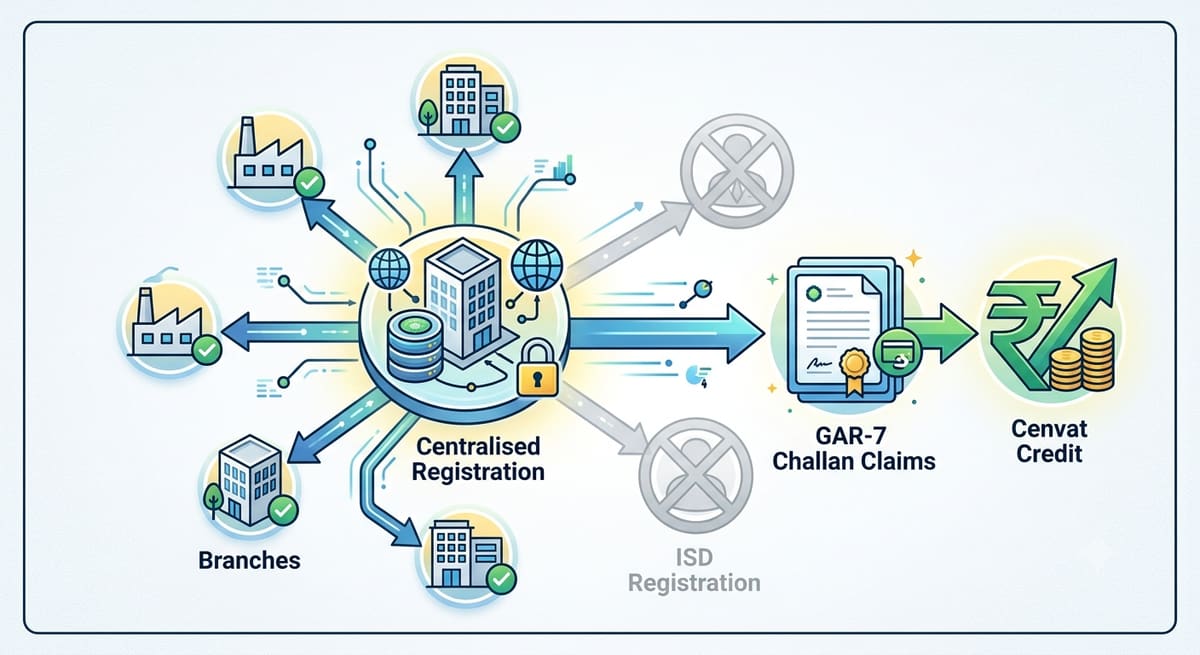
The CESTAT Chandigarh has clarified a critical ambiguity in service tax compliance by affirming that a manufacturer using centralised registration may lawfully avail Cenvat credit on input services through GAR-7 challans issued by its head office, even if the head office is not formally registered as an Input Service Distributor. This ruling reinforces the primacy of substantive compliance over procedural technicalities in indirect tax jurisprudence.
Background & Facts
The Dispute
The appellant, M/s Signify Innovations India Limited (formerly Phillips Lighting India Ltd), operates a manufacturing unit in Mohali, Punjab, and holds a centralised service tax registration under its head office in Chennai. During the relevant periods, the appellant received various input services - including Goods and Transport Agency services, Business Support Services, IT Software, Legal Services, and Sea Freight - directly at its Mohali unit. These services were subject to reverse charge mechanism (RCM), requiring the appellant to pay service tax directly. The appellant discharged this tax liability through its centralised registration in Chennai, using GAR-7 challans, and claimed Cenvat credit on these payments. The Department, however, denied the credit on the ground that the head office, though centrally registered, was not separately registered as an Input Service Distributor (ISD), and therefore, the credit could not be distributed to the Mohali unit under Rule 9 of the Cenvat Credit Rules, 2004.
Key Facts
The appellant’s manufacturing unit is located at Khasra No. 470 & 479, Village Rampur Kalan, Mohali, Punjab
Centralised registration was granted to the Chennai head office under Rule 4(2) & 4(3) of the Service Tax Rules, 1994
The appellant received input services exclusively at its Mohali unit; no services were received by the Chennai head office
Invoices for all input services were issued directly to the Mohali unit
Service tax was paid by the appellant via GAR-7 challans under its centralised registration number, not through any ISD registration
The GAR-7 challans clearly reflected the appellant’s centralised service tax code and Mohali unit’s address
The appellant submitted explanatory letters dated 06.06.2014 and 18.09.2014 to the Department detailing its credit availing mechanism
The Department did not allege suppression of facts, fraud, or intent to evade tax
Procedural History
01.06.2009 to 31.03.2014: First tax period under scrutiny
01.04.2015 to 31.12.2015: Second tax period under scrutiny
01.01.2016 to 30.06.2017: Third tax period under scrutiny
22.04.2015, 03.06.2015, 22.07.2015, 02.05.2016: Show Cause Notices issued for the first two periods
23.01.2018: Show Cause Notice issued for the third period
13.10.2016: Order-in-Original No. 149-151/CE/CHD-II/2016 passed by Commissioner of Central Excise, Chandigarh-II, confirming demand of Rs. 1,96,12,034/- with interest and penalty
09.01.2019: Order-in-Appeal No. LUD-EXCUS-001-APP-1995-18 passed by Commissioner (Appeals), CGST, Chandigarh, upholding the demand of Rs. 72,63,469/-
31.03.2023: Order-in-Appeal No. CHD-EXCUS-001-LDH-APP-81-2022-23 passed by Commissioner (Appeals), CGST, Ludhiana, upholding demand of Rs. 1,68,31,475/-
27.05.2026: Hearing before CESTAT Chandigarh
30.06.2026: Final Order passed by CESTAT Chandigarh
The Parties' Positions
Appellant: Argued that the credit was rightly availed under Rule 9(1)(e) of the Cenvat Credit Rules, 2004, which permits credit on the basis of GAR-7 challans evidencing payment by the service recipient. Emphasised that centralised registration was legally permitted, no services were received by the head office, and ISD registration was not mandatory in this scenario. Cited multiple precedents affirming that procedural lapses cannot override substantive rights.
Respondent: Contended that since the head office was registered as an ISD, credit must be distributed through the ISD mechanism under Rule 7 of the Cenvat Credit Rules. Argued that direct availing of credit via GAR-7 challans without ISD distribution was non-compliant and amounted to wrongful availment.
Relief Sought
The appellant sought: (1) Setting aside of all three impugned orders; (2) Cancellation of the total demand of Rs. 4,37,06,978/- (aggregate of all three periods); (3) Cancellation of interest and penalties; (4) Declaration that availing Cenvat credit via GAR-7 challans under centralised registration is lawful even without ISD registration.
The Legal Issue
Can a manufacturer lawfully avail Cenvat credit on input services paid under reverse charge mechanism through GAR-7 challans issued under its centralised registration, when the head office is not registered as an Input Service Distributor and the services are received exclusively at a single manufacturing unit?
Arguments Presented
For the Appellant
The appellant’s counsel argued that Rule 9(1)(e) of the Cenvat Credit Rules, 2004 explicitly permits credit on the basis of a challan evidencing payment of service tax by the service recipient. She emphasized that the appellant’s centralised registration was legally valid under Notification No. 29/2006-ST and Rule 4(2) of the Service Tax Rules. The head office did not receive any input services; it merely acted as a payment conduit for the Mohali unit. Therefore, ISD registration was neither applicable nor required. She cited Luminous Power Technologies Pvt Ltd v. CGST, Shimla and USV Pvt Ltd v. CCE & ST, Daman, where the Tribunal held that credit availed via centralised registration is valid even without ISD distribution. She further relied on Dashion Ltd v. Commissioner of Central Excise and Bharat Sanchar Nigam Ltd v. CCE & ST, Chandigarh-I, affirming that denial of credit on procedural grounds violates the taxpayer’s substantive right. Circular No. 1063/2/2018 was cited to show that the Department itself acknowledged that non-registration as ISD does not invalidate credit where services are received at the unit paying the tax.
For the Respondent
The respondent reiterated that Rule 7 of the Cenvat Credit Rules mandates distribution of credit only through an ISD. Since the head office was registered as an ISD, any credit availed directly by the Mohali unit without distribution via ISD was deemed non-compliant. The Department argued that the GAR-7 challans were issued by the ISD unit and therefore, credit could only be claimed after formal distribution. No new legal grounds were advanced beyond the mechanical application of Rule 7.
The Court's Analysis
The Tribunal conducted a detailed review of the statutory framework under the Cenvat Credit Rules, 2004, and the Service Tax Rules, 1994. It observed that the Department’s entire case rested on a misinterpretation of the ISD mechanism. The Tribunal noted that ISD registration is mandatory only when input services are received by the head office and distributed to multiple units. In this case, the services were received exclusively by the Mohali unit, and the head office merely acted as a payment vehicle under centralised registration.
"The Department has, in fact, not understood the whole transaction and has issued the Show Cause Notices merely on the basis that once the Head Office of the Appellant is also registered as 'ISD', then they should have distributed the Cenvat Credit to the Appellant."
The Tribunal held that Rule 9(1)(e) is unambiguous: a GAR-7 challan evidencing payment by the service recipient is a valid document for claiming credit. The fact that the challan was issued under the centralised registration number does not negate its validity. The Tribunal further distinguished Luminous Power Technologies as directly on point: in that case, the Tribunal held that non-registration as ISD does not disentitle an assessee from credit where the services are received at the unit paying the tax.
The Tribunal also rejected the Department’s argument that the credit was improperly availed because it was not distributed. It held that distribution is a mechanism for sharing credit among multiple units, not a precondition for claiming credit where only one unit receives the service. The Tribunal emphasized that the appellant had not suppressed facts, had filed returns regularly, and had proactively informed the Department of its credit mechanism in 2014.
"The service tax payment challan is a valid document for availment of Cenvat Credit... the impugned orders... are not sustainable in law."
The Tribunal concluded that the denial of credit on procedural grounds - without any allegation of fraud, suppression, or intent to evade - violates the principle that substantive rights cannot be defeated by technical irregularities.
The Verdict
The appellant succeeded on all counts. The CESTAT Chandigarh set aside all three impugned orders dated 13.10.2016, 09.01.2019, and 31.03.2023. The total demand of Rs. 4,37,06,978/-, along with interest and penalties, was cancelled. The Tribunal held that the appellant was entitled to Cenvat credit on the basis of GAR-7 challans issued under its centralised registration, irrespective of the absence of ISD distribution. No further compliance or adjustment was directed, as the credit was lawfully availed.
What This Means For Similar Cases
Centralised Registration Is a Valid Alternative to ISD Distribution
Practitioners may now confidently advise clients that centralised registration under Rule 4(2) of the Service Tax Rules permits direct payment and credit availing via GAR-7 challans without ISD registration, provided services are received only at the registered unit
Where the head office is merely a payment conduit and not a recipient of input services, ISD registration is not mandatory
This applies to all service recipients under RCM, including manufacturers, IT firms, and logistics companies
Procedural Non-Compliance Cannot Override Substantive Rights
Denial of Cenvat credit solely on the ground of non-distribution via ISD is legally unsustainable if the payment was made by the recipient and documented via GAR-7 challan
The burden now shifts to the Department to prove actual fraud or suppression - not mere procedural deviation
Circular No. 1063/2018 and multiple Tribunal rulings now form a binding precedent on this point
Audit-Based Demands Require Higher Threshold of Proof
Demands raised purely on audit observations, without evidence of suppression or mens rea, are vulnerable to challenge
Taxpayers who maintain proper records and disclose their credit mechanism in writing (e.g., via letters to the Department) are protected under the principle of legitimate expectation
Practitioners should document all communications with tax authorities regarding credit availing methods to preempt future disputes