Topic

public interest litigation

Public interest litigation (PIL) in India allows any citizen to approach courts for enforcement of public rights or redressal of public harm, even without direct personal injury, under Articles 226 and 32 of the Constitution.

73 articlesLatest July 2026
Wildlife Protection Act | Bombay HC Mandates SBWL Compliance with NTCA's Six Statutory Parameters for Tiger Corridor Identification
Case Law Analysis
|Bombay High Court

Wildlife Protection Act | Bombay HC Mandates SBWL Compliance with NTCA's Six Statutory Parameters for Tiger Corridor Identification

Bombay High Court ruled that the State Board for Wildlife (SBWL) cannot restrict tiger corridor identification solely to NTCA's 2014 report and DSS, ignoring six statutory parameters under the Wildlife Protection Act. The judgment reinforces statutory compliance in wildlife conservation, impacting tiger habitat protection and administrative law.


Rule 1(3-A) Allahabad HC Rules | Mandatory Credentials Affidavit Non-Compliance Bars PIL Maintainability : Allahabad HC
Case Law Analysis
|Allahabad High Court

Rule 1(3-A) Allahabad HC Rules | Mandatory Credentials Affidavit Non-Compliance Bars PIL Maintainability : Allahabad HC

Allahabad High Court dismisses a Public Interest Litigation for failing to comply with Rule 1(3-A) of the Allahabad HC Rules, which mandates a sworn affidavit disclosing the petitioner's credentials, public cause, and absence of personal interest. The ruling reinforces procedural compliance as a prerequisite for PIL maintainability, impacting all future PIL filings in the Lucknow Bench.

BNS Section 308(5) & 308(6) | Sting Operations in Public Interest Not Blackmail: MP HC Grants Anticipatory Bail to Journalist
Case Law Analysis
|Madhya Pradesh High Court

BNS Section 308(5) & 308(6) | Sting Operations in Public Interest Not Blackmail: MP HC Grants Anticipatory Bail to Journalist

Madhya Pradesh High Court ruled that sting operations exposing illegal female foeticide do not constitute blackmail under Bharatiya Nyaya Sanhita, granting anticipatory bail to a journalist. The judgment reinforces investigative journalism's protection when acting in public interest, setting a precedent for press freedom under criminal law.

Public Trust Doctrine | Mandamus Issued to Remove Encroachments on Revenue-Recorded Pond Land Under U.P. Revenue Code : Allahabad HC
Case Law Analysis
|Allahabad High Court

Public Trust Doctrine | Mandamus Issued to Remove Encroachments on Revenue-Recorded Pond Land Under U.P. Revenue Code : Allahabad HC

The Allahabad High Court has directed the Tehsildar to decide pending encroachment cases on revenue-recorded pond land within three months, reinforcing that public utility land held in trust cannot be lawfully occupied. This ruling strengthens accountability for local revenue authorities and affirms that encroachments on community water bodies violate the Public Trust Doctrine, affecting thousands of citizens reliant on such lands for ecological and livelihood security.

PIL in Service Matters Barred | Bombay HC Rejects Recovery of Inadvertent Payments to Class-III/IV Employees Under Rafiq Masih Doctrine
Case Law Analysis
|Bombay High Court

PIL in Service Matters Barred | Bombay HC Rejects Recovery of Inadvertent Payments to Class-III/IV Employees Under Rafiq Masih Doctrine

Bombay High Court dismisses a PIL seeking recovery of excess payments made to retired Class-III/IV employees, reinforcing the Supreme Court's Rafiq Masih judgment that bars recovery from low-income employees for employer errors. The ruling underscores the limited scope of PILs in service matters and protects vulnerable employees from financial hardship due to administrative mistakes.

Rule 1(3-A) Allahabad HC Rules | Mandatory Petitioner Affidavit Non-Compliance Renders PIL Non-Maintainable : Allahabad HC
Case Law Analysis
|Allahabad High Court

Rule 1(3-A) Allahabad HC Rules | Mandatory Petitioner Affidavit Non-Compliance Renders PIL Non-Maintainable : Allahabad HC

Allahabad High Court dismisses a PIL for failure to comply with Rule 1(3-A) of the Allahabad HC Rules, 1952, which mandates a sworn affidavit from the petitioner detailing credentials, public interest, and absence of personal gain. The ruling reinforces strict procedural thresholds for PILs, impacting litigants and practitioners in public interest litigation.

Article 15(3) | Free Public Transport for Women and Transgender Persons Constitutes Valid Affirmative Action Under Non-Targeted Empowerment Doctrine : Kerala HC
|Kerala High Court

Article 15(3) | Free Public Transport for Women and Transgender Persons Constitutes Valid Affirmative Action Under Non-Targeted Empowerment Doctrine : Kerala HC

The Kerala High Court has upheld the Priyadarshini Scheme granting free bus travel to all women and transgender persons, ruling that Article 15(3) permits broad-based affirmative action even without targeted evidence of disadvantage. This sets a precedent for gender-inclusive public welfare policies that prioritize structural empowerment over narrow proof of deprivation, affecting millions of daily commuters across the state.

Locus Standi Under Andhra Pradesh Endowments Act | Stranger Cannot Seek Mandamus for Temple Land Encroachment Removal: AP HC
Case Law Analysis
|Andhra Pradesh High Court

Locus Standi Under Andhra Pradesh Endowments Act | Stranger Cannot Seek Mandamus for Temple Land Encroachment Removal: AP HC

The Andhra Pradesh High Court ruled that a third-party petitioner lacks locus standi to seek a writ of mandamus for removal of encroachments on temple land under the Andhra Pradesh Charitable and Hindu Religious Institutions and Endowments Act, 1987. The court directed authorities to protect the temple properties while dismissing the petition.

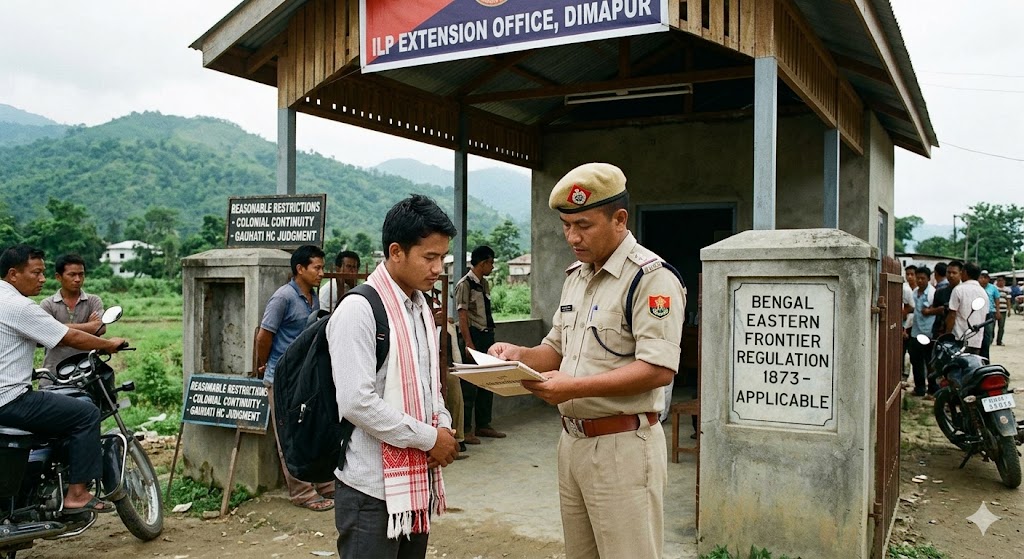
Bengal Eastern Frontier Regulation 1873 | Inner Line Permit Extension to Dimapur Valid Under Colonial Continuity & Reasonable Restrictions : Gauhati HC
Case Law Analysis
|Gauhati High Court

Bengal Eastern Frontier Regulation 1873 | Inner Line Permit Extension to Dimapur Valid Under Colonial Continuity & Reasonable Restrictions : Gauhati HC

Gauhati High Court upholds the application of the Inner Line Permit regime to Dimapur, Chumoukedima, and Niuland under the Bengal Eastern Frontier Regulation, 1873, affirming its continuity under Article 372. The judgment rejects challenges under Articles 14, 19, and 21, clarifying that the permit system constitutes a reasonable restriction under Article 19(5) to protect tribal rights and public order.

Public Interest Litigation | Vacant Possession of Plot Triggers Enforceable State Duty to Complete Rural Infrastructure Work: Allahabad HC
Case Law Analysis
|Allahabad High Court

Public Interest Litigation | Vacant Possession of Plot Triggers Enforceable State Duty to Complete Rural Infrastructure Work: Allahabad HC

The Allahabad High Court has ruled that once vacant possession of a plot earmarked for rural infrastructure is handed over to the Gram Pradhan, the state cannot delay or evade completion of the work. This establishes a binding legal obligation under PIL, ensuring that land handover is not a procedural formality but a trigger for substantive public service delivery in rural areas.

Section 67, U.P. Revenue Code | Tehsildar Must Execute Eviction Order Immediately After Appeal Dismissal: Allahabad HC
Case Law Analysis
|Allahabad High Court

Section 67, U.P. Revenue Code | Tehsildar Must Execute Eviction Order Immediately After Appeal Dismissal: Allahabad HC

The Allahabad High Court has ruled that once an appeal under Section 67 of the U.P. Revenue Code is dismissed, the Tehsildar has no discretion to delay enforcement of the eviction order. This clarifies that administrative inaction cannot override a final revenue adjudication, reinforcing accountability in land encroachment cases and empowering landowners seeking swift restoration of possession.

Consolidation Proceedings | Land Earmarked for Sarvajanik Abadi Not Encroachment Even if Used for Residential Structures : Allahabad HC
Case Law Analysis
|Allahabad High Court

Consolidation Proceedings | Land Earmarked for Sarvajanik Abadi Not Encroachment Even if Used for Residential Structures : Allahabad HC

The Allahabad High Court held that land recorded as Navin Parti and designated for public residential use during land consolidation does not constitute illegal encroachment when occupied by villagers, including the petitioner. This affirms that administrative earmarking during consolidation overrides revenue record classifications for residential intent, protecting low-income households from punitive action based on technical land categorization.