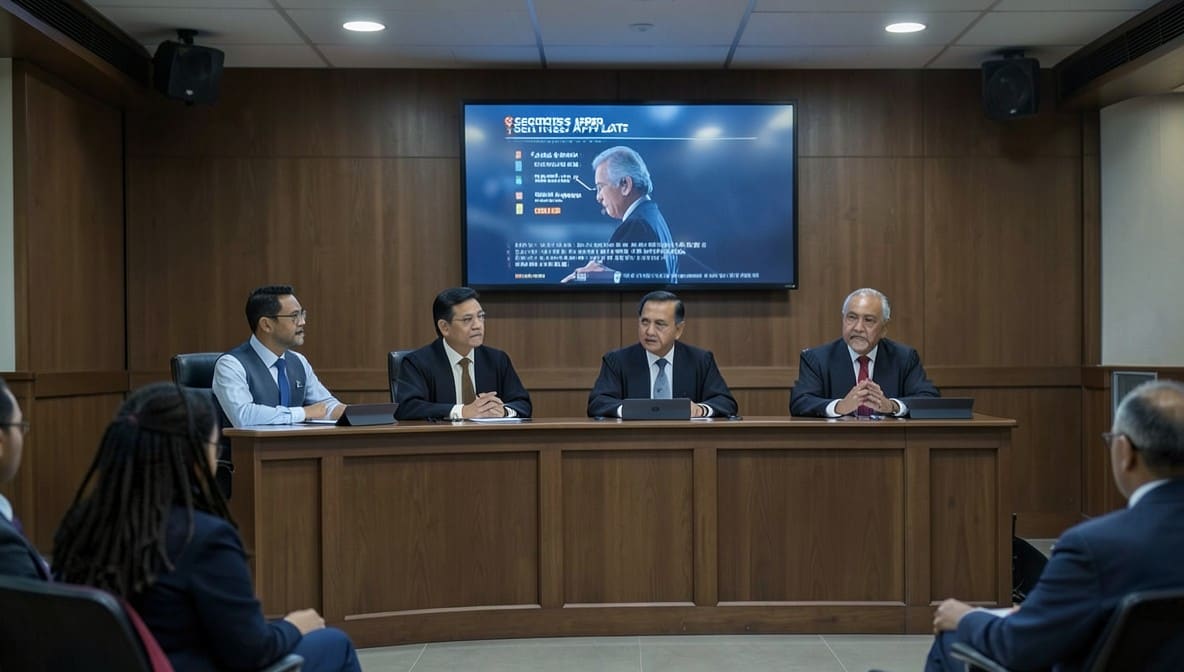
The Securities Appellate Tribunal (SAT) has reaffirmed that only a 'person aggrieved' can maintain an appeal under Section 15T of the SEBI Act. In dismissing an appeal by a society lacking direct interest in the dispute, the Tribunal underscored the statutory requirement of locus standi, distinguishing between public interest litigation and appellate remedies under the SEBI framework.
Background & Facts
The Dispute
The appellant, Chennai Financial Markets & Accountability (CFMA), a society registered under the Tamil Nadu Societies Registration Act, 1975, filed an appeal challenging an order dated September 13, 2024 passed by the Whole Time Member (WTM) of the Securities and Exchange Board of India (SEBI). The appeal arose from a protracted dispute involving allegations of unfair access to secondary servers in the National Stock Exchange (NSE) co-location facility, commonly referred to as the NSE co-location scam.
Key Facts
- January 2015: A whistle-blower complaint was lodged before SEBI, triggering an investigation into alleged unfair access to NSE’s co-location servers by OPG Securities Pvt. Ltd. (OPG) and potential connivance by NSE officials.
- April 30, 2019: SEBI passed two separate orders:
- One against NSE and its officials, exonerating them of connivance and collusion.
- Another against OPG and its directors, holding them guilty of unfair access and imposing a penalty of ₹15.57 crore.
- January 23, 2023: SAT remanded the matter to SEBI for re-adjudication on the following issues:
- Quantum of disgorgement by OPG.
- Reconsideration of the charge of connivance and collusion between OPG and NSE officials.
- Issuance of directions/penalties for concealment/destruction of vital information.
- Reconsideration of Issue No. 2 relating to crowding out other market participants.
- May 17, 2023: SEBI issued a fresh Show Cause Notice (SCN) to OPG and other parties.
- September 13, 2024: SEBI passed the impugned order, disposing of proceedings against NSE and its officials without any directions, while enhancing the penalty against OPG to ₹85.25 crore under the SEBI (Prohibition of Fraudulent and Unfair Trade Practices) Regulations, 2003 (PFUTP Regulations).
Procedural History
- September 13, 2024: SEBI passed the impugned order.
- 2024: OPG filed an appeal before SAT challenging the enhanced penalty (pending consideration).
- 2024: CFMA filed the present appeal (Appeal No. 703 of 2024) before SAT, seeking:
- Quashing of the impugned order.
- Appointment of an independent committee to reconsider the charge of connivance and collusion.
- Direction to SEBI to provide material evidence and seek information from the Central Bureau of Investigation (CBI), which had filed charge sheets against ex-NSE officials.
- Costs and incidental reliefs.
- April 24, 2026: The appeal was heard and reserved for orders.
- June 18, 2026: SAT pronounced the present order, dismissing the appeal on grounds of maintainability.
The Parties' Positions
For the Appellant (CFMA)
- Argued that SEBI failed to address all four issues remanded by SAT in its January 23, 2023 order.
- Contended that CFMA falls within the definition of ‘any person aggrieved’ under Section 15T of the SEBI Act, as it represents public concerns in the financial sector.
- Invoked Rule 21 of the Securities Appellate Tribunal (Procedure) Rules, 2000, urging SAT to exercise its powers to secure the ends of justice.
For the Respondents (SEBI and Others)
- SEBI raised a preliminary objection, arguing that CFMA lacks locus standi as it is neither an investor nor a party directly affected by the impugned order.
- Contended that the appeal is in the nature of a Public Interest Litigation (PIL), which SAT lacks jurisdiction to entertain.
- Other respondents (NSE and former officials) aligned with SEBI’s submissions, emphasizing that CFMA has no direct interest in the dispute.
Relief Sought
The appellant sought:
- Quashing of SEBI’s order dated September 13, 2024.
- Appointment of an independent third party/committee to reconsider the charge of connivance and collusion between OPG and NSE officials.
- Direction to SEBI to assist the committee by providing all material evidence, including forensic reports and CBI charge sheets.
- Costs and incidental reliefs.
The Legal Issue
The central question before SAT was whether Section 15T of the SEBI Act permits an appeal by a party that is not a ‘person aggrieved’ - specifically, whether a society representing public concerns but lacking direct interest in the dispute has locus standi to challenge SEBI’s order.
Arguments Presented
For the Appellant
- Relied on the broad language of Section 15T, which permits ‘any person aggrieved’ to appeal.
- Argued that CFMA’s objective - addressing public concerns in the financial sector - qualifies it as an aggrieved party.
- Invoked Rule 21 of the SAT Rules, urging the Tribunal to exercise its inherent powers to secure justice.
For the Respondent (SEBI)
- Contended that Section 15T requires a direct legal injury or affected right, neither of which CFMA has demonstrated.
- Distinguished the appeal from a valid appellate remedy, characterizing it as a PIL, which SAT cannot entertain.
- Cited SAT’s earlier decision in NSE v. SEBI (Appeal No. 333 of 2019), where a similar appeal by a third party was dismissed for lack of locus standi.
The Court's Analysis
The Tribunal conducted a detailed analysis of Section 15T of the SEBI Act, which provides:
"Any person aggrieved by an order of the Board may prefer an appeal to the Securities Appellate Tribunal."
The Tribunal relied heavily on its earlier decision in NSE v. SEBI (Appeal No. 333 of 2019), where it had examined the meaning of ‘person aggrieved’. In that case, one Mr. A Kumar, an advocate, had filed an appeal challenging the same SEBI order as NSE, arguing that he was espousing a public cause. SAT had held:
"17. [...] Nothing has been stated as to how the appellant is aggrieved by any finding of the WTM in the impugned order. [...] The applicant has no connection with NSE nor is otherwise interested in the functioning of NSE and, therefore, we are of the opinion that the applicant Mr. A. Kumar is not aggrieved by any action of NSE."
"18. [...] The complaint and the writ petition filed before the Madras High Court by Mr. A. Kumar is in the nature of a public interest litigation. Since the ground raised in the memo of appeal and in the intervention application are pending consideration before the Madras High Court which directions has been sought to SEBI to decide its representation, it is not open to Mr. A. Kumar to make the same prayer before this Tribunal. Once the appellant has chosen a particular forum for redressal of his grievance it is no longer open to the applicant Mr. A. Kumar to choose another forum."
The Tribunal noted that CFMA’s case was ‘identical in nature’ to that of Mr. A Kumar. It observed:
- CFMA is neither an investor nor has it suffered any loss.
- There is no lis (legal dispute) between CFMA and NSE or SEBI.
- CFMA’s objective - addressing public concerns - does not confer locus standi under Section 15T.
- The appeal was essentially a PIL, which SAT lacks jurisdiction to entertain.
The Tribunal also addressed CFMA’s reliance on Rule 21 of the SAT Rules, which empowers SAT to:
"make such orders or give such directions as may be necessary or expedient to give effect to its orders or to prevent abuse of its process or to secure the ends of justice."
The Tribunal held that this rule could not be invoked in the present case, as:
- SEBI had already passed a fresh order after remand, fulfilling its regulatory role.
- There was no contingency requiring SAT’s intervention under Rule 21.
The Verdict
The Tribunal dismissed the appeal, holding that CFMA is not a ‘person aggrieved’ under Section 15T of the SEBI Act and that the appeal is not maintainable. No costs were awarded.
What This Means For Similar Cases
Locus Standi Is Non-Negotiable Under Section 15T
- Direct Interest Required: Practitioners must ensure that appellants under Section 15T have a direct legal interest or injury. Mere representation of public concerns is insufficient.
- Distinction from PIL: Courts and tribunals distinguish between appellate remedies and PILs. Section 15T is not a vehicle for public interest litigation.
- Forum Shopping Barred: Once a party chooses a forum (e.g., High Court for PIL), it cannot simultaneously pursue the same relief before another forum (e.g., SAT).
Rule 21 Cannot Bypass Statutory Requirements
- Limited Scope: Rule 21 of the SAT Rules is not a catch-all provision to override statutory limitations. It applies only to:
- Giving effect to SAT’s orders.
- Preventing abuse of process.
- Securing ends of justice in exceptional contingencies.
- No Substitute for Locus Standi: Rule 21 cannot be invoked to bypass the requirement of ‘person aggrieved’ under Section 15T.
Implications for Whistle-Blowers and Public Interest Groups
- Alternative Remedies: Whistle-blowers or public interest groups lacking direct interest must pursue remedies through:
- PILs before High Courts/Supreme Court.
- Complaints to regulatory bodies (e.g., SEBI, CBI).
- Intervention in existing proceedings where they can demonstrate a direct interest.
- No Automatic Standing: Regulatory tribunals like SAT are not forums for generalized grievances. Appellants must establish a personal stake in the dispute.
Strategic Considerations for Practitioners
- Drafting Appeals: Ensure the appellant’s pleadings clearly establish:
- How they are aggrieved by the impugned order.
- The legal injury suffered.
- The direct interest in the outcome.
- Avoiding Dismissal: Appeals lacking locus standi are liable to be dismissed at the threshold. Practitioners should:
- Assess maintainability before filing.
- Explore alternative forums if locus standi is doubtful.
- Consider joining as an intervenor in existing proceedings where feasible.