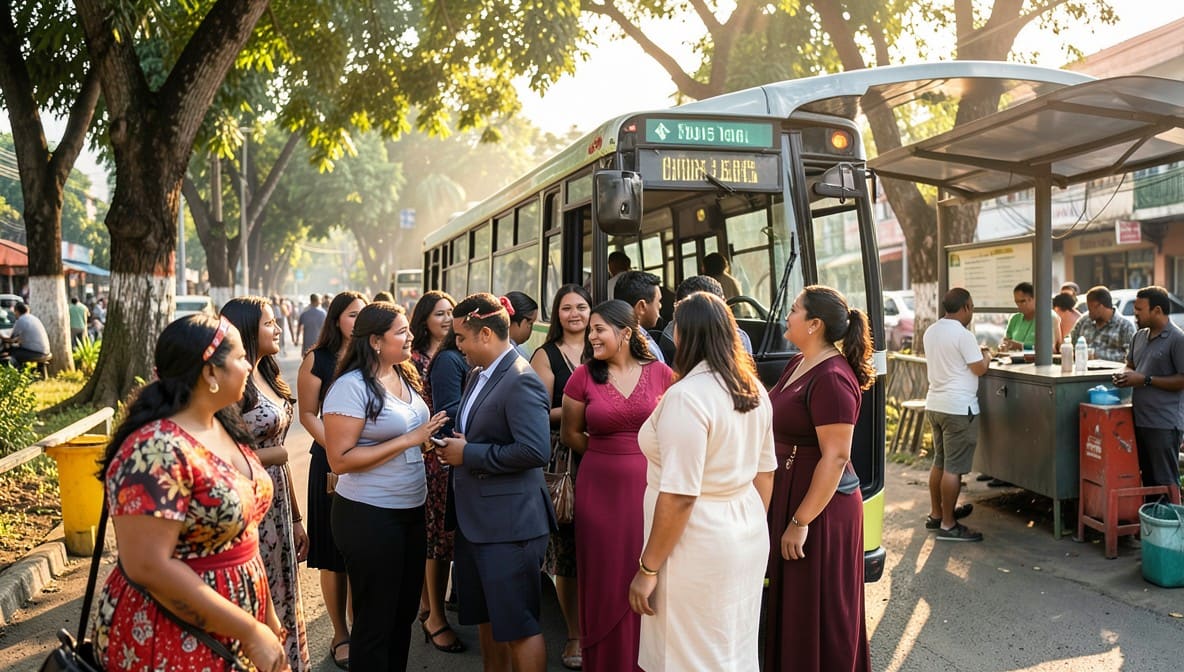
The Kerala High Court has affirmed that the State may extend universal free bus travel benefits to all women and transgender persons without income-based targeting, holding that such measures fall squarely within the protective ambit of Article 15(3) of the Constitution. The judgment reinforces that affirmative action for women need not be narrowly calibrated to economic disadvantage to be constitutionally valid.
Background & Facts
The Dispute
The petitioner, a public-spirited citizen and taxpayer, filed this Public Interest Litigation challenging Government Order (G.O.) dated 11.06.2026, which implemented the "Priyadarshini Scheme" granting free travel on all ordinary Kerala State Road Transport Corporation (KSRTC) buses to all women and transgender persons, effective from 15.06.2026. The petitioner contends that the scheme is arbitrary, lacks empirical justification, and violates Article 14 and Article 15(1) by discriminating against male passengers solely on the basis of sex.
Key Facts
- The scheme was announced as part of the State Government’s "Indira Guarantee" election manifesto.
- The Cabinet approved the scheme on 10.06.2026.
- The Government Order (Exhibit P1) was issued on 11.06.2026.
- Implementation commenced on 15.06.2026.
- The scheme provides free travel to all women and transgender persons, irrespective of income, residence, employment status, or economic need.
- The financial burden of the scheme is borne entirely by the State Government, with KSRTC’s operational costs indemnified through state funding.
- The petitioner alleges the scheme incurs an estimated daily expenditure of Rs. 2 Crore from the Consolidated Fund.
- The petitioner argues that the scheme benefits non-resident women, including tourists, with no nexus to Kerala’s socio-economic objectives.
- The petitioner contrasts this scheme with targeted concessions such as free travel for female students, pregnant women, or women below poverty line, which are based on identifiable disadvantage.
Procedural History
- 11.06.2026: Government Order (G.O. No. 16/2026/TRANS) issued implementing the Priyadarshini Scheme.
- 15.06.2026: Scheme implemented across all ordinary KSRTC services.
- 18.06.2026: Writ Petition (PIL) No. 122/2026 admitted for hearing.
- 22.06.2026: Judgment delivered by the Division Bench of the Kerala High Court.
The Parties' Positions
Petitioner: Argued that the scheme is over-inclusive, lacks rational nexus, and violates Article 14 by treating unequals equally. Contended that Article 15(3) permits only targeted, proportionate, and need-based special provisions, not universal subsidies. Asserted that the scheme is paternalistic, rooted in stereotypes, and not grounded in any policy study or empirical data.
Respondents (State of Kerala and KSRTC): Maintained that the scheme is a valid exercise of the State’s duty under Directive Principles to promote women’s empowerment. Argued that Article 15(3) permits discrimination in favour of women even if it results in differential treatment of men, provided the objective is women’s advancement. Stated that financial burden is borne by the State, not KSRTC, and that similar schemes exist in Delhi, Punjab, and Tamil Nadu.
Relief Sought
The petitioner sought:
- Quashing of Exhibit P1 G.O. dated 11.06.2026.
- Suspension of the free bus travel scheme pending a comprehensive policy and impact assessment.
- Direction to the State to restrict benefits to economically disadvantaged women only.
The Legal Issue
The central question was whether Article 15(3) permits the State to provide universal, non-targeted free travel benefits to all women and transgender persons without any income or need-based criteria, and whether such a classification violates Article 14 or Article 15(1) by discriminating against male passengers.
Arguments Presented
For the Petitioner
The petitioner relied on Anwar Ali Sarkar and Budhan Choudhry to argue that any classification must have an intelligible differentia and rational nexus to a legitimate objective. He contended that the scheme’s objectives - "unrestricted mobility," "inclusive society," and "employment opportunities" - are too vague to satisfy the rational nexus test. He cited Anuj Garg to argue that beneficial legislation for women cannot be shielded merely because it is nominally in their favour; courts must examine whether it is genuinely protective or rooted in patriarchal stereotypes. He further argued that extending benefits to non-resident women and affluent women lacks any connection to Kerala’s welfare goals and violates fiscal responsibility under the Constitution.
For the Respondent
The Advocate General relied on Dattatraya Motiram More, Vijay Lakshmi, and Ramesh Kamal to assert that Article 15(3) is a proviso to Article 15(1) that explicitly permits discrimination in favour of women. He emphasized that the scheme’s purpose - economic and social empowerment of women - is aligned with Directive Principles under Articles 39, 41, and 42. He cited Samatha to argue that courts must uphold State efforts to remove economic inequalities. He contended that the absence of income criteria does not render the classification unreasonable, as the State may choose to uplift an entire class based on historical disadvantage. He also noted that similar schemes in other States have been upheld and that financial burden is a policy matter beyond judicial review.
The Court's Analysis
The Court began by affirming the limited scope of judicial review in matters of State policy, particularly those involving economic largesse and Directive Principles. Citing Subramaniam Balaji and State of Tamil Nadu v. National South Indian River Interlinking Agriculturist Association, the Court held that courts cannot sit in judgment over the wisdom or prudence of a policy, provided it does not violate fundamental rights or statutory norms.
The Court then turned to the constitutional validity of the classification under Article 15. It examined the landmark observation by Chief Justice Chagla in Dattatraya Motiram More, which clarified that Article 15(3) is not a mere exception to Article 15(1) but a positive grant of power to discriminate in favour of women. The Court quoted:
"It is true that in construing a proviso, one must not nullify the section itself. A proviso merely carves out something from the section itself. But it does not and cannot destroy the whole section. The proper way to construe Article 15(3) in our opinion, is that, whereas under Article 15(1), discrimination in favour of men only on the ground of sex is not permissible, by reason of Article 15(3), discrimination in favour of women is permissible and when the State does discriminate in favour of women, it does not offend against Article 15(1)."
The Court held that the scheme’s classification is not based merely on sex, but on the broader constitutional objective of women’s empowerment, which includes removing structural barriers to mobility, employment, and participation in public life. The Court rejected the petitioner’s argument that the scheme must be targeted to economically disadvantaged women, stating that the Constitution does not require the State to limit affirmative action to the poorest. The Court observed:
"When the State evolves a scheme towards materialising such avowed constitutional goals and proceeds to implement them, such policy decisions cannot be subjected to judicial review."
The Court further dismissed the challenge based on financial burden, noting that the State has expressly assumed all costs and indemnified KSRTC. It held that fiscal prudence is a policy determination, not a constitutional violation. The Court also rejected the argument that the scheme’s origin in an election manifesto rendered it invalid, citing Subramaniam Balaji to affirm that manifesto promises are not per se unconstitutional if they align with Directive Principles.
The Verdict
The petition was dismissed. The Court upheld the validity of the Priyadarshini Scheme under Article 15(3), holding that the State’s decision to provide universal free bus travel to all women and transgender persons is a constitutionally permissible affirmative action. The Court found no violation of Article 14 or Article 15(1). No monetary relief was granted, as the petitioner sought only quashing of the order. The scheme remains in full effect.
What This Means For Similar Cases
Special Provisions Need Not Be Targeted
- Practitioners must now recognize that Article 15(3) permits universal benefits for women even without income, caste, or need-based criteria.
- Courts will not strike down welfare schemes merely because they benefit affluent women or non-residents, if the overarching objective is women’s empowerment.
- The burden of proof shifts to challengers to show that the scheme is not genuinely aimed at empowerment, but is instead rooted in stereotyping.
Policy Decisions Are Beyond Judicial Scrutiny
- Challenges to State welfare schemes on grounds of fiscal imprudence or lack of empirical data are unlikely to succeed.
- Courts will defer to the State’s judgment on how best to implement Directive Principles, especially in economic and social domains.
- Public interest litigants seeking to overturn such schemes must focus on constitutional violations, not policy wisdom.
Precedent Expands Scope of Affirmative Action
- This judgment reinforces that affirmative action under Article 15(3) is not confined to reservations or quotas but extends to public service concessions.
- Similar schemes in other States (e.g., Delhi, Punjab, Tamil Nadu) are now further validated.
- Future schemes offering free transport, healthcare, or education to women may rely on this precedent to resist legal challenges.