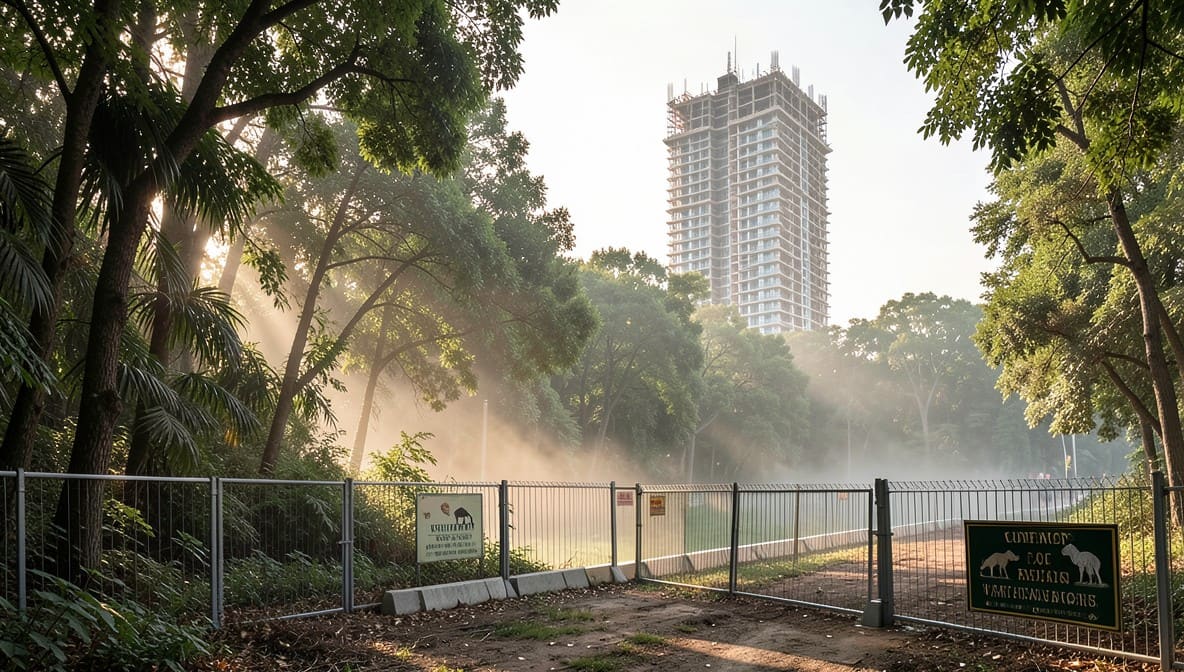
The Bombay High Court has underscored the critical role of the National Tiger Conservation Authority (NTCA) in determining tiger corridors for wildlife clearance, directing it to examine the State Board for Wildlife's (SBWL) decision to restrict corridor identification to NTCA's 2014 report and Decision Support System (DSS). The judgment highlights the need for compliance with statutory parameters and transparency in wildlife conservation decisions, setting a precedent for adherence to NTCA guidelines under Section 38-O(1)(g) of the Wildlife Protection Act, 1972.
Background & Facts
The Dispute
The petitioners, Sheetal Kolhe (Director of Landscape Research and Conservation Foundation) and Udayan Patil (Secretary of Sruhsti Paryavaran Mandal), filed a Public Interest Litigation (PIL) challenging the decision of the State Board for Wildlife (SBWL) in its 24th meeting. The SBWL resolved to consider only tiger corridors depicted in NTCA's 2014 report, "Connecting Tiger Populations for Long-Term Conservation," and the Decision Support System (DSS) for wildlife clearance under Section 38-O(1)(g) of the Wildlife Protection Act, 1972. The petitioners contended that this decision ignored six statutory parameters laid down by NTCA for corridor delineation and wildlife clearance assessment.
Key Facts
- 17.04.2025: SBWL's 24th meeting resolved to restrict tiger corridor identification to NTCA's 2014 report and DSS, excluding other statutory sources.
- 07.02.2023: NTCA issued a letter (No. 1-2/2020) listing six authoritative sources for corridor delineation and clearance assessments:
- Administrative boundaries of core, buffer, and eco-sensitive zones of tiger reserves.
- Tiger corridors delineated in NTCA's 2014 report.
- Corridors delineated in Tiger Conservation Plans (TCPs) approved by NTCA under Section 38-V(3)(b).
- Corridors identified in WII's 2016 report, "Tiger Corridors of Eastern Landscape."
- Corridors identified in WII's 2021 report, "Telemetry-Based Tiger Corridors of Vidarbha Landscape."
- Distribution of tigers and endangered fauna based on All India Tiger Estimation (AITE) data.
- 06.02.2025: National Highway Circle requested reconsideration of studies contradicting NTCA's parameters.
- 20.08.2025: NTCA clarified that only two sources - NTCA's 2014 report and TCPs - are statutorily recognized for wildlife clearance.
- 25.07.2025: NTCA filed an affidavit acknowledging 32 tiger corridors and 52 tiger reserves but contradicted its earlier stance on DSS reliance.
Procedural History
- PIL No. 46/2025 filed before the Bombay High Court, Nagpur Bench, challenging SBWL's decision.
- 06.05.2026: Judgment reserved.
- 13.07.2026: Judgment pronounced.
The Parties' Positions
For the Petitioners
- SBWL's decision is arbitrary and exceeds its advisory jurisdiction by ignoring NTCA's six parameters.
- The DSS is inadequate and not statutorily recognized for corridor identification.
- NTCA's affidavit (25.07.2025) contradicts its earlier directives, creating confusion.
- SBWL's decision was taken without proper deliberation, violating principles of natural justice.
For the Respondents
- SBWL: Contended that the decision was taken after due deliberation and adhered to NTCA's clarification dated 20.08.2025, which recognized only NTCA's 2014 report and TCPs as statutory sources.
- NTCA: Argued that its mandate under Section 38-O(1)(g) includes identifying tiger corridors and ensuring their protection. It relied on AITE data and Tiger Conservation Plans for corridor refinement but did not explicitly endorse SBWL's decision.
Relief Sought
The petitioners sought:
- Quashing of SBWL's decision in its 24th meeting.
- Direction to SBWL to comply with NTCA's six parameters for corridor identification.
- Transparency and reasoned decisions in wildlife clearance processes.
The Legal Issue
The central question was whether SBWL's decision, restricting tiger corridor identification to NTCA's 2014 report and DSS, complies with statutory directives under Section 38-O(1)(g) of the Wildlife Protection Act, 1972 and NTCA's guidelines, or whether it constitutes arbitrary exercise of power.
Arguments Presented
For the Petitioners
- Section 8 of the Wildlife Protection Act, 1972 limits SBWL's role to advisory functions, and it cannot unilaterally determine wildlife clearance criteria.
- SBWL's decision ignores NTCA's six parameters, which are binding under Section 38-O(1)(g).
- The DSS is non-statutory and inadequate for decision-making, as acknowledged by NTCA's disclaimer.
- SBWL's decision was taken without proper deliberation, violating principles of natural justice.
For the Respondents
- SBWL: Argued that the decision was taken after due deliberation and adhered to NTCA's clarification dated 20.08.2025, which recognized only NTCA's 2014 report and TCPs as statutory sources.
- NTCA: Contended that its mandate under Section 38-O(1)(g) includes identifying tiger corridors and ensuring their protection. It relied on AITE data and Tiger Conservation Plans for corridor refinement but did not explicitly endorse SBWL's decision.
The Court's Analysis
The Court examined the statutory framework under the Wildlife Protection Act, 1972, and the roles of the NBWL, NTCA, SBWL, PCCF, and CWLW in wildlife conservation:
- NBWL is the apex body for wildlife conservation, ensuring no tiger reserves are diverted for unsustainable uses without its approval.
- NTCA is a statutory authority responsible for formulating policies, approving Tiger Conservation Plans, and ensuring tiger reserves are not diverted for ecologically unsustainable uses.
- SBWL is an advisory body at the state level, recommending wildlife conservation policies and considering diversion of forest land for development projects.
The Court observed that Section 38-O(1)(g) empowers NTCA to ensure tiger reserves and linking areas are not diverted for unsustainable uses except in public interest with NBWL's approval. The Court noted:
"Clause (g) of sub-section (1) of Section 38-O speaks about the function of the Tiger Conservation Authority (TCA) to ensure that the tiger reserves and areas linking one protected area or tiger reserve with another protected area or tiger reserve are not diverted for ecologically unsustainable uses, except in the public interest and with the approval of the National Board for Wild Life (NBWL) and on the advice of the Tiger Conservation Authority."
The Court highlighted that NTCA's silence on the core issue - whether SBWL's decision complied with its 07.02.2023 directive - was concerning. It relied on the judgment in Goa Foundation v. State of Goa (2023 SCC OnLine Bom 1495), which emphasized NTCA's statutory authority and the binding nature of its directives for wildlife conservation:
"The NTCA is a high-powered central body constituted under the Parliamentary statute... Sweeping powers have been conferred, and critical functions have been assigned to the NTCA under Section 38-O of the WLPA."
The Court concluded that SBWL's decision to restrict corridor identification to NTCA's 2014 report and DSS ignored NTCA's six parameters, raising concerns about arbitrariness and lack of transparency. Given NTCA's statutory mandate, the Court deemed it appropriate to refer the matter to NTCA for a comprehensive examination of the issues raised.
The Verdict
The Court disposed of the PIL with the following directions:
- The matter is referred to NTCA to examine all issues raised by the petitioners, including the validity of SBWL's 24th meeting decision.
- NTCA must record reasons for each challenge raised in the petition.
- NTCA must take a decision within three months from the date of the judgment (13.07.2026).
- The decision must be communicated to the petitioners within two weeks thereafter.
What This Means For Similar Cases
NTCA's Statutory Authority Must Be Respected
- State wildlife boards (SBWL) cannot unilaterally deviate from NTCA's directives without statutory justification. Courts will scrutinize decisions that ignore NTCA's parameters, especially when they contradict binding guidelines.
- Transparency and reasoned decisions are non-negotiable in wildlife clearance processes. SBWL must ensure due deliberation and opportunity for stakeholders before taking decisions.
Tiger Conservation Plans Are Binding
- Tiger Conservation Plans (TCPs), approved under Section 38-V(3)(b), are statutory documents and must be considered for wildlife clearance. Ignoring TCPs can render decisions arbitrary and liable to challenge.
- Non-statutory studies (e.g., Eastern Vidarbha Landscape Study, Telemetry-based Tiger Corridor Study) cannot replace statutorily recognized sources for wildlife clearance decisions.
Judicial Oversight in Wildlife Governance
-
Courts will intervene where statutory bodies exceed their jurisdiction or act arbitrarily. Public Interest Litigations (PILs) remain a potent tool for ensuring compliance with environmental laws.
-
NTCA's role as a regulatory authority is reinforced, and its directives must be strictly adhered to by state boards and other authorities.
-
Practitioners should ensure that wildlife clearance decisions comply with all statutory parameters laid down by NTCA.
-
Documentary evidence (e.g., NTCA's directives, TCPs) should be relied upon to challenge arbitrary decisions.
-
Timely legal challenges can prevent irreversible ecological damage, as highlighted in the petitioners' argument about ongoing construction projects.