The Allahabad High Court has dismissed a PIL as an abuse of process, emphasizing that repeated litigation on the same factual grievance - after prior judicial disposal - cannot be masked as public interest. The judgment reinforces that PILs must serve collective welfare, not personal vendettas disguised as public concern.
Background & Facts
The Dispute
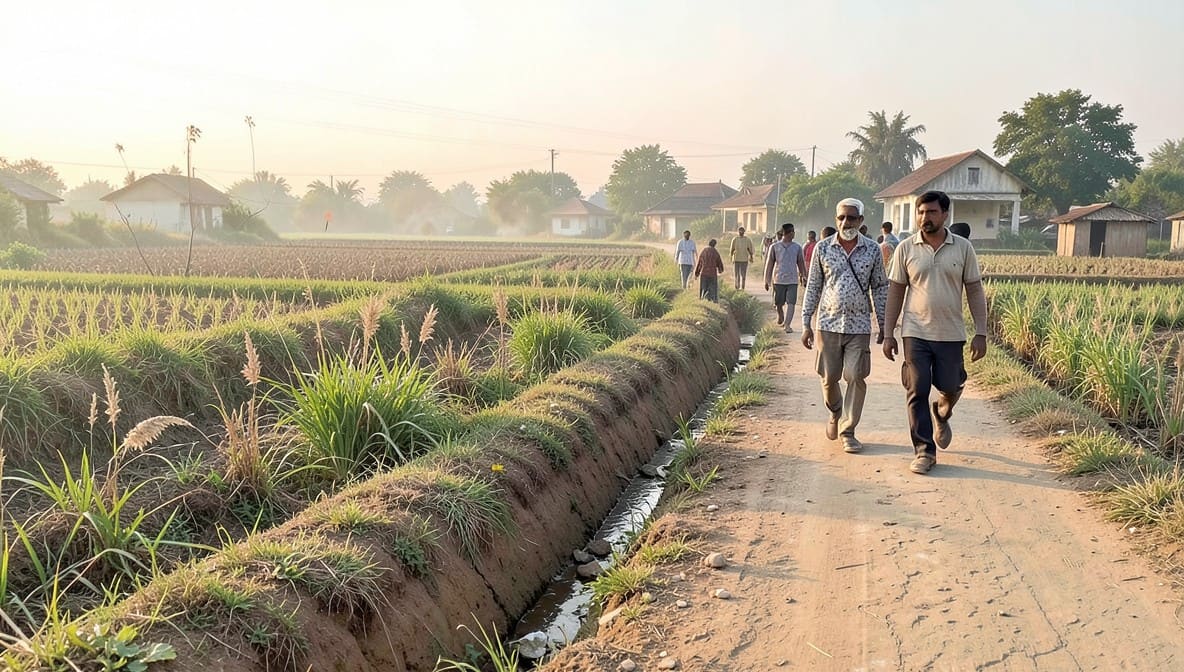
The petitioners seek restoration of plot nos. 404 and 409, recorded as pathway (Rasta) in revenue records, which they allege were obstructed by the digging of a pit for cleaning a pond on adjacent plot no. 355Kha in Village Khanpur, Tehsil Sadar, District Meerut. They claim the pit blocks public passage and violates recorded land use.
Key Facts
- Plot nos. 404Ka and 409 are recorded in revenue records as Rasta (pathway)
- Plot no. 355Kha contains a pond, the water from which necessitates drainage
- The Land Management Committee of Village Khanpur passed a resolution on 22.06.2022 to construct a drain along plot nos. 404Ka, 409, and adjacent plots (356, 357, 359, 360, 387, 1058, 403, 405, 406, 407)
- Tenure holders of the affected plots (except Om Pal Singh) consented to the drain construction
- Om Pal Singh, bhumidhar of plot nos. 406 and 408 and father of petitioner no. 1, objected to the drain construction
- Om Pal Singh filed Writ-C No. 19632 of 2022 before this Court seeking to restrain excavation on plot no. 409
Procedural History
- 22.06.2022: Land Management Committee resolves to construct drain for water drainage from pond on plot no. 355Kha
- 29.07.2022: High Court disposes of Writ-C No. 19632 of 2022 with the following order:
"Heard learned counsel for the petitioner, learned Standing Counsel for the State respondent. Instructions placed today, which is taken on record. Copy of the instructions has supplied to the learned counsel for the petitioner before this Court. By means of this petition under Article 226 of the Constitution, the petitioner has prayed for mandamus directing the respondent no.3 from restraining digging at plot no. 409, which is recorded as passage while plot nos. 406, 407 and 408 are the Bhumidhari land of the present petition. Instructions have been obtained in this matter by Sri Sunil Kumar Singh, learned counsel appearing for Gaon Sabha and as per instructions, along side road a small drain is being constructed to take away the water from Abadi area. No pond is under construction, nor any pond is proposed along side of the road because the adjacent land is the bhumidhari land. Since, now the respondents are not constructing any pond over and above any private land of the Bhumidhar of the village and only construction is being done of a ditch to carry water from the abadi, along side of the road, no cause survives any more. Accordingly, the petition is consigned to record."
- Pending: Om Pal Singh filed a recall application in Writ-C No. 19632 of 2022, which remains undecided
- 12.01.2026: Present PIL (No. 1289 of 2026) filed by Dinesh Kumar and four others, sons and relatives of Om Pal Singh, seeking restoration of plots 404 and 409 as pathway
- 16.05.2026: Deputy District Magistrate, Meerut, issues instruction confirming no pit was dug; soil on road is embankment of drain, not obstruction
- 19.05.2026: Judgment delivered dismissing PIL
The Parties' Positions
- Petitioners: Claim the pit dug for pond cleaning obstructs public pathway on plots 404 and 409, violating revenue records and public access rights
- Respondents: State and Gaon Sabha assert no pond exists or is being constructed; only a public drain is being built with consent of most landholders; no pit was dug; soil on road is embankment; petition is a re-litigation of dismissed claim
Relief Sought
The petitioners seek a direction to the respondents to restore plot nos. 404 and 409 as pathway by filling up the pit dug for cleaning the pond on plot no. 355Kha.
The Legal Issue
Can a petitioner file a fresh PIL on the same factual grievance already adjudicated and dismissed by the High Court, where the only new averment is unsubstantiated and contradicted by official records?
Arguments Presented
For the Petitioner
The petitioners argued that plot nos. 404 and 409 are recorded as pathway in revenue records and that the digging of a pit for pond cleaning has obstructed public access. They contended that such obstruction violates public rights and demands judicial intervention under Article 226. They relied on the principle that public pathways must be preserved for community use.
For the Respondent
The State and Gaon Sabha countered that the present petition is a re-agitation of the same grievance raised and dismissed in Writ-C No. 19632 of 2022. They submitted that no pond is being constructed, only a drain is being built with the consent of tenure holders, and no pit was dug - only embankment soil from the drain construction lies on the road, causing no obstruction. They emphasized that the petitioners failed to disclose the pendency of the recall application in the earlier writ petition, constituting suppression of material facts.
The Court's Analysis
The Court examined the factual and procedural history with particular attention to the dismissal of Writ-C No. 19632 of 2022. It noted that the earlier petition, filed by Om Pal Singh, sought identical relief - restraint on excavation on plot no. 409 - and was dismissed on the basis of official instructions that no pond was being constructed, only a public drain with consent of landholders.
"Since, now the respondents are not constructing any pond over and above any private land of the Bhumidhar of the village and only construction is being done of a ditch to carry water from the abadi, along side of the road, no cause survives any more. Accordingly, the petition is consigned to record."
The Court held that the present PIL, filed by the son and relatives of Om Pal Singh, raises no new facts or legal grounds. The allegation of a "pit" dug for pond cleaning is directly contradicted by the official instruction dated 16.05.2026, which clarifies that the soil on the road is merely the embankment of the drain, not an obstruction. The Court further observed that the petitioners deliberately omitted the pendency of the recall application in the earlier writ petition, which constitutes suppression of material facts.
The Court emphasized that PILs are meant to address systemic public wrongs, not to circumvent final judicial orders or to re-litigate personal disputes. The filing of a second petition on the same subject, after a dismissal on merits, amounts to an abuse of the process of the court. The Court cited settled principles that courts must guard against the misuse of PILs as tools for harassment or delay.
The Verdict
The petition was dismissed. The Court held that the present PIL is a misconceived attempt to re-litigate a dismissed grievance and constitutes an abuse of process. No relief was granted. The Court imposed no costs but made clear that any further litigation on this matter will invite strict action.
What This Means For Similar Cases
PILs Cannot Be Used to Circumvent Final Orders
- Practitioners must not file successive petitions on the same grievance after judicial disposal, even under the guise of public interest
- Courts will treat such filings as abuse of process and dismiss them summarily
- Any attempt to reframe a dismissed personal grievance as a PIL will be met with adverse inference
Disclosure of Prior Litigation Is Mandatory
- Failure to disclose pending or concluded proceedings on the same subject is a serious procedural lapse
- Suppression of material facts, especially in PILs, invites dismissal and potential penalties
- Advocates must conduct thorough litigation history checks before filing any public interest petition
Consent of Landholders Validates Public Infrastructure
- Construction of public drains or utilities on revenue-recorded pathways is lawful if approved by the Land Management Committee and consented to by majority tenure holders
- Objections by a minority cannot override collective decisions made through statutory village bodies
- Courts will defer to documented consent and official instructions over unsubstantiated allegations