The Allahabad High Court has reaffirmed the state’s duty to protect public utility land recorded as ponds in revenue records, directing prompt adjudication of pending encroachment cases under the U.P. Revenue Code. This judgment underscores the judiciary’s role in enforcing accountability in land administration, particularly where public resources are illegally occupied.
Background & Facts
The Dispute
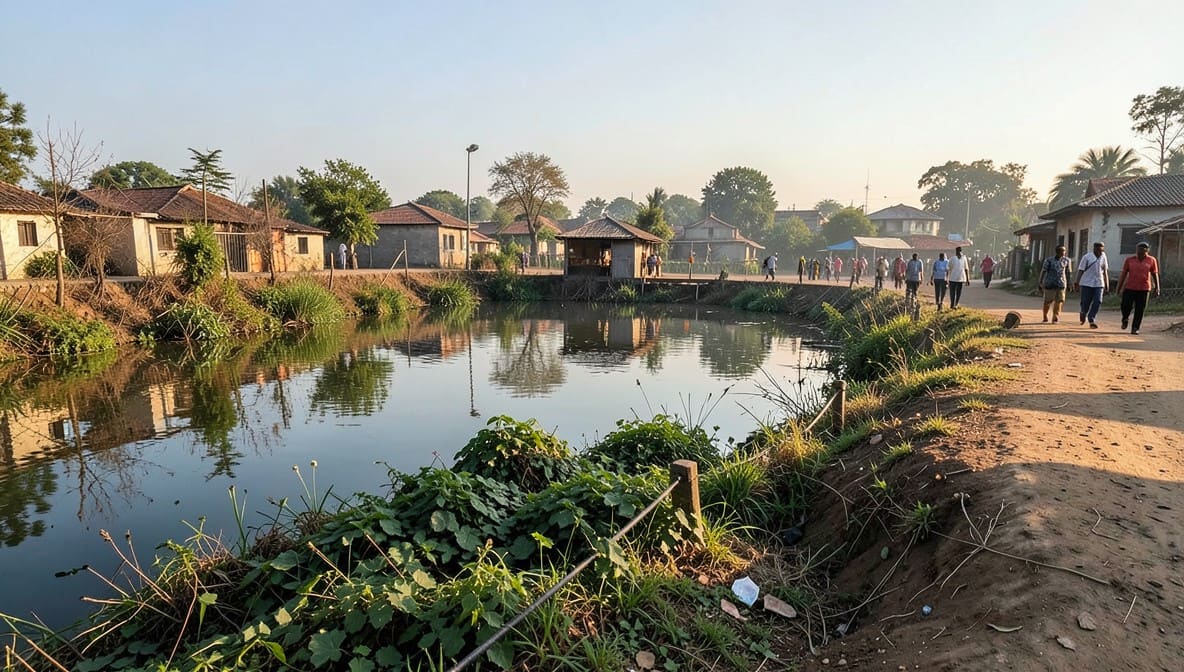
The petitioner, Ful Chand Tiwari, filed a Public Interest Litigation seeking removal of illegal encroachments on public utility land in Village Jagdishpur, Tehsil and District Bhadohi. The land in question is recorded in the revenue records as Pond/Talab, comprising three Khasras: Khasra No. 334/1 (area 1.0120 hectare), Khasra No. 334M (area 0.1930 hectare), and Khasra No. 334M (area 0.379 hectare). The encroachments are alleged to have been made by respondents 5, 6, 7, and 8, who have allegedly constructed structures or otherwise occupied land designated for public use.
Key Facts
- The land is officially recorded as Pond/Talab in the revenue records, indicating its status as public utility land.
- The encroachments are unauthorized and violate the intended public purpose of the land.
- No evidence was presented that the encroachments were lawful or sanctioned by any competent authority.
- The petitioner did not claim personal ownership but invoked public interest in preserving communal land resources.
Procedural History
- 2026: Public Interest Litigation No. 585 of 2026 filed before the Allahabad High Court.
- 23.03.2026: Tehsildar, Bhadohi, issued instructions regarding proceedings under Section 67(1) of the U.P. Revenue Code, 2006, which were placed on record by the Standing Counsel.
- The following 12 cases were registered before the Tehsildar under Section 67(1):
- T202616670504732
- T202616670504733
- T202616670504734
- T202616670504735
- T202616670504736
- T202616670504737
- T202616670504741
- T202616670504743
- T202616670504746
- T202616670504747
- T202616670504749
- T202616670504754
- All cases remain pending as of the date of the judgment.
Relief Sought
The petitioner sought a writ of mandamus directing the respondents to remove the illegal encroachments from the public pond land and restore it to its intended public use.
The Legal Issue
The central question was whether the High Court, in a Public Interest Litigation, can direct a revenue authority to expedite and conclude pending proceedings under Section 67(1) of the U.P. Revenue Code, 2006, for removal of encroachments on land recorded as public pond.
Arguments Presented
For the Petitioner
The petitioner’s counsel, Dharmendra Kumar Pandey and Samsad Ahmed Khan, argued that land recorded as Pond/Talab in revenue records is public utility land protected under the principle of public trust. Unauthorized occupation violates public interest and statutory obligations under the U.P. Revenue Code. The delay in adjudicating the pending cases amounts to administrative apathy and warrants judicial intervention.
For the Respondent
The Standing Counsel for the State of Uttar Pradesh and the Counsel for Gaon Sabha accepted notice and confirmed that proceedings under Section 67(1) had already been initiated. No substantive opposition was raised to the petitioner’s prayer, as the state acknowledged the pendency of the cases and the need for their resolution.
The Court's Analysis
The Court observed that the land in question is explicitly recorded as Pond/Talab in the revenue records, which confers upon it the status of public utility land. The state, as trustee of such land, has a statutory and constitutional duty to protect it from unauthorized occupation. The initiation of proceedings under Section 67(1) of the U.P. Revenue Code, 2006 demonstrates recognition of the illegality of the encroachments. However, the prolonged pendency of twelve cases without final orders raises concerns of administrative inaction.
"The Court cannot permit the continued encroachment of public land merely because proceedings have been initiated but not concluded. The public interest demands timely adjudication."
The Court emphasized that while it generally refrains from interfering in administrative processes, it retains the power to issue directions in PILs where public rights are at stake and there is demonstrable delay. The existence of pending cases under Section 67(1) provides a clear legal pathway for resolution, and the Tehsildar is under a statutory obligation to decide them expeditiously.
The Court further noted that affording opportunity of hearing to the parties is a mandatory procedural requirement under natural justice, and this must be strictly complied with before any order is passed.
The Verdict
The writ petition was disposed of with a direction to the Tehsildar, Tehsil Bhadohi, District Bhadohi, to decide all twelve pending cases under Section 67(1) of the U.P. Revenue Code, 2006, by passing appropriate orders in accordance with law, after affording opportunity of hearing to the parties concerned, within a period of three months from the date of presentation of the certified copy of this order.
What This Means For Similar Cases
Public Pond Land Cannot Be Ignored
- Practitioners must treat land recorded as Pond/Talab in revenue records as inviolable public utility land under the public trust doctrine.
- Any encroachment, regardless of duration or apparent acceptance, is prima facie illegal and subject to removal under Section 67(1).
Judicial Oversight of Administrative Delay
- Courts will intervene in PILs where revenue authorities initiate proceedings but fail to conclude them within a reasonable time.
- A three-month deadline for adjudication sets a clear benchmark for administrative accountability in land encroachment cases.
Procedural Compliance Is Non-Negotiable
-
Every order under Section 67(1) must record compliance with the principles of natural justice, including notice and hearing.
-
Failure to afford hearing renders any order voidable, even if the encroachment is proven.
-
Always verify revenue records for land classification before initiating or defending encroachment proceedings.
-
File PILs where encroachments on public land persist despite pending administrative action.
-
Demand timelines for disposal of pending cases under Section 67(1) in writ petitions to prevent indefinite delay.