High Courts judgments

10232 High Courts judgments explained in plain English: what was decided, the law applied and why it matters. Page 83 of 427.

Reservation Policy | Caste Certificate Submission Deadline Must Be Strictly Followed Without Retrospective Relief : MP HC Indore
Case Law Analysis
|Madhya Pradesh High Court

Reservation Policy | Caste Certificate Submission Deadline Must Be Strictly Followed Without Retrospective Relief : MP HC Indore

MP High Court reinstates an Anganwadi Sahayika whose appointment was cancelled for late caste certificate submission, emphasizing that administrative fairness does not extend to condoning procedural lapses post-deadline. The ruling underscores that reservation eligibility hinges on timely compliance with documentary requirements, protecting merit-based selections from retrospective challenges.

Disability Rights Under Article 14 | Transfer Orders Must Consider Medical Hardship & Pending Representations : MP HC Indore
Case Law Analysis
|Madhya Pradesh High Court

Disability Rights Under Article 14 | Transfer Orders Must Consider Medical Hardship & Pending Representations : MP HC Indore

MP High Court directs reconsideration of a transfer order for a disabled employee, emphasizing that medical hardship of the employee and their dependent spouse, along with pending representations, must be factored into administrative decisions. The ruling reinforces the duty of reasonable accommodation under Article 14 for government employees with disabilities.

BNSS Section 483 | Driver’s Peripheral Role in Exam Fraud Insufficient for Continued Custody; Bail Granted on Socio-Economic Grounds : MP HC Jabalpur
|Madhya Pradesh High Court

BNSS Section 483 | Driver’s Peripheral Role in Exam Fraud Insufficient for Continued Custody; Bail Granted on Socio-Economic Grounds : MP HC Jabalpur

Madhya Pradesh High Court rules that mere facilitative role-such as displaying question papers-without direct fraud or portal creation does not justify prolonged incarceration under BNSS Section 483. Bail granted considering the accused’s socio-economic status, clean antecedents, and lack of evidence tampering risk, reinforcing proportionality in pre-trial detention.

Vindhya Pradesh Land Revenue Act | Collector’s Name in Temple Land Records Invalid Without Determining Private vs Public Temple Status : MP HC Gwalior
|Madhya Pradesh High Court

Vindhya Pradesh Land Revenue Act | Collector’s Name in Temple Land Records Invalid Without Determining Private vs Public Temple Status : MP HC Gwalior

Madhya Pradesh High Court rules that revenue authorities cannot record the Collector’s name in temple land records unless the temple’s status as private or public is first adjudicated. The judgment reinforces that treating temple lands as government property without due process violates property rights under the Vindhya Pradesh Land Revenue Act.

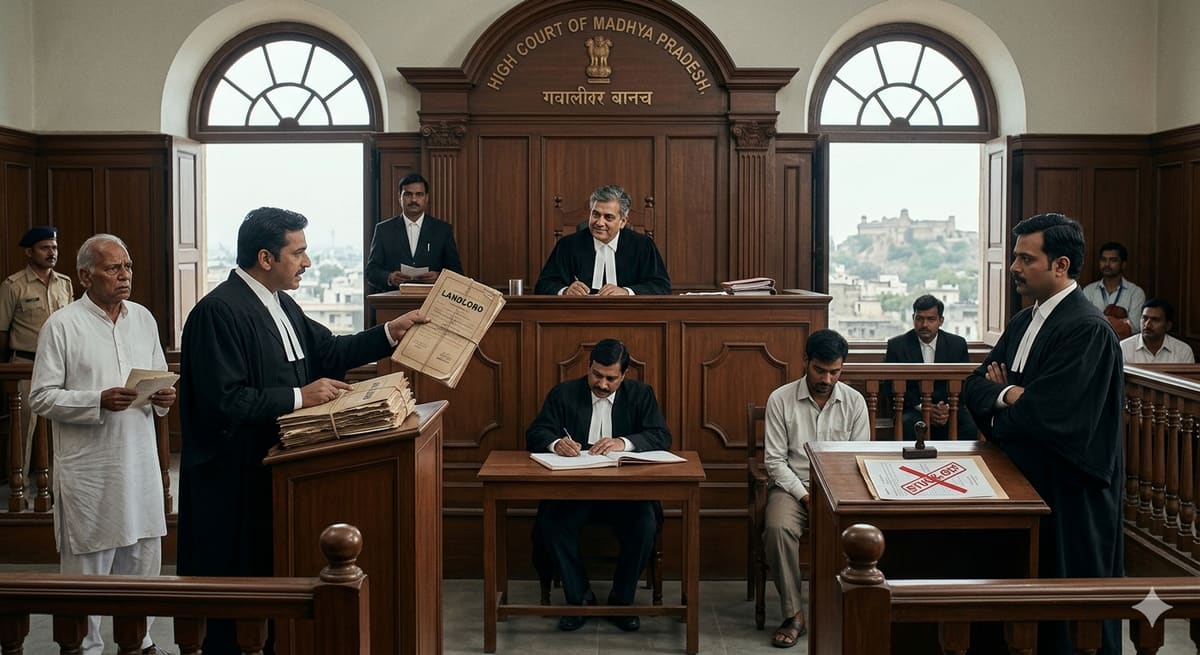
M.P. Accommodation Control Act Section 12 | Plaintiff Must Prove Landlord-Tenant Relationship Even If Defendant's Defence Is Struck Off : MP HC Gwalior
Case Law Analysis
|Madhya Pradesh High Court

M.P. Accommodation Control Act Section 12 | Plaintiff Must Prove Landlord-Tenant Relationship Even If Defendant's Defence Is Struck Off : MP HC Gwalior

The Madhya Pradesh High Court has ruled that under the M.P. Accommodation Control Act, 1961, the burden to establish a landlord-tenant relationship rests solely on the plaintiff - regardless of whether the defendant's written statement is struck off. This clarifies that procedural defaults do not shift the evidentiary burden, protecting tenants from summary eviction without proof of tenancy.

Frequent Transfers Without Replacement Violate Natural Justice | MP HC Stays Transfer of Gram Panchayat Secretary Under Article 226 : MP HC Jabalpur
Case Law Analysis
|Madhya Pradesh High Court

Frequent Transfers Without Replacement Violate Natural Justice | MP HC Stays Transfer of Gram Panchayat Secretary Under Article 226 : MP HC Jabalpur

MP High Court stays the transfer of a Gram Panchayat Secretary after four transfers in one year, ruling that frequent transfers without replacement disrupt administrative fairness and service efficiency. The court directed the authorities to decide the pending representation within 30 days, reinforcing natural justice principles in public employment.

Transfer Policy Violation | Frequent Transfers Without Replacement Violate Natural Justice; HC Stays Order Pending Representation : MP HC Gwalior
Case Law Analysis
|Madhya Pradesh High Court

Transfer Policy Violation | Frequent Transfers Without Replacement Violate Natural Justice; HC Stays Order Pending Representation : MP HC Gwalior

The Madhya Pradesh High Court has stayed the transfer of an Associate Professor after finding that repeated relocations without replacement violate procedural fairness under Article 226. The court mandated a decision on his representation within three weeks, reinforcing that administrative transfers must respect legitimate expectations and institutional continuity, especially when a faculty member is the sole subject expert in their discipline.

Article 21 | Police Must Protect Major Couples in Voluntary Inter-Caste Marriage Against Familial Harassment: MP HC Indore
Case Law Analysis
|Madhya Pradesh High Court

Article 21 | Police Must Protect Major Couples in Voluntary Inter-Caste Marriage Against Familial Harassment: MP HC Indore

The Madhya Pradesh High Court has directed police to safeguard couples in voluntary inter-caste marriages from family-based threats, affirming that personal autonomy under Article 21 overrides societal objections. This ruling reinforces the binding precedent of Lata Singh and Shakti Vahini, mandating immediate police action upon credible threat reports, and empowers couples to approach any station in emergencies.

Section 302 IPC | Fleeing After Pouring Kerosene Establishes Mens Rea for Murder: MP HC Jabalpur
Case Law Analysis
|Madhya Pradesh High Court

Section 302 IPC | Fleeing After Pouring Kerosene Establishes Mens Rea for Murder: MP HC Jabalpur

The Madhya Pradesh High Court held that an accused’s immediate flight after dousing a victim in kerosene and setting her ablaze constitutes conclusive circumstantial evidence of intentional murder under Section 302 IPC. This ruling reinforces that post-offense conduct, when coupled with forensic and eyewitness testimony, can independently establish mens rea beyond reasonable doubt - critical for prosecutors in arson-related homicide cases where direct evidence is scarce.

Section 306 IPC | Bail Granted Pending Appeal After Serving 4.5 Years of 10-Year Sentence Under Section 430 BNSS, Without Prejudging Merits : MP HC Jabalpur
|Madhya Pradesh High Court

Section 306 IPC | Bail Granted Pending Appeal After Serving 4.5 Years of 10-Year Sentence Under Section 430 BNSS, Without Prejudging Merits : MP HC Jabalpur

The Madhya Pradesh High Court granted bail to a convict under Section 306 IPC after he served over four and a half years of a 10-year sentence, suspending the remainder pending appeal under Section 430 BNSS. The ruling affirms that substantial time served, combined with a prima facie meritorious appeal, justifies interim release even in serious offences - reinforcing proportionality and Article 21 rights in post-conviction bail jurisprudence.

BNS Section 483 | Bail Granted Where Sudden Quarrel Lacks Common Intention, Even With Fatal Outcome : MP HC Jabalpur
Case Law Analysis
|Madhya Pradesh High Court

BNS Section 483 | Bail Granted Where Sudden Quarrel Lacks Common Intention, Even With Fatal Outcome : MP HC Jabalpur

The Madhya Pradesh High Court granted bail to an accused in a fatal road dispute, holding that a spontaneous altercation without premeditation negates common intention under BNS, even when death results. This reinforces that bail is not automatically denied in homicide cases where the act arises from unpremeditated conflict, protecting those caught in volatile, non-conspiratorial confrontations.

Interim Order Violation | Failure to Reinstate Employees Until 62 Triggers Salary Liability from Date of Unlawful Stoppage : Andhra Pradesh HC
Case Law Analysis
|Andhra Pradesh High Court

Interim Order Violation | Failure to Reinstate Employees Until 62 Triggers Salary Liability from Date of Unlawful Stoppage : Andhra Pradesh HC

The Andhra Pradesh High Court has ruled that government employers who defy interim orders to continue service until age 62 must pay full salaries from the date of unlawful termination, regardless of employment status. This establishes a critical financial deterrent against judicial defiance and protects both regular and contingent workers from economic harm caused by administrative non-compliance.

BNSS Section 482 | Anticipatory Bail Granted Where No Specific Role Alleged in Civil Dispute: Karnataka HC
Case Law Analysis
|Karnataka High Court

BNSS Section 482 | Anticipatory Bail Granted Where No Specific Role Alleged in Civil Dispute: Karnataka HC

The Karnataka High Court granted anticipatory bail to a woman with no direct involvement in alleged BNS 2023 offences, emphasizing that mere association in a civil dispute does not justify pre-arrest detention. This reinforces that procedural fairness under Article 21 requires concrete allegations of active participation, not passive connection, to sustain custodial pressure in non-violent economic disputes.

Legitimate Expectation | Employment as Compensation for Land Acquisition Under G.O.Ms.No.98/1986 Enforceable; Delay Violates Article 14 : Andhra Pradesh HC
Case Law Analysis
|Andhra Pradesh High Court

Legitimate Expectation | Employment as Compensation for Land Acquisition Under G.O.Ms.No.98/1986 Enforceable; Delay Violates Article 14 : Andhra Pradesh HC

The Andhra Pradesh High Court has ruled that employment promised to displaced families under G.O.Ms.No.98/1986 constitutes legally enforceable compensation, not mere policy. Prolonged inaction breaches the doctrine of legitimate expectation and Article 14, mandating immediate consideration of pending applications by affected dependents.

Section 9 Arbitration Act | Acceptance of Installments Under JDA Preserves Status Quo, Barred Alienation Pending Arbitration: Karnataka HC
Case Law Analysis
|Karnataka High Court

Section 9 Arbitration Act | Acceptance of Installments Under JDA Preserves Status Quo, Barred Alienation Pending Arbitration: Karnataka HC

The Karnataka High Court ruled that accepting Rs. 2.55 crore in instalments under a Joint Development Agreement, despite non-possession, confirms the agreement remains operative. This conduct triggers Section 9 relief to freeze property alienation, ensuring the status quo is preserved for arbitration - a critical precedent for developers and landowners in unresolved JDA disputes.

Acquittal Mandates Return of Seized Funds | BNSS Section 482 | No Confiscation Without Conviction : Karnataka HC
Case Law Analysis
|Karnataka High Court

Acquittal Mandates Return of Seized Funds | BNSS Section 482 | No Confiscation Without Conviction : Karnataka HC

The Karnataka High Court has ruled that seized funds must be returned upon acquittal, even if temporarily transferred under interim orders, because confiscation without a conviction violates the presumption of innocence and the statutory framework under BNSS. This sets a critical precedent for all accused persons whose property is seized during investigation, ensuring financial restitution as a right, not a privilege.

CrPC Section 133 | Cannot Be Invoked for Boundary or Title Disputes Within Municipal Limits; Must Be Resolved Under Karnataka Municipalities Act, 1964 : Karnataka HC
Case Law Analysis
|Karnataka High Court

CrPC Section 133 | Cannot Be Invoked for Boundary or Title Disputes Within Municipal Limits; Must Be Resolved Under Karnataka Municipalities Act, 1964 : Karnataka HC

The Karnataka High Court has ruled that administrative orders under CrPC Section 133 cannot override municipal law by adjudicating property boundary or title claims. Such disputes fall exclusively within the domain of municipal authorities under the Karnataka Municipalities Act, 1964, preventing misuse of criminal procedure for civil land conflicts and clarifying jurisdictional boundaries for local governance.

Industrial Disputes Act Section 33(2)(b) | Labour Commissioner Cannot Decide Merits of Domestic Inquiry; Only Procedural Compliance Is Reviewable : Karnataka HC
Case Law Analysis
|Karnataka High Court

Industrial Disputes Act Section 33(2)(b) | Labour Commissioner Cannot Decide Merits of Domestic Inquiry; Only Procedural Compliance Is Reviewable : Karnataka HC

The Karnataka High Court has ruled that when an employer seeks approval under Section 33(2)(b) of the Industrial Disputes Act to dismiss a workman, the Labour Commissioner’s role is strictly limited to verifying procedural compliance - not evaluating whether the domestic inquiry was fair or justified. This decision reinforces that substantive fairness must be determined by industrial tribunals, not administrative officers, protecting employers from premature merit-based interference and clarifying jurisdictional boundaries in labour disputes.

CPC Order XLIII Rule 1(r) | Appellate Courts Cannot Override Trial Court’s Injunction Denial Where Plaintiff Suppressed Registered Partition Deed : Karnataka HC Dharwad
|Karnataka High Court

CPC Order XLIII Rule 1(r) | Appellate Courts Cannot Override Trial Court’s Injunction Denial Where Plaintiff Suppressed Registered Partition Deed : Karnataka HC Dharwad

The Karnataka High Court quashed an appellate injunction order after finding the plaintiff deliberately concealed a registered partition deed, reaffirming that appellate courts lack authority to substitute the trial court’s discretion unless its decision is perverse or arbitrary. This ruling strengthens procedural integrity in property disputes by penalizing suppression of material evidence and upholding the trial court’s first-hand assessment of prima facie claims.

Anticipatory Bail Granted on Parity with Co-Accused & Omnibus Allegations | BNSS Section 482 : MP HC Gwalior
Case Law Analysis
|Madhya Pradesh High Court

Anticipatory Bail Granted on Parity with Co-Accused & Omnibus Allegations | BNSS Section 482 : MP HC Gwalior

The Madhya Pradesh High Court granted anticipatory bail to a mother-in-law accused in a dowry death case, holding that blanket allegations shared with a co-accused already on bail, without individualized evidence, justify bail under BNSS Section 482. This reinforces that parity and lack of specific culpability can override the gravity of non-bailable offences when investigation risks are absent.

GST Differential Liability in Works Contracts | State Must Reimburse Contractors for Post-Implementation Tax Hike : Karnataka HC
Case Law Analysis
|Karnataka High Court

GST Differential Liability in Works Contracts | State Must Reimburse Contractors for Post-Implementation Tax Hike : Karnataka HC

The Karnataka High Court has ruled that contractors executing state projects must be reimbursed for additional GST liability arising after the GST regime's 2017 rollout, when contracts were originally priced under VAT. This sets a critical precedent for public works contractors nationwide, affirming that fiscal shifts cannot be unilaterally borne by private parties without contractual recourse or state compensation.