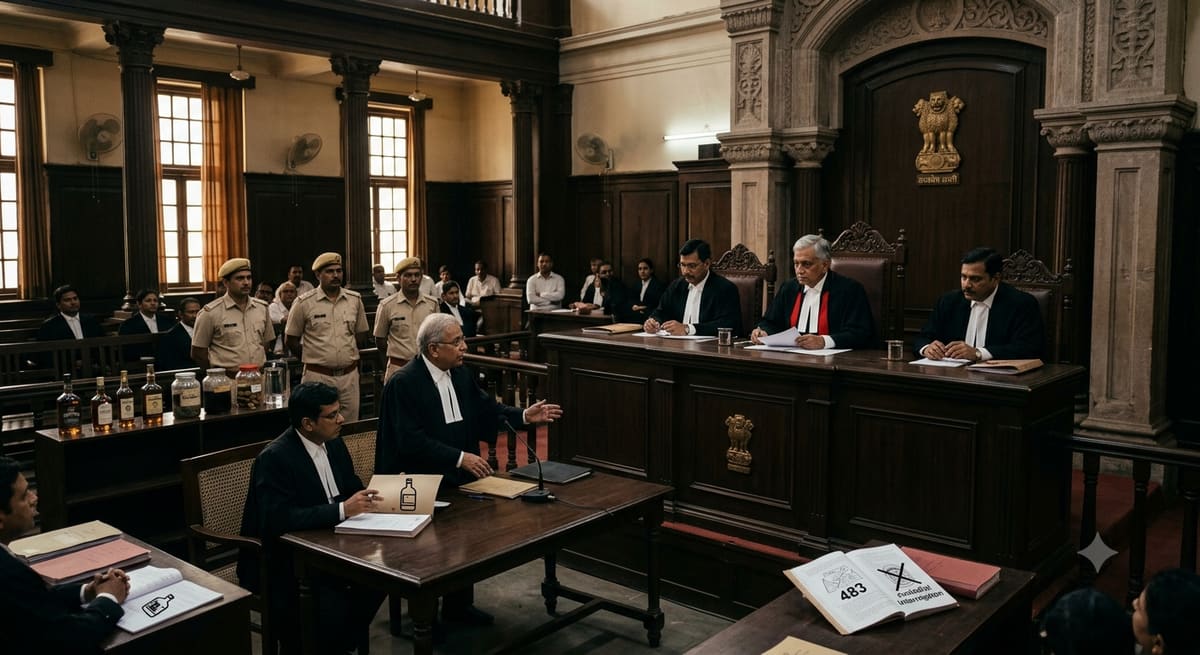
In a significant order under Section 483 of the Bharatiya Nagarik Suraksha Sanhita, 2023, the Madhya Pradesh High Court granted regular bail to an accused in an excise case, emphasizing that the absence of a Forensic Science Laboratory report and the minor quantity of recovered alcohol weakened the prosecution's case. The judgment underscores that prolonged detention without concrete evidence of harm violates the principles of justice, particularly when the trial is likely to be delayed.
Background & Facts
The Dispute
The applicant, Ramji Kurmi, was arrested on 02.05.2026 in connection with FIR/Crime No. 475/2026 registered at Police Station-Motinagar, District-Sagar, Madhya Pradesh. The FIR was lodged for offences punishable under Sections 34 and 49A of the M.P. Excise Act, 1915, which pertain to the possession and sale of illicit alcohol. The applicant has been in custody since his arrest.
Key Facts
- FIR Details: Crime No. 475/2026, registered under Sections 34 and 49A of the M.P. Excise Act, 1915
- Recovery: Only 5 liters of alcohol were seized from the applicant’s possession
- FSL Report: The prosecution failed to produce the Forensic Science Laboratory report, which was crucial to determine whether the recovered alcohol was unfit for human consumption
- Custody: The applicant has been in custody since 02.05.2026
- Criminal Record: The applicant has no prior criminal record
Procedural History
- 02.05.2026: Applicant arrested and taken into custody
- Date of FIR: Not explicitly mentioned, but registered as Crime No. 475/2026
- Earlier Hearing: The Court had previously directed the State to produce the FSL report, but the State failed to comply
- 24.06.2026: Present bail application filed under Section 483 of the Bharatiya Nagarik Suraksha Sanhita, 2023 before the Madhya Pradesh High Court
Relief Sought
The applicant sought regular bail on the grounds that:
- The recovery of only 5 liters of alcohol was minor
- The absence of an FSL report weakened the prosecution’s case
- The applicant had no criminal antecedents
- The trial was likely to take a considerable amount of time
The Legal Issue
The central question before the Court was whether the applicant was entitled to regular bail under Section 483 of the Bharatiya Nagarik Suraksha Sanhita, 2023, given the absence of an FSL report and the minor quantity of alcohol recovered, particularly when the offence under Section 59-A of the M.P. Excise Act is non-bailable.
Arguments Presented
For the Applicant
Learned counsel for the applicant argued that:
- The recovery of only 5 liters of alcohol was insignificant
- The prosecution had failed to produce the FSL report, which was critical to establish that the alcohol was unfit for human consumption
- The applicant had been falsely implicated and had no criminal record
- The trial would take a long time to conclude, and prolonged detention without concrete evidence would be unjust
For the State
Learned counsel for the State opposed the bail application, contending that:
- The offence under Section 59-A of the M.P. Excise Act is non-bailable
- The FSL report was awaited, and its absence did not necessarily weaken the prosecution’s case
- The gravity of the offence warranted denial of bail
The Court's Analysis
The Court conducted a thorough examination of the factual and legal aspects of the case. Key observations included:
-
Absence of FSL Report: The Court noted that the State had failed to produce the FSL report despite an earlier direction. This report was essential to establish whether the recovered alcohol was injurious to human health. The Court observed that, in the absence of such evidence, the prosecution’s case was significantly weakened.
-
Minor Recovery: The Court emphasized that only 5 liters of alcohol were recovered from the applicant’s possession. This minor quantity, coupled with the absence of an FSL report, did not justify keeping the applicant in custody indefinitely.
-
Principle of Justice: The Court reiterated the principle that detention without concrete evidence of wrongdoing violates the fundamental rights of the accused. It held that the applicant could not be kept behind bars without proof that the recovered alcohol was harmful.
-
Trial Delay: The Court acknowledged that the trial was likely to take a considerable amount of time. Prolonged detention without sufficient evidence would be unjust and contrary to the principles of natural justice.
"From the perusal of the case diary, it is clear that no FSL report has been produced. Only 05 liter alcohol has been recovered from the possession of the applicant. At this stage, the applicant cannot be kept behind bars without any concrete evidence that the recovered alcohol was injurious to human health."
The Verdict
The Court allowed the bail application, directing the applicant’s release on furnishing a personal bond of Rs. 50,000 with one surety in the like amount. The Court further directed the applicant to comply with the provisions of Section 480(3) of the Bharatiya Nagarik Suraksha Sanhita, 2023, which pertains to the conditions of bail. The Miscellaneous Criminal Case was disposed of accordingly.
What This Means For Similar Cases
Absence of FSL Report Can Weaken Prosecution’s Case
- Practitioners should emphasize the absence of scientific evidence, such as FSL reports, in bail applications, particularly when the recovery is minor
- Courts may be inclined to grant bail if the prosecution fails to produce critical evidence within a reasonable time
Minor Recovery Alone May Not Justify Prolonged Detention
- In cases involving minor recoveries (e.g., small quantities of alcohol or contraband), the accused may argue that prolonged detention is disproportionate to the alleged offence
- The principle that detention without concrete evidence violates fundamental rights can be a strong ground for bail
Compliance with Bail Conditions Is Non-Negotiable
- The Court’s direction to comply with Section 480(3) of BNSS underscores the importance of adhering to bail conditions
- Failure to comply with such conditions may result in the cancellation of bail, and practitioners should advise clients accordingly