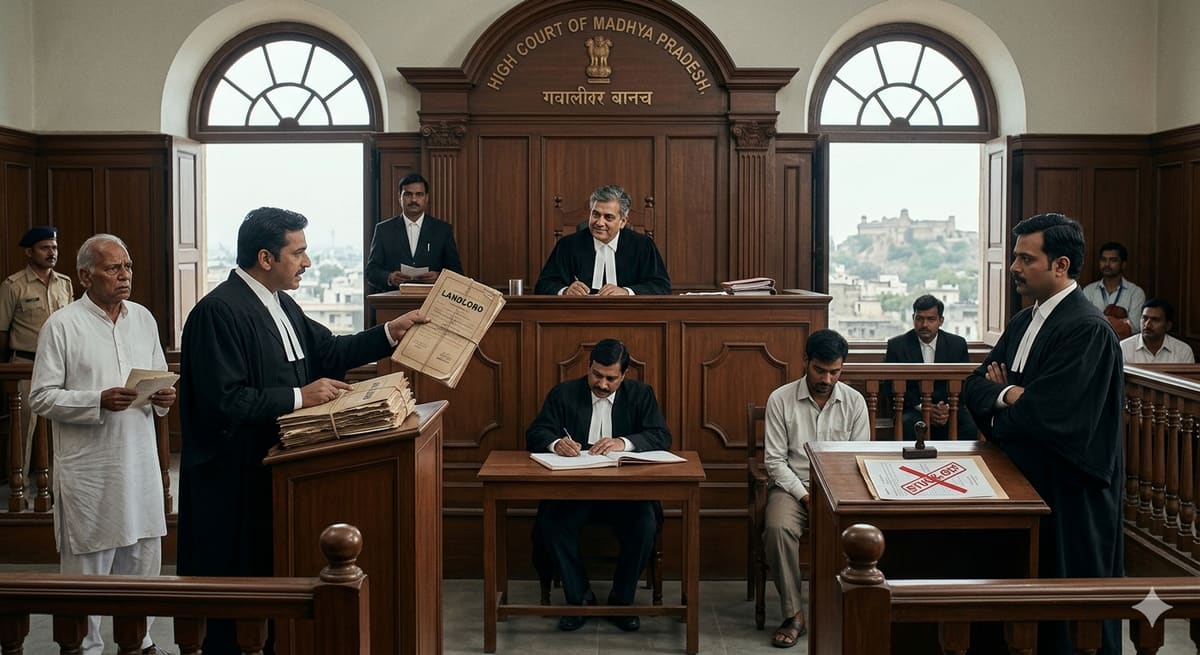
The Madhya Pradesh High Court has reaffirmed that a plaintiff in an eviction suit under the M.P. Accommodation Control Act, 1961 must independently establish the existence of a landlord-tenant relationship, regardless of whether the defendant's defence has been struck off. This judgment clarifies that procedural defaults by the defendant do not relieve the plaintiff of the burden of proving essential facts.
Background & Facts
The Dispute
The appellants, Laxminarayan and others, filed a civil suit for eviction against the respondent, Ganesh Chandra Tiwari, under Sections 12(1)(a), (c), and (e) of the M.P. Accommodation Control Act, 1961. They claimed ownership of a residential-commercial property located at Ward No. 3, Laxmi Gali, Lahar, District Bhind, acquired via a sale deed dated 30.07.1958 from Ramcharan Lal and Dwarka Prasad for Rs. 700. They alleged that the defendant had been in possession as a tenant since January 1996, paying a monthly rent of Rs. 700 for non-residential use.
Key Facts
The suit property was purchased by the plaintiffs’ father, Jiyalal, on 30.07.1958
Tenancy allegedly commenced in January 1996 with monthly rent of Rs. 700
Rent payments were made regularly until January 2001
Plaintiffs claimed bona fide need for the property for the business of Haridas’s son, Anand, aged 14 in January 2001
Defendant stopped paying rent from February 2001 and refused to vacate
Legal notice demanding payment and eviction was issued on 21.11.2006
Suit was filed on 01.03.2007
Defendant denied tenancy, claiming ownership since 1950s through purchase from Dhanlal Kori for Rs. 90
Plaintiffs produced sale deed (Ex. P/1), property tax receipts, electricity bills (Ex. P/14), and tax register
Electricity bill (Ex. P/14) listed property address as Soni Gali, Lahar, not Laxmi Gali as in plaint
Plaintiffs described property as single-storied; defendant’s map showed it as double-storied
Boundaries in sale deed and plaint did not match: e.g., "Babulal Soni" vs. "Babulal Chaudhary"
Procedural History
01.03.2007: Civil Suit No. 3-A/2007 filed before Additional District Judge, Lahar
23.11.2007: Trial Court struck off defendant’s defence under Section 13(6) of the Act, permitting only cross-examination
04.07.2008: High Court dismissed W.P. No. 5720/2007 challenging the strike-off order
08.08.2008: Trial Court dismissed suit, holding no landlord-tenant relationship established
24.06.2026: First Appeal No. 243 of 2008 decided by Madhya Pradesh High Court, Gwalior Bench
The Parties' Positions
Plaintiffs/Appellants: Argued that since the defendant’s defence was struck off, their unrebutted evidence on title and tenancy should have been accepted. They also sought to amend the plaint to claim possession based on title.
Defendant/Respondent: Contended that no landlord-tenant relationship existed, title was not established, and the property description in plaint was materially incorrect.
Relief Sought
The appellants sought reversal of the trial court’s dismissal order, eviction of the defendant, recovery of arrears of rent, and possession of the suit property.
The Legal Issue
Can a plaintiff in an eviction suit under the M.P. Accommodation Control Act, 1961, succeed merely because the defendant’s defence has been struck off, without independently proving the existence of a landlord-tenant relationship and their own title?
Arguments Presented
For the Appellant/Petitioner
Counsel argued that under Modula India v. Kamakshya Singh DEO, once a defence is struck off, the defendant is not rendered helpless, but the plaintiff’s unrebutted evidence must be accepted. They relied on the testimony of PW-1 (Haridas), PW-2 (Narayan Das), and PW-3 (Anand), along with documentary evidence including the sale deed, tax receipts, and electricity bills, to establish title and tenancy. They also contended that the amendment to claim possession based on title, permitted by this Court on 29.04.2011, should have been considered.
For the Respondent/State
Counsel countered that the plaintiffs failed to prove the essential elements of tenancy: creation of tenancy and payment of rent. He highlighted contradictions in property description (Laxmi Gali vs. Soni Gali), mismatched boundaries, incorrect building height, and lack of documentary proof of rent payments. He emphasized that the plaintiffs’ inaction for five years after claiming bona fide need, coupled with the fact that the alleged beneficiary was a 14-year-old child, rendered their claim implausible.
The Court's Analysis
The Court examined the legal position established in Modula India v. Kamakshya Singh DEO (1988) 4 SCC 619, which holds that striking off a defence is a penal measure and must be applied with judicial restraint. The Court emphasized:
"The basic principle that where a plaintiff comes to the court he must prove his case should not be whittled down even in a case where no defendant appears."
It further noted that even in the absence of rebuttal evidence, the court cannot abdicate its duty to independently assess the sufficiency of the plaintiff’s case. The burden of proving landlord-tenant relationship remains on the plaintiff, and this burden cannot be discharged by default.
The Court critically evaluated the oral testimony of the plaintiffs’ witnesses. PW-1 (Haridas) claimed tenancy was created in the presence of PW-2 and PW-3, but neither corroborated this. PW-3 admitted ignorance of the timing of negotiations. No witness from the shop of Ram Kumar (Haridas’s son), where negotiations allegedly occurred, was examined.
The Court found no documentary evidence of rent payments. The electricity bill (Ex. P/14) listed the property in Soni Gali, contradicting the plaint’s assertion of Laxmi Gali. The boundaries in the sale deed and plaint were materially inconsistent. The description of the house as single-storied in the plaint conflicted with the double-storied structure shown in the defendant’s map.
The Court also found the claim of bona fide need suspect: Anand was only 14 years old in January 2001, making the assertion that he required the property for a grocery business implausible. The five-year delay in issuing the legal notice further weakened the claim.
Regarding the amendment to claim possession based on title, the Court distinguished Rabindranath Panigrahi v. Surendra Sahu, noting that case involved concurrent findings of fact under Section 100 CPC, whereas this was a first appeal under Section 96 CPC, where findings of fact are binding unless perverse.
The Court concluded that the trial court’s findings were based on a careful appreciation of evidence and were neither perverse nor erroneous.
The Verdict
The appeal was dismissed. The judgment and decree of the trial court dated 08.08.2008 were upheld. The plaintiffs were not granted eviction or recovery of rent. However, they were expressly permitted to file a separate suit for possession based on title.
What This Means For Similar Cases
Burden of Proof Cannot Be Shifted by Default
Practitioners must understand that striking off a defence under Section 13(6) of the M.P. Accommodation Control Act does not shift the burden of proof to the defendant
Plaintiffs must still prove tenancy and title with cogent evidence, even if the defendant is silent
Oral testimony alone, without corroboration or documentary support, is insufficient
Inconsistencies in Property Description Are Fatal
Mismatched property boundaries, incorrect locality names, or conflicting structural descriptions will undermine the plaintiff’s case
Courts will treat such discrepancies as indicators of lack of genuine possession or fabricated claims
All documents must be internally consistent and match the plaint description
Bona Fide Need Must Be Credible and Timely
Claims of personal or family need must be plausible and supported by contemporaneous action
Delay of five years in seeking eviction after asserting need is fatal to credibility
Use of a minor child as the beneficiary of need, without evidence of business capacity, will be viewed skeptically
Always corroborate tenancy with rent receipts, bank records, or third-party witnesses
Never rely solely on plaintiff testimony in eviction suits
Amend pleadings early; late amendments do not cure defective evidence