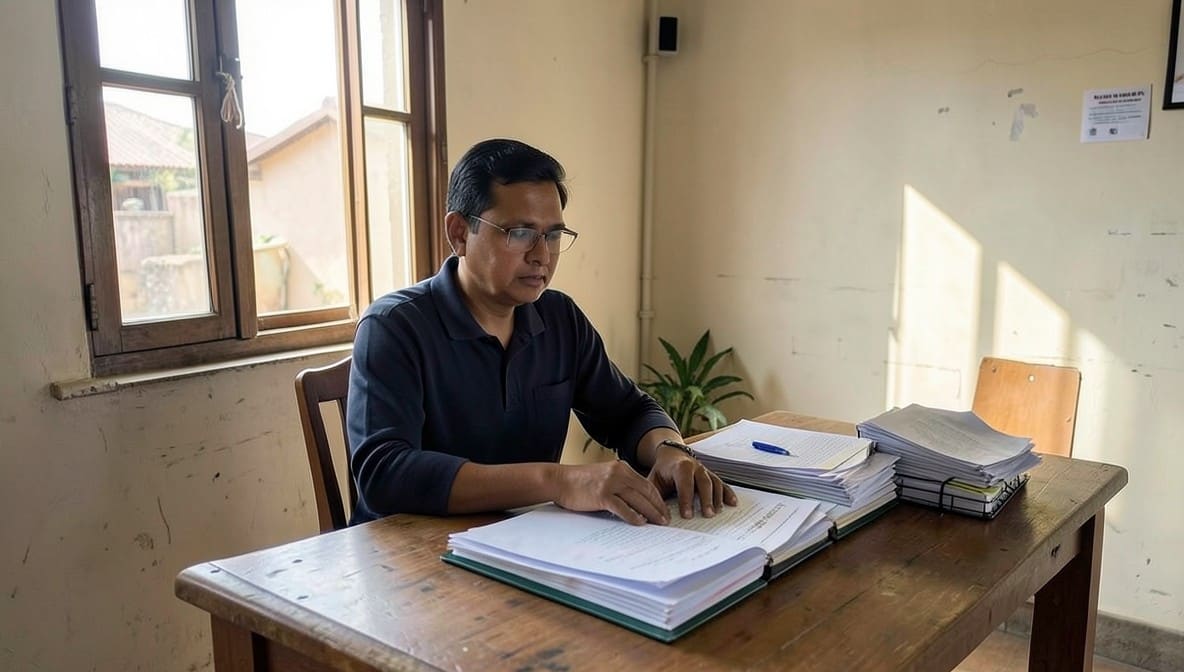
The Madhya Pradesh High Court has intervened to prevent arbitrary administrative transfers of government employees, holding that repeated relocations without replacement or consideration of representation violate the principles of fair service administration. This order reinforces the doctrine that administrative convenience cannot override the rights of public servants to stable tenure and due process.
Background & Facts
The Dispute
The petitioner, Anand Pandey, is a government employee serving as Secretary of the Gram Panchayat at Gadhikarhiya, Janpad Panchayat Pawai, District Panna. He has been subjected to a pattern of frequent transfers, which he alleges are disruptive, unjustified, and motivated by malafide intent. The impugned order, dated 15.06.2026, transferred him from his current posting to Janpad Panchayat Ajaygarh.
Key Facts
- The petitioner has been transferred four times within the last one year prior to the impugned order
- All transfers occurred without any replacement being appointed to his current position
- The petitioner submitted representations challenging the transfers, none of which received a formal decision
- No administrative justification was provided for the transfer dated 15.06.2026
- The petitioner continues to hold the position of Secretary, Gram Panchayat Gadhikarhiya, as no successor has been posted
Procedural History
- 15.06.2026: Impugned transfer order issued by competent authority
- Before 15.06.2026: Multiple prior transfers within the preceding 12 months
- Prior to filing: Petitioner submitted written representations to higher authorities seeking stay and review of transfers
- 24.06.2026: Writ Petition No. 22700 of 2026 filed before the High Court of Madhya Pradesh at Jabalpur
- 24.06.2026: Court heard arguments and reserved order
- 25.06.2026: Order passed staying transfer and directing decision on representation
Relief Sought
The petitioner sought quashing of the impugned transfer order dated 15.06.2026, a direction to cease frequent transfers, and a declaration that his representations must be decided within a reasonable time. He also sought restoration of his posting and a guarantee of tenure stability.
The Legal Issue
The central question was whether frequent transfers of a public servant without replacement or consideration of representation violate the principles of natural justice and reasonable administrative conduct under Article 14 and Article 311 of the Constitution.
Arguments Presented
For the Petitioner
The petitioner’s counsel argued that four transfers in one year, coupled with the absence of any replacement, rendered the transfer order arbitrary and mala fide. He cited State of U.P. v. Raj Narain to emphasize that administrative convenience cannot override the right to fair procedure. He further submitted that the non-decision on representations amounted to denial of hearing, violating the rule of audi alteram partem. The lack of replacement suggested the transfer was punitive or retaliatory, not administrative.
For the Respondent
The Government Advocate did not contest the factual pattern of transfers but requested time to seek instructions from the administrative department. No counter-affidavit or justification for the transfers was filed before the Court.
The Court's Analysis
The Court observed that the petitioner had been transferred four times in a single year, with no indication of replacement in his current post. This pattern, the Court noted, disrupts administrative continuity and undermines the employee’s ability to perform duties effectively. The Court emphasized that while transfer is a legitimate administrative tool, its repeated use without justification or procedural fairness crosses the threshold of arbitrariness.
"The absence of any replacement in the post vacated by the petitioner raises serious questions about the bona fides of the transfer order. When an employee is shifted repeatedly without any administrative necessity, and his representations remain unaddressed, the process becomes a violation of the principles of natural justice."
The Court further held that the failure to decide pending representations, despite their submission, constitutes a breach of the duty to act fairly. The Court declined to adjudicate the merits of the transfer but found sufficient grounds to intervene on procedural grounds.
The Verdict
The writ petition is disposed of with the following directions: The impugned transfer order dated 15.06.2026 is stayed. The petitioner is permitted to continue in his post as Secretary, Gram Panchayat Gadhikarhiya, Janpad Panchayat Pawai, District Panna. The competent authority is directed to decide the petitioner’s pending representation within 30 days from the date of receipt of the certified copy of this order. No costs are awarded.
What This Means For Similar Cases
Transfer Cannot Be Used as a Tool of Harassment
- Practitioners must challenge transfers occurring more than twice in a year without documented administrative necessity
- Evidence of non-replacement after transfer strengthens the case for arbitrariness
- Representations must be formally acknowledged and decided within a reasonable time
Due Process in Administrative Transfers Is Non-Negotiable
- Failure to consider representations violates audi alteram partem
- Courts will intervene even without adjudicating merits if procedural fairness is breached
- Administrative departments must maintain records of transfer justifications for each instance
Tenure Stability Enhances Public Service Efficiency
- Employees must be allowed reasonable time to implement schemes or complete projects
- Frequent rotation without replacement creates administrative vacuum and service gaps
- Courts may issue interim stays to preserve status quo pending decision on representation