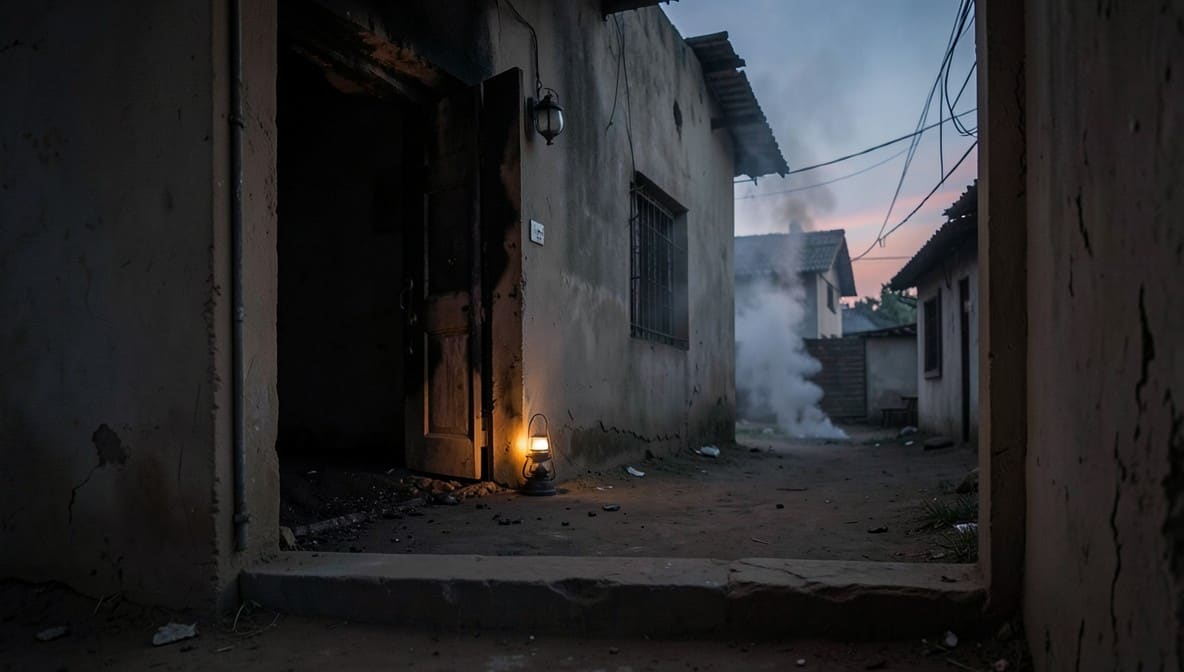
The Madhya Pradesh High Court has affirmed that conduct immediately following a fatal fire - specifically, fleeing the scene without attempting rescue - can independently establish the intention to commit murder under Section 302 IPC, even in the absence of direct eyewitnesses to the act.
Background & Facts
The Dispute
The appellant, Tersingh Yadav, was convicted for the murder of his mother, Gangabai, by pouring kerosene on her and setting her on fire at their residence in Village Boria, Chhindwara district, on 02.02.2013. The prosecution alleged that the appellant acted with premeditated intent to kill, motivated by domestic tensions. The victim, Gangabai, was the mother-in-law of complainant Smt. Indirabai, who resided in the adjacent house.
Key Facts
- The incident occurred on 02.02.2013 at approximately 7:30 p.m.
- Smt. Indirabai heard loud screams from Tersingh’s house and found the door bolted from inside.
- Gangabai was shouting for help but could not be reached due to the locked door.
- Indirabai alerted neighbours Pappu Yadav and Kesu Yadav.
- Upon entry, Gangabai was found engulfed in flames; residents Prakash, Nandu Yadav, and Vijay extinguished the fire using clothes and a quilt.
- Gangabai was admitted to District Hospital, Chhindwara, at 9:40 p.m. on 02.02.2013.
- She died at 1:00 a.m. on 03.02.2013.
- The appellant opened the door after the fire started and fled the scene immediately.
- No alternative explanation for the fire was offered by the accused during trial.
- The deceased had no history of self-harm or accidental exposure to fire.
- The complainant, Indirabai, was the daughter-in-law of the deceased and resided next door.
Procedural History
- 02.02.2013: Incident occurred at approximately 7:30 p.m.
- 02.02.2013: Dehati Nalishi registered at Police Station Kundipura.
- 02.02.2013: First Information Report (Exhibit P/31) registered under Section 307 IPC.
- 03.02.2013 at 1:00 a.m.: Death intimation sent by Dr. L.L. Sahu from District Hospital, Chhindwara.
- 03.02.2013: Zero Merg Intimation registered by Hospital Chowki, Chhindwara.
- 03.02.2013: Merg Report No. 03/13 registered by Police Station Kundipura.
- 03.02.2013: Inquest report (Panchnama) and spot map Panchnama prepared.
- 04.02.2013: Post-mortem examination conducted.
- 15.02.2013: Charge-sheet filed under Section 302 IPC.
- 2013: Trial commenced in Sessions Trial No. 105/2013 before 1st Additional Sessions Judge, Chhindwara.
- 30.12.2013: Trial Court convicted appellant under Section 302 IPC and sentenced him to life imprisonment and a fine of Rs. 1,000/-.
- 2014: Criminal Appeal No. 302 of 2014 filed before the High Court of Madhya Pradesh at Jabalpur.
- 21.08.2025: Oral arguments heard.
- 24.06.2026: Judgment delivered.
The Parties' Positions
For the Appellant
The appellant’s counsel contended that the conviction was based on suspicion and conjecture. He argued that:
- The complainant, Smt. Indirabai, was a suspicious witness due to her indifference to the victim’s welfare despite living next door.
- The prosecution failed to establish motive or prove the appellant’s presence at the time of the act.
- The trial court ignored contradictions in witness statements and failed to explain why the accused would commit such an act without provocation.
- No direct evidence linked the appellant to pouring kerosene.
For the Respondent
The State contended that:
- The appellant’s conduct - fleeing the scene without attempting rescue - was itself incriminating.
- The absence of any alternative explanation for the fire, coupled with the appellant’s exclusive presence at the scene, established guilt beyond reasonable doubt.
- The trial court properly appreciated the circumstantial evidence.
- The victim’s death was not accidental and the appellant’s silence on the cause of fire amounted to an admission.
Relief Sought
The appellant sought quashing of the conviction and sentence under Section 302 IPC, arguing that the trial court erred in relying on suspicion and failing to apply the principle of benefit of doubt. He requested acquittal or, alternatively, reduction of sentence.
The Legal Issue
The central question was whether the conduct of the accused immediately after a fatal fire - fleeing without attempting rescue - can, in the absence of direct evidence, establish the intention to commit murder under Section 302 IPC.
Arguments Presented
For the Appellant
The appellant’s counsel relied on the principle that conviction cannot rest on suspicion alone (State of U.P. v. Krishna Kumar). He argued that the complainant’s testimony was unreliable due to her alleged neglect of the victim, and that the prosecution failed to prove motive or establish the appellant’s presence at the time of the act. He emphasized that the absence of any defence regarding accidental fire did not equate to an admission of guilt.
For the Respondent
The State contended that the appellant’s conduct was the most compelling piece of evidence. He had exclusive access to the premises, was the last person seen with the victim, and fled without rendering aid. The State cited State of Maharashtra v. Suresh to argue that such conduct, when coupled with the totality of circumstances, can form the basis of a conviction under Section 302 IPC.
The Court's Analysis
The Court undertook a meticulous review of the evidence, focusing on the appellant’s actions immediately after the fire. It noted that the accused did not raise any defence that the fire was accidental, nor did he claim that kerosene spilled unintentionally. The Court emphasized that the accused was present at the scene, opened the door only after the fire had taken hold, and fled without attempting to save his mother.
"The conduct of the appellant himself clearly establishes that it was he who poured kerosene on Gangabai and set her on fire."
The Court held that the appellant’s failure to assist, combined with the absence of any plausible alternative explanation, rendered the incident non-accidental. It observed that the victim was elderly, dependent, and had no reason to set herself on fire. The Court further noted that the complainant’s alleged indifference did not invalidate the testimony, as her account was corroborated by multiple independent neighbours who witnessed the scene.
The Court rejected the argument that motive must be proven beyond doubt, citing State of Haryana v. Bhagwan Das that motive is not an essential ingredient of murder under Section 302 IPC, though its presence strengthens the case. The Court concluded that the cumulative effect of the circumstances - presence, opportunity, absence of accident, and flight - established the appellant’s guilt beyond reasonable doubt.
The Verdict
The appeal was dismissed. The High Court upheld the conviction under Section 302 IPC and the sentence of rigorous imprisonment for life and a fine of Rs. 1,000/- with default stipulation. The Court affirmed that the trial court’s findings were based on proper appreciation of evidence and that no grounds existed for interference. All pending applications were disposed of. The record was sent back to the trial court for further proceedings.
What This Means For Similar Cases
Flight After Fire Can Be Conclusive
- Practitioners must treat post-incident conduct as a critical evidentiary factor in arson-related murder cases.
- Absence of rescue attempts, especially by a family member with exclusive access, may be treated as an implied admission of guilt.
- Defence arguments based on witness unreliability must be weighed against objective conduct.
Circumstantial Evidence Can Sustain Conviction
- When direct evidence is lacking, the chain of circumstantial evidence must be complete, consistent, and unbroken.
- The accused’s failure to offer any alternative explanation for the incident strengthens the prosecution’s case.
- Courts will not require proof of motive if the conduct and circumstances overwhelmingly point to intentional homicide.
Burden of Explanation Shifts to the Accused
- Once the prosecution establishes a prima facie case through circumstantial evidence, the accused bears the burden of offering a plausible alternative.
- Silence or refusal to explain suspicious conduct may be construed as an adverse inference under Section 313 CrPC.
- This judgment reinforces that in cases of fatal fires, the absence of accident claims is not merely neutral - it is incriminating.