Chhattisgarh High Court judgments

498 Chhattisgarh High Court judgments explained in plain English: what was decided, the law applied and why it matters. Page 4 of 21.

Section 511 & 450 IPC | Uncorroborated Testimony & Medical Inconclusiveness Vitiate Conviction for Attempt & House Trespass : Chhattisgarh HC
|Chhattisgarh High Court

Section 511 & 450 IPC | Uncorroborated Testimony & Medical Inconclusiveness Vitiate Conviction for Attempt & House Trespass : Chhattisgarh HC

Chhattisgarh High Court sets aside conviction under Sections 511 and 450 IPC, ruling that uncorroborated testimony, inconclusive medical evidence, and admitted enmity between parties create reasonable doubt. The judgment underscores the burden of proof in criminal trials where victim credibility alone is insufficient without independent corroboration.


Central Crop Insurance Portal Registration Mandatory for Claim Enforcement | Writ Jurisdiction Bars Factual Disputes Over Portal Failures : CGHC
Case Law Analysis
|Chhattisgarh High Court

Central Crop Insurance Portal Registration Mandatory for Claim Enforcement | Writ Jurisdiction Bars Factual Disputes Over Portal Failures : CGHC

Chhattisgarh High Court holds that farmers cannot enforce agricultural insurance claims without registration on the Central Crop Insurance Portal, even if premiums were paid. The ruling underscores that writ jurisdiction cannot resolve disputes over administrative lapses in portal registration, shifting the burden of compliance to claimants.

Valid Caste Certificate Triggers Mandatory Scrutiny for School Record Correction | Natural Justice Violated by Refusal : CGHC
Case Law Analysis
|Chhattisgarh High Court

Valid Caste Certificate Triggers Mandatory Scrutiny for School Record Correction | Natural Justice Violated by Refusal : CGHC

The Chhattisgarh High Court ruled that when a minor produces a valid caste certificate, authorities must refer the claim to the District Committee for scrutiny - refusing to do so violates natural justice and deprives children of their future reservation rights. This sets a binding precedent for all educational institutions to act on certified caste claims, not dismiss them on procedural grounds.

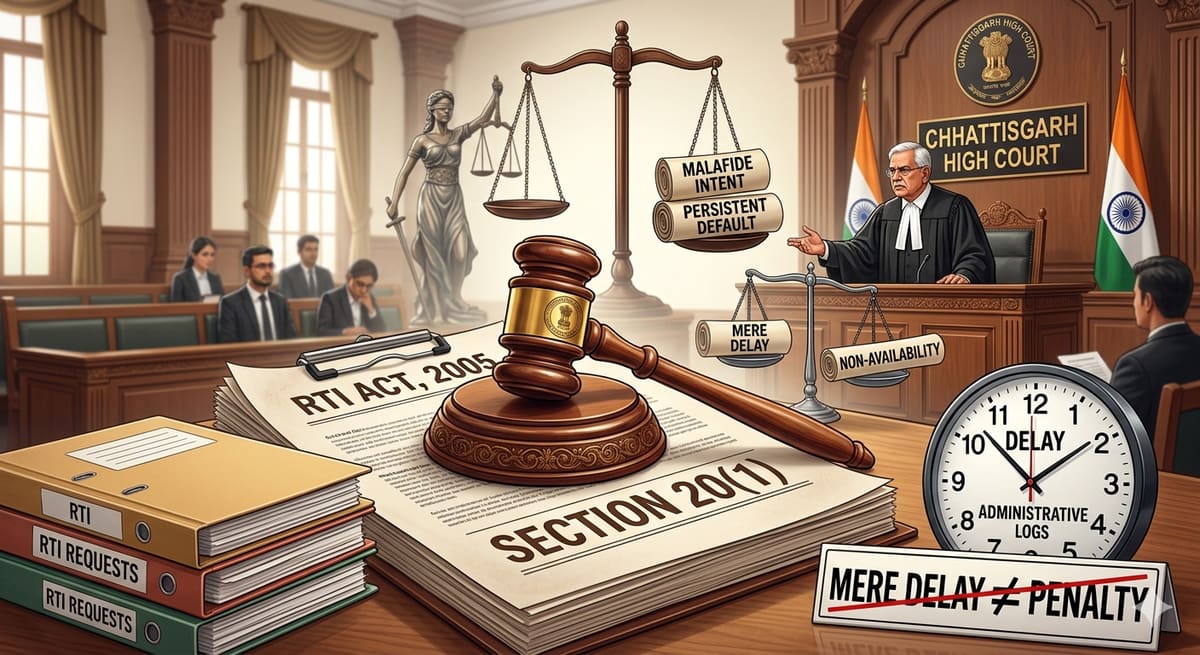
Section 20(1) RTI Act | Penalty Requires Proven Malafide Intent or Persistent Default, Not Mere Delay or Non-Availability : Chhattisgarh HC
Case Law Analysis
|Chhattisgarh High Court

Section 20(1) RTI Act | Penalty Requires Proven Malafide Intent or Persistent Default, Not Mere Delay or Non-Availability : Chhattisgarh HC

The Chhattisgarh High Court has ruled that Public Information Officers cannot be penalized under Section 20(1) of the RTI Act for mere delay or incomplete information unless there is a clear finding of malafide intent or persistent, unreasonable default. This sets a vital safeguard for PIOs acting in good faith and reinforces that procedural lapses alone do not justify financial penalties under the law.

Section 106 BNS | Designation Alone Insufficient for Corporate Liability; Prima Facie Case Established by Systemic Safety Failures : Chhattisgarh HC
Case Law Analysis
|Chhattisgarh High Court

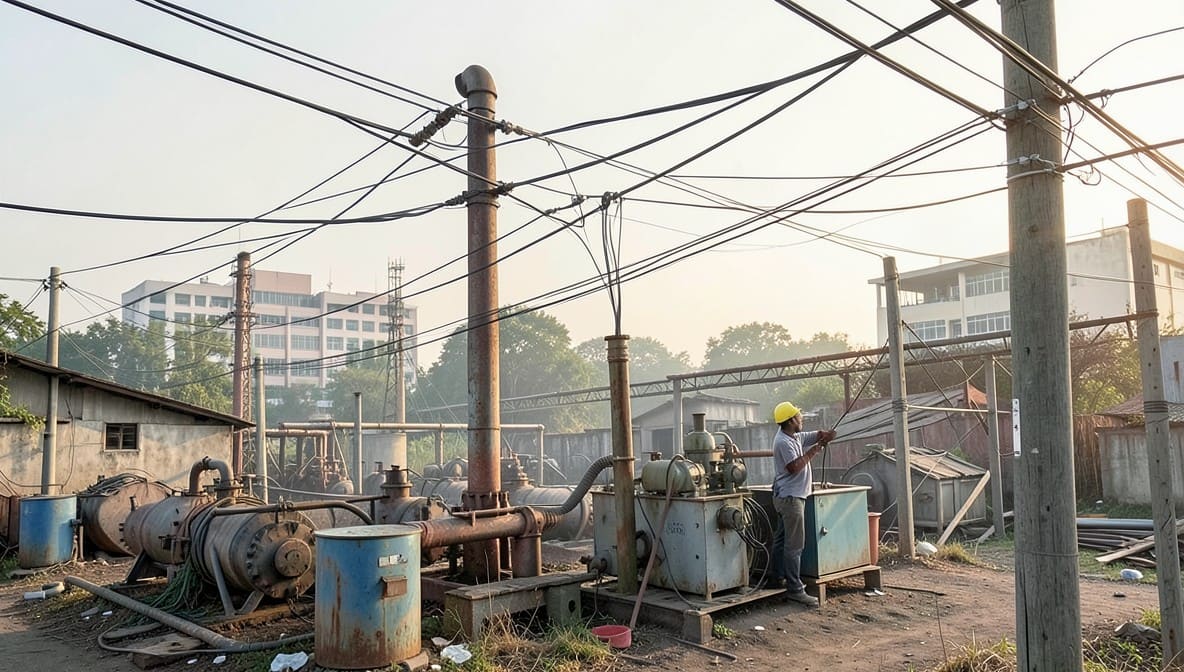
Section 106 BNS | Designation Alone Insufficient for Corporate Liability; Prima Facie Case Established by Systemic Safety Failures : Chhattisgarh HC

The Chhattisgarh High Court ruled that merely naming a director under Section 106 BNS without specific allegations of involvement is inadequate, but when systemic safety failures are documented - such as unguarded high-voltage wiring and unchecked work practices - a prima facie case of negligence arises. This sets a critical precedent for holding corporate leadership accountable not by title, but by demonstrable oversight failures in workplace safety.

Order 6 Rule 17 CPC | Late Amendment Permitted If It Clarifies Defence Without Altering Suit Nature : Chhattisgarh HC
Case Law Analysis
|Chhattisgarh High Court

Order 6 Rule 17 CPC | Late Amendment Permitted If It Clarifies Defence Without Altering Suit Nature : Chhattisgarh HC

The Chhattisgarh High Court ruled that a late amendment under Order 6 Rule 17 CPC is permissible if it merely clarifies an existing defence without altering the suit's fundamental nature. This holding reinforces procedural fairness, allowing amendments even after two years if evidence remains open and no prejudice is caused to the opposing party.

Chhattisgarh Sahukari Act | Licensed Money Lender’s Documentary Evidence of Legitimate Debt Recovery Justifies Anticipatory Bail : Chhattisgarh HC
Case Law Analysis
|Chhattisgarh High Court

Chhattisgarh Sahukari Act | Licensed Money Lender’s Documentary Evidence of Legitimate Debt Recovery Justifies Anticipatory Bail : Chhattisgarh HC

Chhattisgarh High Court rules that a licensed money lender’s documentary proof of lawful transactions and legitimate debt recovery negates automatic denial of anticipatory bail, even in cases of exorbitant interest allegations. The ruling sets a precedent that financial disputes alone do not constitute grounds for arrest under the Chhattisgarh Sahukari Act.

Chhattisgarh Civil Services Pension Rules 1976 | Pre-Absorption Service Must Be Reckoned for Pension as Deferred Compensation : Chhattisgarh HC
Case Law Analysis
|Chhattisgarh High Court

Chhattisgarh Civil Services Pension Rules 1976 | Pre-Absorption Service Must Be Reckoned for Pension as Deferred Compensation : Chhattisgarh HC

The Chhattisgarh High Court ruled that the State's failure to formulate a clear policy on reckoning pre-absorption service of Shikshakarmis for pension violates Articles 14 and 16, as pension is deferred compensation. The court directed the State to include such service in pension calculations, ensuring constitutional equality and fairness for retired employees.

Article 243G Accountability | Mandamus Mandatory for Recovery & FIR on Conclusive Inquiry Report of Public Fund Misappropriation : CGHC
Case Law Analysis
|Chhattisgarh High Court

Article 243G Accountability | Mandamus Mandatory for Recovery & FIR on Conclusive Inquiry Report of Public Fund Misappropriation : CGHC

Chhattisgarh High Court rules that a conclusive inquiry report establishing misappropriation of public funds by Gram Panchayat officials imposes a mandatory duty on authorities to recover the funds and register an FIR. Failure to act violates constitutional accountability under Article 243G, empowering citizens to seek judicial intervention for enforcement of statutory duties.

Article 14 & Service Law | Arbitrary Denial of Pay Scale Benefits After 42 Years of Lawful Service Violates Constitutional Fairness : CGHC Awards Arrears with 12% Interest
Case Law Analysis
|Chhattisgarh High Court

Article 14 & Service Law | Arbitrary Denial of Pay Scale Benefits After 42 Years of Lawful Service Violates Constitutional Fairness : CGHC Awards Arrears with 12% Interest

Chhattisgarh High Court rules that denying pay scale benefits to an employee after 42 years of lawful service-solely on grounds of a non-sanctioned post-is arbitrary and violative of Article 14. The court directed payment of arrears with 12% interest, reinforcing that long-standing service acceptance estops the state from raising technical objections post-retirement.

Criminal Acquittal Voids Civil Demand for Electricity Theft | Section 135 Electricity Act 2003: Chhattisgarh HC
Case Law Analysis
|Chhattisgarh High Court

Criminal Acquittal Voids Civil Demand for Electricity Theft | Section 135 Electricity Act 2003: Chhattisgarh HC

The Chhattisgarh High Court has ruled that when a criminal charge under Section 135 of the Electricity Act is acquitted, any civil demand for recovery of alleged theft charges must be refunded, as civil liability cannot stand without a valid criminal finding. This protects consumers from dual punishment and reinforces that unjust enrichment claims cannot survive the collapse of their criminal foundation.

Legitimate Expectation Under State Rehabilitation Policy Trumps Corporate Policy Changes : Chhattisgarh HC
Case Law Analysis
|Chhattisgarh High Court

Legitimate Expectation Under State Rehabilitation Policy Trumps Corporate Policy Changes : Chhattisgarh HC

The Chhattisgarh High Court ruled that land oustees retain employment rights under the state rehabilitation policy in force at the time of land acquisition, even if subsequent corporate policies attempt to override them. The court held that such changes violate Article 14 and 21, reinforcing the principle of legitimate expectation for displaced families.

Natural Justice in ACR Evaluations | Non-Communication of Adverse Reports Violates Fairness; CGHC Grants Remedy for Uncommunicated 'Poor' Ratings : CGHC
Case Law Analysis
|Chhattisgarh High Court

Natural Justice in ACR Evaluations | Non-Communication of Adverse Reports Violates Fairness; CGHC Grants Remedy for Uncommunicated 'Poor' Ratings : CGHC

Chhattisgarh High Court holds that failure to communicate adverse Annual Confidential Reports (ACRs) deprives employees of the right to representation, vitiating administrative fairness. The court directed authorities to allow the petitioner to seek upgradation of 'Poor' ratings within 30 days, with a decision mandated within 90 days.

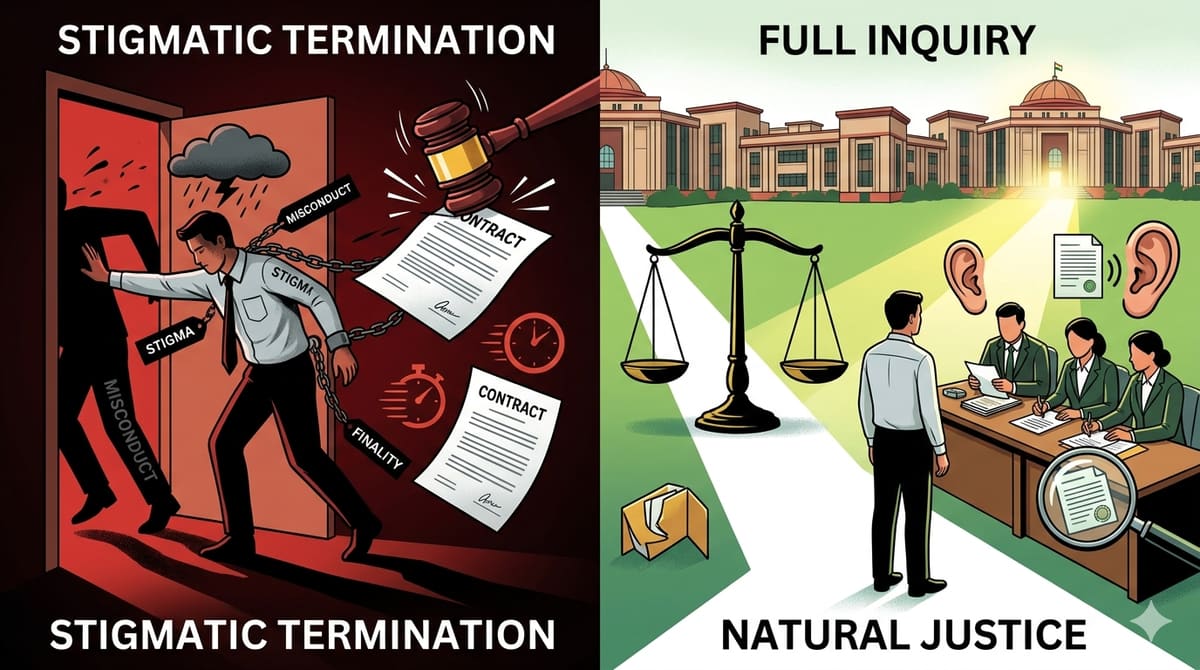
Rule 14 CCA Rules 1966 | Termination Without Inquiry Violates Natural Justice Even for Past Misconduct: CGHC
Case Law Analysis
|Chhattisgarh High Court

Rule 14 CCA Rules 1966 | Termination Without Inquiry Violates Natural Justice Even for Past Misconduct: CGHC

Chhattisgarh High Court rules that absorption into government service triggers full procedural protections under Rule 14 of the CCA Rules, 1966, mandating a formal inquiry before termination-even for misconduct predating regularization. The judgment reinforces that natural justice applies retroactively to past acts once an employee is regularized, protecting government servants from arbitrary dismissal.

Section 49(8) Chhattisgarh Co-op Act | President of Cooperative Society Must Be Elected, Not Nominated; Nomination Violates Democratic Mandate : CGHC
Case Law Analysis
|Chhattisgarh High Court

Section 49(8) Chhattisgarh Co-op Act | President of Cooperative Society Must Be Elected, Not Nominated; Nomination Violates Democratic Mandate : CGHC

The Chhattisgarh High Court has ruled that appointing a cooperative society president through nomination instead of election violates Section 49(8), which mandates a democratic process. This decision binds all cooperative societies in the state to conduct transparent elections within 90 days, reinforcing member rights and administrative accountability under cooperative law.

Chhattisgarh Land Revenue Code, Section 165(6) | Collector Must Decide Land Sale Applications Within 60 Days to Avoid Violating Right to Livelihood Under Article 21 : CGHC
Case Law Analysis
|Chhattisgarh High Court

Chhattisgarh Land Revenue Code, Section 165(6) | Collector Must Decide Land Sale Applications Within 60 Days to Avoid Violating Right to Livelihood Under Article 21 : CGHC

The Chhattisgarh High Court has ruled that prolonged administrative inaction on land sale applications by Collectors violates the right to livelihood under Article 21, mandating a 60-day deadline for decision-making. This binds revenue authorities across the state and offers immediate relief to small landholders facing financial distress due to bureaucratic delay.

Third Time-Bound Pay Scale Entitlement After 30 Years | Patwari’s Legitimate Expectation Upheld Under State Circulars : CGHC
Case Law Analysis
|Chhattisgarh High Court

Third Time-Bound Pay Scale Entitlement After 30 Years | Patwari’s Legitimate Expectation Upheld Under State Circulars : CGHC

The Chhattisgarh High Court has ruled that a Patwari with over 30 years of service is entitled to the third time-bound pay scale under state circulars, affirming legitimate expectation and binding precedent from prior rulings. This decision mandates prompt adjudication of such claims and sets a clear standard for equitable pay progression in state-level revenue service roles.

Section 21(g) ART Act 2021 | Rigid Age Cap on Husband Cannot Deny IVF to Medically Eligible Wife : Chhattisgarh HC
Case Law Analysis
|Chhattisgarh High Court

Section 21(g) ART Act 2021 | Rigid Age Cap on Husband Cannot Deny IVF to Medically Eligible Wife : Chhattisgarh HC

The Chhattisgarh High Court ruled that mechanically applying the husband's age limit under Section 21(g) of the ART Act 2021 to deny IVF to a medically fit wife violates her fundamental right to reproductive autonomy under Article 21. The order mandates the fertility clinic to proceed with treatment, shields it from liability, and permits continuation even if the wife reaches 50 during the process, setting a precedent for individualized medical assessment over statutory rigidity.