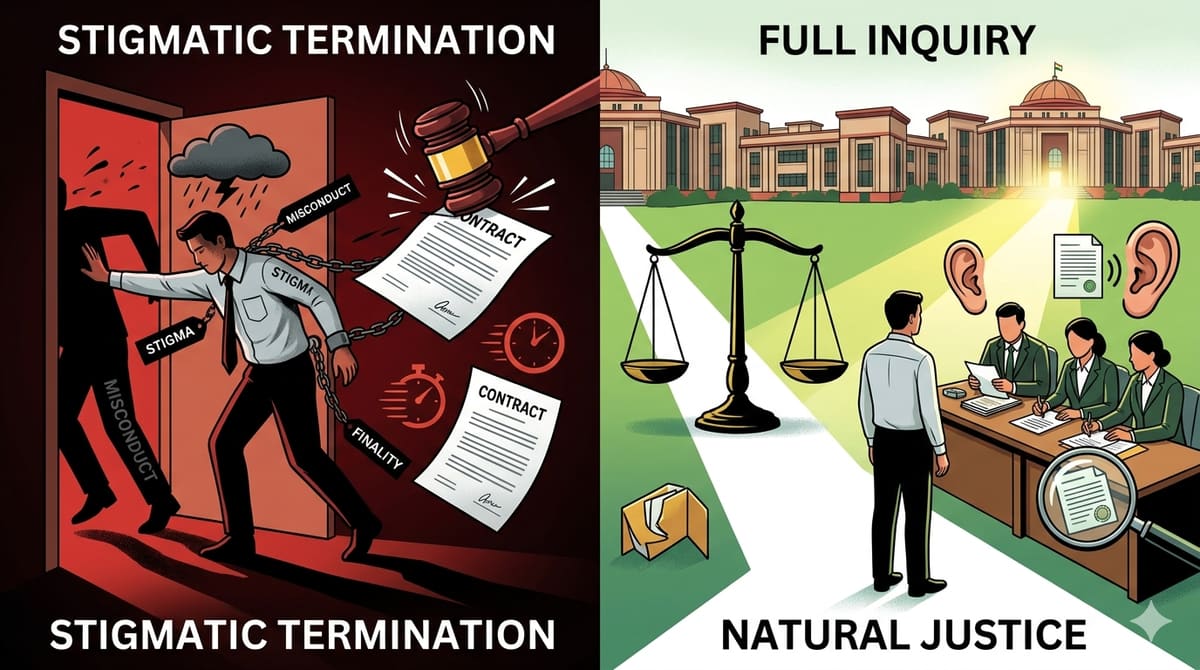
The Chhattisgarh High Court has reaffirmed that termination of a government servant on grounds of alleged document forgery without a formal disciplinary inquiry under the Central Civil Services (Conduct) Rules, 1966, violates fundamental principles of natural justice. This judgment underscores the non-negotiable procedural safeguards required even in cases involving serious allegations of fraud in appointment.
Background & Facts
The Dispute
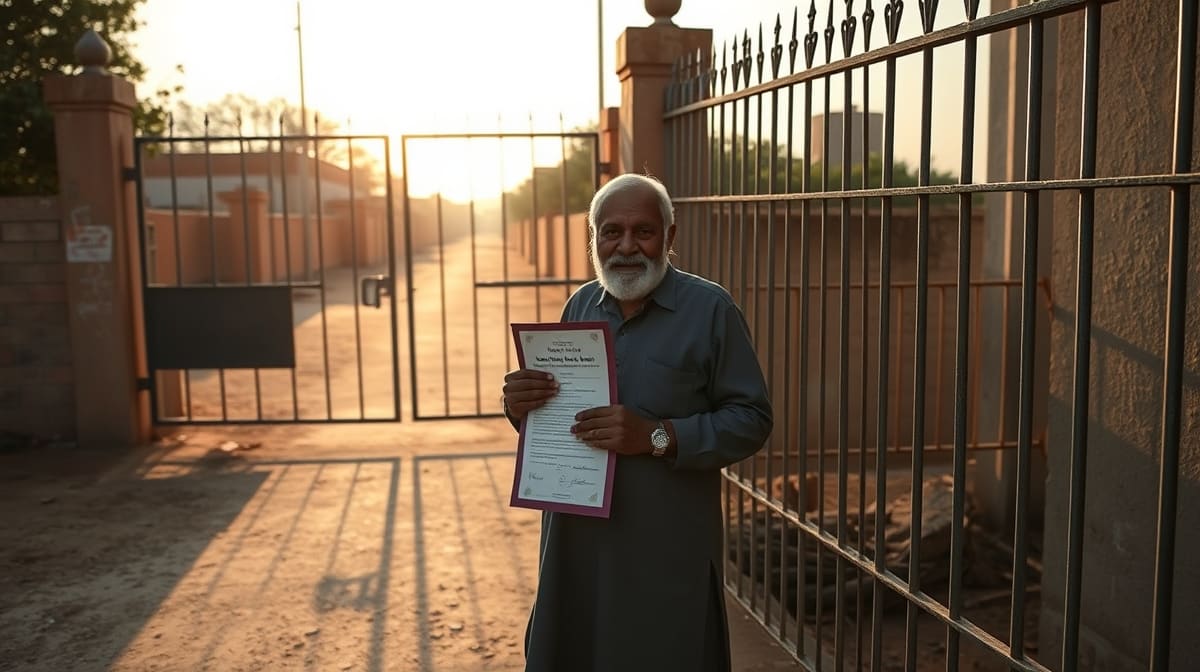
The petitioner, Gajanand Gajendra, a 77-year-old assistant teacher, was appointed as a Shiksha Karmi Grade-III on 29.06.2007 based on his D.Ed. mark sheet. His services were regularized on 25.09.2009 and later merged into the School Education Department on 10.08.2018, thereby acquiring the status of a civil servant under the CCA Rules, 1966. On 31.03.2022, a show cause notice was issued alleging that the D.Ed. mark sheet submitted at the time of initial appointment was forged. The petitioner submitted a reply. On 20.04.2022, his services were terminated without any inquiry, inquiry report, or opportunity to defend himself.
Key Facts
- Appointed as Shiksha Karmi Grade-III on 29.06.2007 on the basis of D.Ed. mark sheet
- Services regularized on 25.09.2009
- Absorbed into School Education Department on 10.08.2018
- Acquired civil servant status upon absorption
- Show cause notice issued on 31.03.2022 alleging forged D.Ed. mark sheet
- Petitioner submitted written reply to the show cause notice
- Termination order passed on 20.04.2022 without any inquiry
- No verification of the mark sheet was conducted by the Department at the time of appointment or regularization
Procedural History
- 29.06.2007: Initial appointment as Shiksha Karmi Grade-III
- 25.09.2009: Regularization of services
- 10.08.2018: Absorption into School Education Department
- 31.03.2022: Show cause notice issued
- 20.04.2022: Termination order passed without inquiry
- 22.04.2022: Impugned order dated (likely administrative confirmation of termination)
- 28.04.2026: Writ petition decided by the High Court
The Parties' Positions
Petitioner’s Position: The petitioner argued that as a civil servant absorbed into the School Education Department, he was governed by the CCA Rules, 1966. Termination without a formal inquiry under Rule 14 violated his right to fair procedure and natural justice. He emphasized that the Department had not verified his documents at the time of appointment or regularization, and could not now use alleged forgery as a pretext to bypass statutory safeguards.
Respondents’ Position: The State did not contest the petitioner’s status as a civil servant but relied on the alleged forgery to justify termination. No evidence of an inquiry, charge sheet, or opportunity to be heard was presented before the Court.
Relief Sought
The petitioner sought quashing of the termination order dated 20.04.2022, reinstatement with all consequential benefits, and costs.
The Legal Issue
The central question was whether Rule 14 of the Central Civil Services (Conduct) Rules, 1966, mandates a formal disciplinary inquiry before terminating a civil servant on grounds of alleged document forgery, even if the misconduct occurred at the time of appointment.
Arguments Presented
For the Petitioner
The petitioner’s counsel relied on K. Sankaran v. State of Tamil Nadu and State of U.P. v. Mohd. Noor, emphasizing that once a person is absorbed into government service, they are entitled to the full protection of the CCA Rules, 1966. The failure to conduct an inquiry, even in cases of alleged fraud at the time of appointment, renders the termination void. The Department’s own negligence in not verifying documents at the time of appointment could not be used to circumvent procedural safeguards.
For the Respondent
The State did not present any substantive legal argument before the Court. No inquiry report, charge sheet, or evidence of compliance with Rule 14 was produced. The counsel merely opposed the petition on the basis of the alleged forgery without addressing the procedural defect.
The Court's Analysis
The Court observed that the petitioner had been absorbed into the School Education Department on 10.08.2018, thereby becoming a civil servant under the CCA Rules, 1966. The Court held that the status of a civil servant cannot be stripped away by a mere administrative order based on allegations of past misconduct, especially when no inquiry was conducted.
"It is well settled that a civil servant cannot be dismissed or removed without an inquiry in accordance with the provisions of Rule 14 of the CCA Rules, 1966. The fact that the alleged misconduct occurred at the time of appointment does not absolve the authority from following due process."
The Court noted that the Department had not verified the D.Ed. mark sheet at the time of appointment in 2007 or during regularization in 2009. The lapse of over a decade before initiating action indicated that the termination was not prompted by genuine administrative concern but by arbitrary exercise of power. The Court further held that the show cause notice alone, without an inquiry, does not satisfy the requirements of natural justice.
The Court rejected the notion that forgery at the time of appointment renders the entire service void ab initio, stating that such a doctrine cannot override statutory procedural protections unless explicitly provided by law.
The Verdict
The termination order dated 20.04.2022 is quashed. The respondent authorities are directed to initiate a fresh disciplinary inquiry strictly in accordance with Rule 14 of the CCA Rules, 1966, and complete the entire process within 90 days. If the petitioner is found innocent, he shall be entitled to all consequential benefits, including pay, allowances, and pensionary benefits, from the date of termination. No costs are awarded.
What This Means For Similar Cases
Procedural Compliance Is Non-Negotiable
- Practitioners must insist on strict compliance with Rule 14 of the CCA Rules, 1966, even in cases involving alleged fraud at the time of appointment
- A show cause notice alone is insufficient; a formal inquiry with charge sheet, opportunity to defend, and reasoned order is mandatory
- Negligence by the department in verifying documents at the time of appointment cannot be used to bypass statutory safeguards
Absorption Confers Civil Servant Status
- Once a contractual or temporary employee is absorbed into a regular government post, they acquire the full protections of the CCA Rules
- The date of absorption, not the date of initial appointment, triggers the applicability of disciplinary procedures
- Past misconduct cannot be used to justify summary termination without due process
Delay in Action Undermines Allegations
- Delay of over a decade in initiating action against alleged forgery weakens the credibility of the charge
- Courts will view such delays as indicative of mala fide or arbitrary intent
- Practitioners should highlight delay as a factor in challenging termination orders