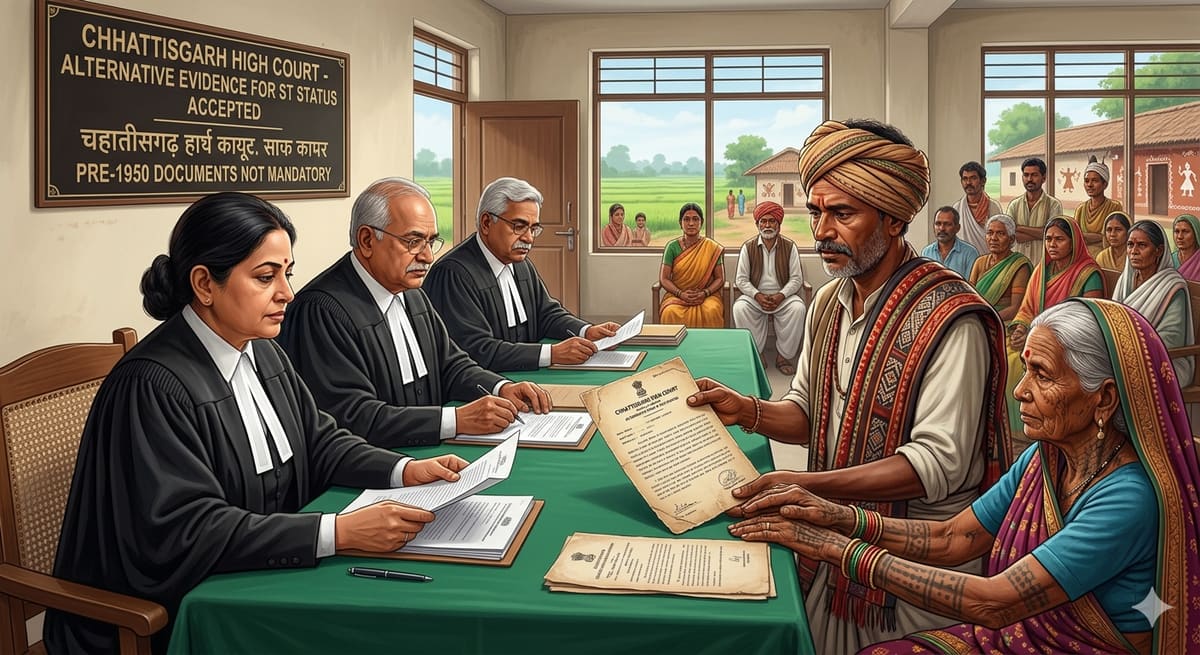
The Chhattisgarh High Court has clarified that the requirement of producing land or other records prior to 1950 cannot be a mandatory precondition for verifying Scheduled Tribe caste certificates under the state’s certification rules. This ruling affirms that procedural rigidity must yield to substantive proof of caste identity and longstanding residence, particularly where documentary evidence is genuinely unavailable.
Background & Facts
The Dispute
The petitioners, Rahul Chandra and Diksha Chandra, siblings and permanent residents of Bilaspur, Chhattisgarh, sought verification of their Scheduled Tribe (Gond) caste certificates to avail of reservation benefits in competitive examinations and government employment. Their father, appointed in 1989 under the ST quota in what was then the Madhya Pradesh Water Resources Department (now Chhattisgarh), had been recognized as an ST candidate. The petitioners were born and raised in Chhattisgarh and hold valid domicile certificates issued by the Tahsildar, Bilaspur. A permanent caste certificate was issued to them by the Sub-Divisional Officer, Bilaspur, on 02.07.2011.
Key Facts
Petitioner No.1 (Rahul Chandra) was born on 22.08.1993; Petitioner No.2 (Diksha Chandra) on 27.07.1994, both in Bilaspur, Chhattisgarh
Father’s employment under ST quota began in 1989 in the Hasdeo Basin, Water Resources Department (now Chhattisgarh)
Caste certificate issued on 02.07.2011 by Sub-Divisional Officer, Bilaspur
Domicile certificates issued by Tahsildar, Bilaspur
Ancestral roots trace to Bhopal, Madhya Pradesh, but petitioners have resided exclusively in Chhattisgarh since birth
Application for caste verification submitted to District Level Caste Scrutiny Committee, Bilaspur
No decision rendered for over seven months despite submission of all available documents
Procedural History
2020 - 2021: Application pending before District Level Caste Scrutiny Committee
07.04.2021: WPC No.1977 of 2021 disposed of by this Court directing the Committee to decide within two months
13.04.2021: District Level Caste Scrutiny Committee issued order (Annexure P/2) rejecting verification on grounds that ancestral records pre-1950 from Madhya Pradesh were unavailable
31.01.2022: Additional Commissioner, Bilaspur Division, upheld the rejection in Appeal Case No.47/B-121/2020-21 (Annexure P/1)
20.04.2022: Writ Petition No.2041 of 2022 filed before the Chhattisgarh High Court
Relief Sought
The petitioners sought:
Quashing of the orders dated 13.04.2021 and 31.01.2022
Direction to the District Level Caste Scrutiny Committee to verify their caste certificate without insisting on documents prior to 1950
Any other relief deemed just in the interest of equity
The Legal Issue
The central question was whether the Chhattisgarh Scheduled Castes, Scheduled Tribes & Other Backward Classes (Regulation of Social Status Certification) Rules, 2013 permit denial of caste certificate verification solely on the ground of absence of documents prior to 1950, despite the petitioner’s lifelong residence in the state and possession of other corroborative evidence.
Arguments Presented
For the Petitioner
Learned counsel argued that:
The Rules 2013 do not mandate documents prior to 1950 as a sine qua non
The State Government has issued circulars explicitly stating that such documents are not essential
The petitioners have valid domicile and prior caste certificates, and their father’s employment under ST quota since 1989 establishes longstanding ST identity
The Committee’s inaction for seven months violated the right to equality and reasonable opportunity under Article 14 and Article 16
This Court’s earlier ruling in Kiran Mesharm v. State of Chhattisgarh (WPC No.2102 of 2020) had already held that records prior to 1950 are not indispensable and that alternative evidence and inquiry must suffice
For the Respondent
The State counsel did not dispute the legal proposition advanced by the petitioners. No substantive counter-arguments were presented to justify the rigid insistence on pre-1950 documents.
The Court's Analysis
The Court examined the Chhattisgarh Scheduled Castes, Scheduled Tribes & Other Backward Classes (Regulation of Social Status Certification) Rules, 2013, particularly the procedural framework for verification. It noted that the Rules contemplate a flexible, inquiry-based approach rather than a rigid document-centric regime. The Court relied on its own precedent in Kiran Mesharm v. State of Chhattisgarh, where it had held:
"...ends of justice would meet, if the petitioner is directed to approach the Respondent No. 2 again and submit her Inability Certificate if she does not have the documents prior to 1950 and at the same time the petitioner would also produce records that she has in her possession to establish her caste status."
The Court emphasized that caste identity is not a static, archival relic but a lived social reality. The petitioners’ birth, upbringing, domicile, and familial employment history in Chhattisgarh constitute compelling evidence of their ST status. The insistence on pre-1950 documents from Madhya Pradesh, where the petitioners’ ancestors resided but they themselves never did, was deemed arbitrary and contrary to the spirit of the Rules.
The Court further observed that the State’s own circulars and administrative guidelines have consistently relaxed this requirement, making the Committee’s refusal legally untenable. The delay of seven months in deciding the application compounded the violation of the petitioners’ rights.
The Verdict
The writ petition was allowed. The orders dated 13.04.2021 and 31.01.2022 were set aside. The District Level Caste Scrutiny Committee is directed to consider the petitioners’ application upon submission of an Inability Certificate regarding pre-1950 documents and any other available records. The Committee shall complete its verification and issue a decision within 60 days of receipt of the application. The petitioners’ right to claim reservation benefits shall not be prejudiced during this period.
What This Means For Similar Cases
Documents Prior to 1950 Are Not Mandatory
Practitioners must challenge any denial of caste certificates based solely on absence of pre-1950 documents
The burden shifts to the verifying authority to conduct a substantive inquiry using alternative evidence
Domicile certificates, prior caste certificates, employment records, and community affidavits are sufficient to establish caste identity
Inquiry, Not Documentation, Is the Standard
Verification committees must follow the inquiry-based methodology under Rules 2013, not a checklist approach
An Inability Certificate must be accepted as a valid substitute for missing documents
Delay in decision-making beyond statutory timelines constitutes a violation of Article 14 and must be remedied by writ
State Circulars Bind Administrative Authorities
Administrative circulars issued by the State Government on caste verification are binding on subordinate committees
Non-compliance with such circulars renders orders liable to be quashed
Practitioners should always cite relevant circulars alongside statutory rules in petitions