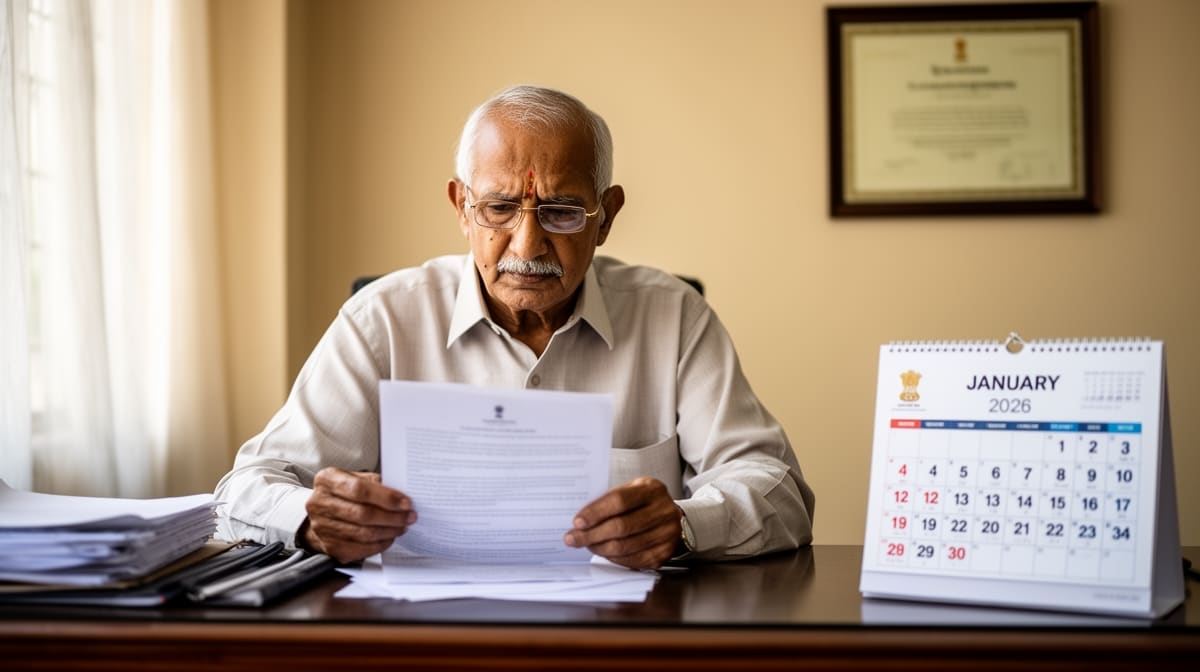
The Chhattisgarh High Court has directed the State to formulate a clear, reasoned, and constitutionally compliant policy on whether service rendered by Shikshakarmis prior to their absorption into the School Education Department must be counted for pension under the Chhattisgarh Civil Services (Pension) Rules, 1976. This judgment reaffirms that pension is deferred compensation and that systemic ambiguity in service reckoning violates Articles 14 and 16 of the Constitution.
Background & Facts
The Dispute
The petitioners, numbering over 30, were initially appointed as Shikshakarmis (teaching assistants) under Janpad Panchayats and Municipal Corporations in Chhattisgarh, some as early as 1998. They performed teaching duties in government schools, were paid from public funds, and operated under the administrative and disciplinary control of State authorities. Their services were regularized under applicable rules and, on 01.07.2018, they were absorbed into the newly created cadre of Teachers (Local Body) under the School Education Department.
Key Facts
- The petitioners served continuously as Shikshakarmis from dates ranging between 1998 and 2010, with no break in service
- Their salaries were paid through Panchayat funds but under State supervision and for public educational purposes
- On 30.06.2018, the State issued a policy (Annexure P/1) absorbing eligible Shikshakarmis with 8 years of service as of 01.07.2018 into the regular cadre
- Clause 4 of the policy stated: "Service shall be reckoned only from the date of absorption i.e. 01.07.2018"
- Clause 6 mandated application of the New Contributory Pension Scheme, excluding the Old Pension Scheme under the Rules of 1976
- On 24.06.2024, a subsequent order (Annexure P/2) reiterated that past service would not be counted for pension eligibility
- Several petitioners retired after 2020, including one on 31.07.2023, yet were denied pension benefits based on pre-absorption service
- The State had previously restored the Old Pension Scheme via Gazette Notifications dated 11.05.2022 and 20.01.2023, but these did not clarify the reckoning date for absorbed employees
Procedural History
- 1998 - 2010: Petitioners appointed as Shikshakarmis under Panchayats
- 01.07.2018: Absorption into School Education Department as Teachers (Local Body)
- 30.06.2018: State issues policy restricting service reckoning to 01.07.2018 and imposing New Pension Scheme
- 2020: Similarly situated employees filed WPS No.4828/2020; disposed of on 17.12.2020 with direction to consider representations
- 05.10.2021: Representations rejected mechanically by authorities
- 2021: WPS No.777/2021 filed by other petitioners on identical grounds
- 17.02.2026: Single Judge of Chhattisgarh HC in WPS No.777/2021 issued directions requiring State to formulate a reasoned policy on reckonable service
- 2026: State filed WA No.325/2026 against the 17.02.2026 order
- 2026: Division Bench dismissed WA No.325/2026, affirming the Single Judge’s directions
- 2024: Present batch of writ petitions (WPS No.7714/2024, WPS No.8475/2024, WPS No.674/2025) filed by petitioners seeking inclusion of pre-absorption service
The Parties' Positions
The petitioners are former Shikshakarmis now absorbed as Teachers (Local Body), including retired employees. They contend that their entire service, from initial appointment, qualifies as continuous government service under State control and must be counted for pension under the Rules of 1976. They argue that the policy’s exclusion of pre-absorption service is arbitrary, discriminatory, and violates the principle that pension is deferred wages.
The State, represented by the Secretary, School Education Department, and other officials, contends that Shikshakarmis were not regular government servants prior to absorption, their service was under local bodies, and the New Pension Scheme applies to all employees absorbed after the cut-off. It argues that financial prudence and administrative uniformity justify the classification.
Relief Sought
The petitioners seek:
- Quashing of Clauses 4 and 6 of the 30.06.2018 policy
- Quashing of the 24.06.2024 order
- Direction to count entire service from initial date of appointment for pension eligibility
- Grant of pensionary benefits under the Chhattisgarh Civil Services (Pension) Rules, 1976
- Any other relief deemed fit by the Court
The Legal Issue
The central question is whether the State can lawfully exclude service rendered by Shikshakarmis prior to their absorption into the regular cadre from reckoning for pension under the Rules of 1976, when such service was continuous, under State control, and for sovereign educational functions, without a clear, reasoned, and constitutionally compliant policy.
Arguments Presented
For the Petitioner
Learned counsel argued that the petitioners’ service as Shikshakarmis was not temporary or contractual in nature but involved continuous, sovereign duties under State supervision, funded by public exchequer, and regularized under statutory norms. They relied on D.S. Nakara v. Union of India to assert that pension is deferred compensation, not a bounty. They cited Ram Gopal Sahu v. State of Chhattisgarh and Partha Das v. State of Tripura to show that courts have recognized continuity of service for pension even after absorption. They emphasized that the State’s own restoration of the Old Pension Scheme in 2022 - 2023 implied recognition of entitlement, but the failure to define the reckonable date created arbitrariness. They further relied on the 17.02.2026 order in WPS No.777/2021, affirmed by the Division Bench, which held that the issue required a conscious policy decision.
For the Respondent
The Government Advocate contended that Shikshakarmis were not government servants prior to absorption; their appointments, salaries, and control were under Panchayats and Urban Local Bodies, not the State. He argued that the State had the right to fix cut-off dates for pension eligibility under Government of Andhra Pradesh v. N. Subbarayudu and Union of India v. P.N. Menon. He claimed that the 30.06.2018 policy was a valid executive decision and that petitioners had accepted absorption terms, thus estopped from challenging them. He further argued that extending Old Pension benefits would create financial strain and disrupt administrative uniformity.
The Court's Analysis
The Court conducted a meticulous review of the legal and factual matrix, emphasizing that the issue was not about individual entitlement but systemic policy vacuum. It noted that the State had restored the Old Pension Scheme for certain categories but left the critical question of the reckonable date unresolved. The Court observed that the petitioners’ service, though initially under local bodies, was effectively under State control, funded by public money, and performed functions identical to those of regular teachers.
"Pension is not a bounty but a deferred portion of compensation for past service."
The Court reaffirmed the principle from D.S. Nakara and BALCO Employees’ Union v. Union of India that while policy formulation lies with the executive, judicial review is warranted when such policies are arbitrary, discriminatory, or lack rational nexus. It held that the State’s silence on the reckonable date created inconsistent administrative practices and violated Article 14. The Court distinguished this from mere financial prudence, noting that the issue involved constitutional rights, not budgetary convenience.
The Court extensively relied on its own earlier decision in WPS No.777/2021, dated 17.02.2026, which had already recognized the need for a reasoned policy decision. The Division Bench’s dismissal of the State’s appeal in WA No.325/2026 affirmed this approach as legally sound and constitutionally balanced. The Court held that judicial discipline required adherence to this precedent.
The Court explicitly declined to direct the grant of pension or to fix the reckonable date, recognizing that such determinations involve complex financial, administrative, and structural considerations. Instead, it emphasized that the State must now act with clarity and constitutional fidelity.
"The formulation or amendment of policy remains within the exclusive prerogative of the State Government. However, any policy decision so taken must be clear, unambiguous, uniformly applicable and constitutionally compliant."
The Court found no merit in the State’s estoppel argument, noting that the petitioners were enforcing a statutory right, not seeking to renege on a voluntary agreement. It also rejected the argument that delay or laches barred relief, as the issue was systemic and ongoing.
The Verdict
The writ petitions are disposed of. The State of Chhattisgarh is directed to undertake a comprehensive, conscious, and reasoned reconsideration of the determinative date of appointment for reckoning qualifying service for pension in respect of employees who served as Shikshakarmis and were later absorbed into the School Education Department. The State shall consider continuity of service, nature of duties, source of salary, administrative control, and constitutional guarantees under Articles 14 and 16. The decision must be clear, categorical, uniformly applicable, and communicated via a speaking order within 120 days from the date of receipt of this order. All contentions on merits, including delay, estoppel, and financial implications, are left open for consideration by the State during this exercise. There shall be no order as to costs.
What This Means For Similar Cases
Policy Silence Cannot Justify Discrimination
- Practitioners must challenge administrative inaction where pension eligibility hinges on ambiguous or silent policies affecting a class of employees
- Merely restoring an Old Pension Scheme without defining reckonable service creates legal vulnerability under Article 14
- Any policy excluding pre-absorption service must articulate a rational, documented nexus with administrative or financial objectives
Continuity of Service Trumps Nomenclature
- Service rendered under local bodies but under State control, for public functions, and funded by public exchequer qualifies as continuous government service
- The shift from "Shikshakarmi" to "Teacher" does not negate the factual continuity of duties and supervision
- Courts will look beyond titles to the substance of service - administrative control, funding source, and functional role
Judicial Restraint as a Tool for Accountability
- Courts will not dictate policy but will compel the State to make one
- A 120-day deadline for a speaking order creates enforceable accountability
- This approach prevents judicial overreach while ensuring constitutional compliance
- Similar cases involving absorbed contractual employees (e.g., Anganwadi workers, ASHA workers) may now invoke this precedent to demand policy clarity