The Chhattisgarh High Court has reaffirmed that the principles of natural justice apply even to temporary, contingency-paid employees when termination carries a stigmatic impact. This judgment clarifies that procedural compliance alone is insufficient if the process lacks substantive fairness, particularly when an employee’s reputation and future employability are at stake.
Background & Facts
The Dispute
The dispute arose from the termination of Gaind Ram Yadav, a temporary watchman appointed on 25.10.2016 under the Chhattisgarh State District and Sessions Judges Establishment Contingency Paid Employees Recruitment and Conditions of Service Rules, 1980. He was employed to guard government property in the District Court complex, Bilaspur, drawing salary from the contingency fund.
Key Facts
The petitioner was appointed in the Unreserved (Handicap) category on 25.10.2016.
His duty hours were from 5:30 PM to 8:00 AM daily.
On 27.04.2019, a Reverse Osmosis (RO) filter from a water cooler on the ground floor of the court premises went missing.
The petitioner reported the loss upon returning to duty at 5:30 PM on 27.04.2019 and stated he had no knowledge of the theft.
The RO filter was later found near furniture work being carried out in the building.
On 29.04.2019, a show-cause notice was issued alleging theft of the RO filter.
The petitioner submitted a reply on 04.05.2019 denying any involvement.
On 04.05.2019, a second show-cause notice was issued, now accusing him of intentionally removing the RO filter without permission from the Zila Nazir.
The petitioner replied again on 06.05.2019, reiterating his innocence and explaining his duty schedule.
On 26.06.2019, the District and Sessions Judge, Bilaspur, terminated his services on the ground of suspicion of intentional theft.
Procedural History
25.10.2016: Appointment as Watchman on contingency fund basis
27.04.2019: RO filter reported missing
29.04.2019: First show-cause notice issued
04.05.2019: Petitioner’s first reply; second show-cause notice issued
06.05.2019: Petitioner’s second reply
26.06.2019: Termination order passed
2019: Writ Petition (WP(S) No. 6829 of 2019) filed before Single Judge, Chhattisgarh HC
10.02.2026: Single Judge set aside termination order, directed reinstatement without back-wages
28.03.2026: Appeal filed by State and District Judge (Appellants)
Relief Sought
The appellants sought to set aside the Single Judge’s order dated 10.02.2026 and uphold the termination order dated 26.06.2019. The respondent sought continuation of reinstatement with service benefits and clarification on back-wages.
The Legal Issue
The central question was whether the termination of a temporary, contingency-paid employee on grounds of suspected theft, without a formal inquiry or opportunity to cross-examine witnesses, violates the principles of natural justice, particularly when the termination carries a stigmatic impact on future employment.
Arguments Presented
For the Appellants
The appellants contended that Rule 15 of the Chhattisgarh State District and Sessions Judges Establishment Contingency Paid Employees Recruitment and Conditions of Service Rules, 1980, only mandates issuance of a show-cause notice and consideration of the employee’s reply. They argued that two show-cause notices were issued, replies were received, and the decision was made after due consideration. They relied on Krishna Pal v. District & Sessions Judge, Morena to argue that the Single Judge misapplied precedent, emphasizing that temporary employees are not entitled to the same procedural safeguards as permanent government servants. They further asserted that the petitioner’s repeated negligence and breach of conduct conditions in his appointment order justified termination.
For the Respondent
The respondent argued that the termination was stigmatic, as it branded him as a thief without a proper inquiry. He contended that even temporary employees are protected under Article 14 and Article 21 of the Constitution, and that the absence of a formal inquiry, opportunity to present evidence, or cross-examination rendered the process arbitrary and unfair. He relied on established jurisprudence that stigmatic dismissals require heightened procedural fairness, regardless of employment status.
The Court's Analysis
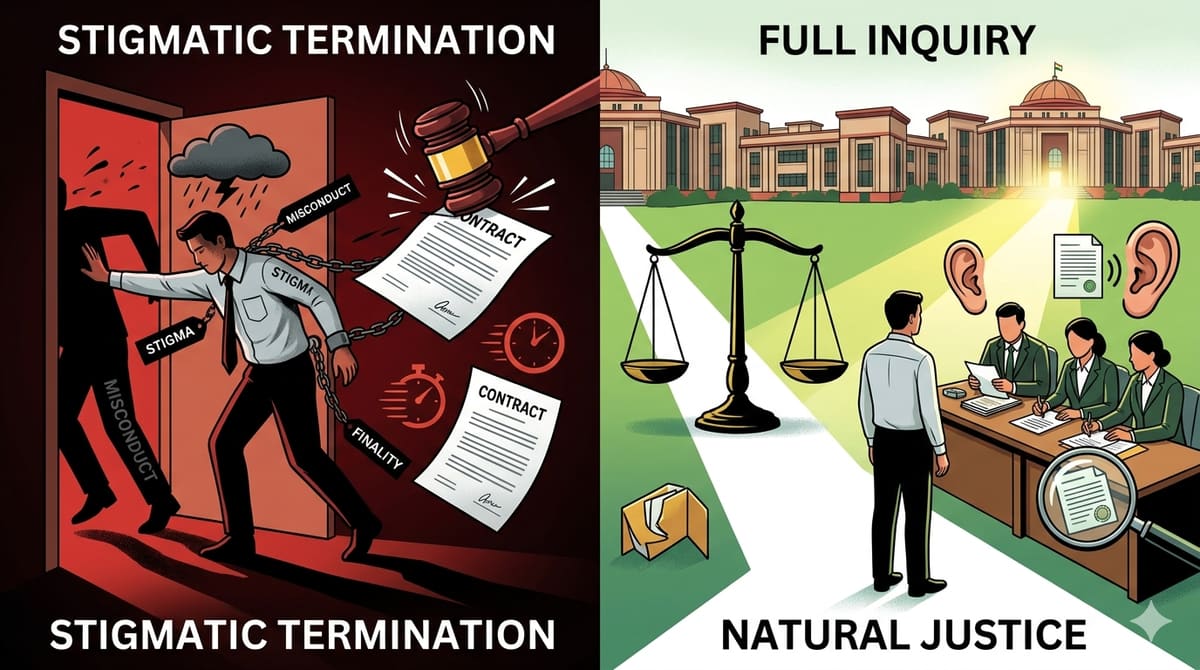
The Court rejected the appellants’ narrow interpretation of Rule 15. While acknowledging that the Rules do not mandate a full-fledged departmental inquiry for contingency-paid employees, the Court emphasized that natural justice is not a creature of statute but a constitutional imperative. The Court observed that termination on grounds of theft - especially in a position of trust like a watchman - carries a permanent stigma that affects future employment prospects.
"The mere issuance of show-cause notices and receipt of replies cannot substitute for a fair and impartial inquiry when the allegations are of such gravity as to tarnish the employee’s character."
The Court distinguished Krishna Pal’s case, noting that in that matter, the employee was not accused of theft but of negligence. Here, the allegation was criminal in nature - intentional theft of government property. The Court held that such allegations, even against temporary staff, demand a process that allows the employee to meaningfully defend himself, including the right to present witnesses or documentary evidence.
The Court further noted that the termination order did not specify whether the suspicion was based on circumstantial evidence, witness statements, or forensic findings. No inquiry committee was constituted, no opportunity was given to confront accusers, and no record of the investigation was maintained. This rendered the process procedurally defective.
The Court affirmed the Single Judge’s finding that the termination was stigmatic and therefore required adherence to higher standards of fairness. The fact that the employee was temporary did not absolve the employer of its duty to act fairly.
The Verdict
The appeal was dismissed. The order of the Single Judge dated 10.02.2026 was affirmed. The respondent was reinstated in service with all service benefits, excluding back-wages. The question of back-wages was left to the competent authority to decide upon submission of an application regarding whether the respondent was gainfully employed during the period of termination. The State was granted liberty to initiate appropriate proceedings under the Rules if it so desired, provided such proceedings comply with natural justice.
What This Means For Similar Cases
Stigmatic Allegations Demand More Than Show-Cause Notices
Practitioners must now argue that any termination based on allegations of theft, corruption, or moral turpitude - even for temporary staff - requires a minimal inquiry process
Merely issuing notices and accepting replies is insufficient if the employee is denied the chance to present evidence or challenge witnesses
Temporary Employment Does Not Mean Absence of Natural Justice
Employers cannot use contractual status as a shield to bypass fairness
Courts will examine the nature of the allegation, not just the employment category, to determine the required procedural safeguards
This applies to all government and quasi-government employers using contingency-paid staff (watchmen, peons, clerks, etc.)
Documentation and Record-Keeping Are Critical
Termination orders must clearly state the basis of suspicion
Any investigation, however informal, must be documented
Failure to maintain records may lead to judicial intervention on grounds of arbitrariness