The Chhattisgarh High Court has affirmed that public servants, including Patwaris, are entitled to time-bound pay increments under state government circulars upon completing specified service milestones, provided no legal bar exists. This judgment reinforces the principle that administrative benefits granted by policy must be uniformly applied to similarly situated employees.
Background & Facts
The Dispute
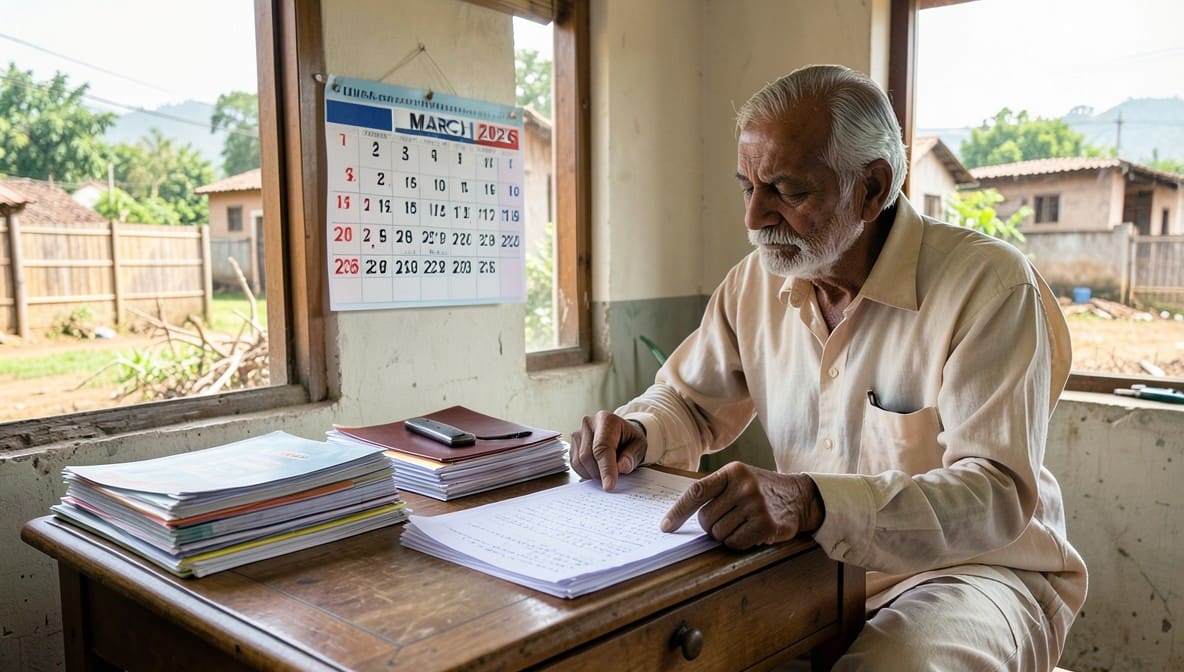
The petitioner, Vinayak Singh, is a Patwari serving at P.H.N.-027, Bademurma, Tahsil Nangur, District Baster, Chhattisgarh. He claims entitlement to the third time-bound pay scale upon completing 30 years of continuous service, which has been denied despite having received the first two increments after 10 and 20 years of service.
Key Facts
- The petitioner was appointed as Patwari on 01.06.1993
- He was granted the first time-bound pay scale after completing 10 years of service, effective 01.06.2003
- He was granted the second time-bound pay scale after completing 20 years of service, effective 01.06.2013
- He completed 30 years of service on 01.06.2023
- Despite completion of 30 years, the third time-bound pay scale has not been granted
- The State Government issued circulars dated 08.08.2018 and 11.06.2019 providing for time-bound pay scales for Patwaris upon completion of 10, 20, and 30 years of service
- Similar claims by other Patwaris have been granted, including in the case of R.S. Verma v. State of Chhattisgarh (WPS No. 2805 of 2002, decided on 29.08.2006)
- The petitioner has made no formal representation seeking the third pay scale prior to filing this writ petition
Procedural History
- 01.06.2023: Petitioner completed 30 years of continuous service
- 2025: Petitioner approached administrative authorities informally for the third pay scale; no formal response received
- 2026: Writ Petition No. 3529 of 2026 filed before the High Court of Chhattisgarh
- 27.03.2026: Hearing before the Hon’ble Justice Parth Prateem Sahu
The Parties' Positions
For the Petitioner
The petitioner’s counsel, Mr. Manoj Chauhan, argued that:
- The State Government’s circulars dated 08.08.2018 and 11.06.2019 clearly provide for a third time-bound pay scale upon 30 years of service
- The petitioner has been granted the first two increments without dispute
- Other similarly placed Patwaris have received the benefit
- The judgment in R.S. Verma v. State of Chhattisgarh and the Supreme Court’s decision in State of Tripura & Ors v. K.K. Roy (2004 AIR SCW 1) support the petitioner’s claim
- Denial of the benefit without reason violates the principle of equality under Article 14 of the Constitution
For the Respondents
The State, represented by Mr. Lav Sharma, requested time to seek instructions. No substantive opposition was filed at the hearing.
Relief Sought
The petitioner sought:
- A direction to the respondents to grant the third time-bound pay scale with effect from 01.06.2023
- Payment of arrears with interest
- Any other relief the Court deemed fit
The Legal Issue
Whether a Patwari who has completed 30 years of service is entitled to the third time-bound pay scale under State Government circulars, and whether the denial of such benefit without adjudication violates the principles of equality and legitimate expectation.
Arguments Presented
For the Petitioner
The petitioner relied on two key authorities: R.S. Verma v. State of Chhattisgarh (2006), where the High Court had directed grant of the third pay scale to a similarly situated Patwari, and State of Tripura v. K.K. Roy (2004), where the Supreme Court held that administrative benefits granted by policy must be applied uniformly to avoid arbitrariness. The counsel emphasized that the petitioner’s service was continuous, unblemished, and recognized for the first two increments. Denial of the third increment, despite identical conditions, amounted to discriminatory treatment.
For the Respondent
The State did not contest the claim substantively. The counsel sought time to obtain instructions, indicating no legal objection to the claim, but no formal reply was filed.
The Court's Analysis
The Court acknowledged that the petitioner had fulfilled the service condition stipulated in the State’s own circulars. The circulars dated 08.08.2018 and 11.06.2019 were not disputed and formed part of the administrative policy framework. The Court noted that the petitioner had been granted the first two increments without objection, establishing a pattern of recognition.
"The State cannot deny a benefit it has itself prescribed for a class of employees, particularly when similar claims have been granted and no valid reason for denial has been advanced."
The Court further observed that the petitioner had not been given an opportunity to make a formal representation. While the claim was prima facie valid, the Court declined to directly direct the grant of the benefit, as the matter involved administrative discretion and documentation verification.
The Court emphasized that the principle of legitimate expectation, reinforced by K.K. Roy, requires that policy benefits be applied fairly and consistently. The denial of the third pay scale without any reasoned order or opportunity to be heard would violate Article 14.
The Verdict
The writ petition was disposed of with directions. The petitioner was granted liberty to submit a comprehensive representation along with all supporting documents to Respondent No. 2 (The Collector, Jagdalpur). The concerned authority was directed to consider the representation expeditiously and decide it in accordance with law, preferably within three months from the date of receipt. No arrears or interest were directed at this stage, but the petitioner may pursue such claims upon a favorable decision.
What This Means For Similar Cases
Policy Benefits Must Be Applied Uniformly
- Practitioners representing public servants must insist on uniform application of state circulars granting time-bound pay scales
- Denial of such benefits without a reasoned order constitutes arbitrariness under Article 14
- Past grants of similar benefits to others create a legitimate expectation that cannot be arbitrarily withdrawn
Administrative Representation Is a Prerequisite
- Before approaching courts, claimants must exhaust administrative remedies by submitting formal representations
- Courts will not substitute administrative discretion but will ensure fair and timely adjudication
- A three-month deadline for decision sets a clear benchmark for administrative efficiency
Precedent as a Tool for Equality
- R.S. Verma and K.K. Roy are now binding precedents for similar claims across Chhattisgarh
- Lawyers should cite these cases in all pending matters involving time-bound pay scales for Patwaris and other similar posts
- Where identical service conditions exist, denial of benefits requires compelling justification