Topic

unauthorized construction

Unauthorized construction in India refers to building activities carried out without proper municipal approvals or in violation of zoning and building regulations.

18 articlesLatest July 2026
Border Area Regulations | Writ Jurisdiction Inapplicable for Unauthorized Religious Structures Within 50 km of Indo-Pak Border : Rajasthan HC
Case Law Analysis
|Rajasthan High Court

Border Area Regulations | Writ Jurisdiction Inapplicable for Unauthorized Religious Structures Within 50 km of Indo-Pak Border : Rajasthan HC

Rajasthan High Court upholds eviction notices for unauthorized religious structures near the Indo-Pak border, ruling that national security concerns override procedural objections under writ jurisdiction. The judgment reinforces that land revenue and colonization laws prevail in sensitive border zones, limiting constitutional remedies for affected parties.

Section 89(3) APMR & UDA Act | Only Metropolitan Commissioner Can Issue Unauthorized Construction Orders : Andhra Pradesh HC
Case Law Analysis
|Andhra Pradesh High Court

Section 89(3) APMR & UDA Act | Only Metropolitan Commissioner Can Issue Unauthorized Construction Orders : Andhra Pradesh HC

The Andhra Pradesh High Court ruled that under Section 89(3) of the APMR & UDA Act, the power to issue provisional orders for unauthorized constructions rests exclusively with the Metropolitan Commissioner or Vice-Chairperson. Orders issued by subordinate authorities are without jurisdiction and liable to be set aside, reinforcing strict adherence to statutory delegation in urban development enforcement.

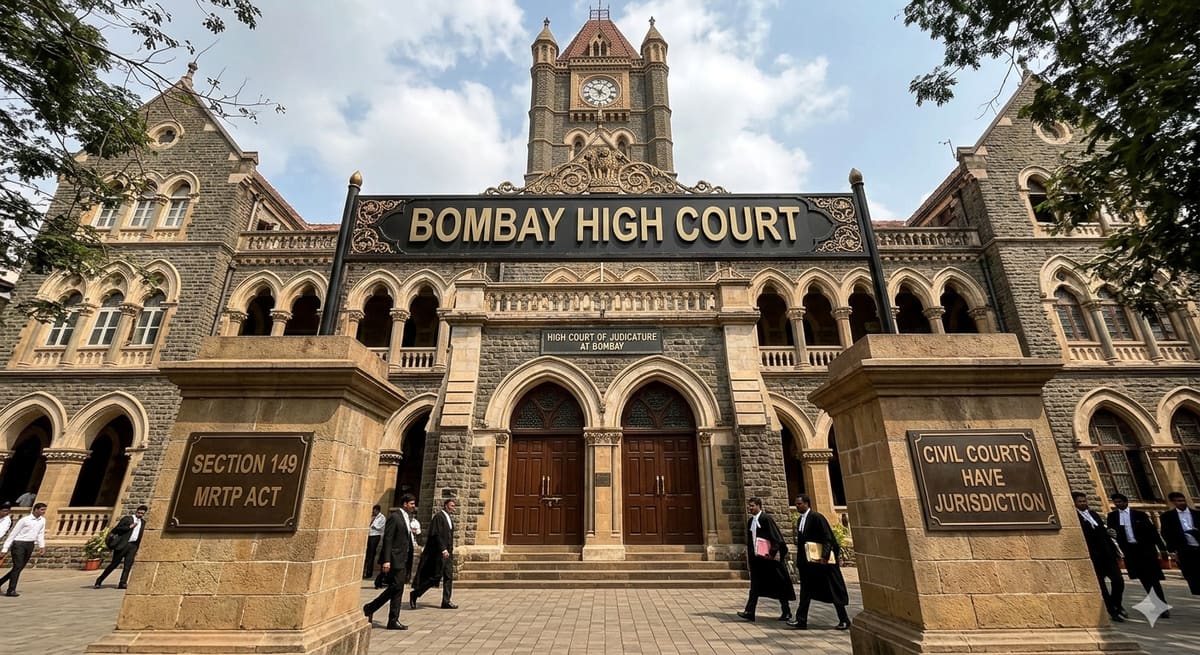
Section 149 MRTP Act | Civil Courts Can Examine Nullity of Planning Authority Notices Despite Finality Clause: Bombay HC
Case Law Analysis
|Bombay High Court

Section 149 MRTP Act | Civil Courts Can Examine Nullity of Planning Authority Notices Despite Finality Clause: Bombay HC

Bombay High Court holds that civil courts retain jurisdiction to scrutinize notices under Section 149 of the MRTP Act if they are prima facie nullities, even where the provision bars further appeals. Plaintiffs must prove jurisdictional errors or arbitrariness-not mere illegality-to challenge such notices. This ruling clarifies the scope of judicial review over planning authority orders.

Order I Rule 10 CPC | Third-Party Resident Affected by Unauthorized Construction May Be Impleaded as Proper Party Despite No Relief Sought Against Them : Bombay HC
Case Law Analysis
|Bombay High Court

Order I Rule 10 CPC | Third-Party Resident Affected by Unauthorized Construction May Be Impleaded as Proper Party Despite No Relief Sought Against Them : Bombay HC

The Bombay High Court ruled that a resident suffering direct harm-such as structural leakage-from unauthorized construction on a neighboring property can be impleaded as a proper party in a suit challenging a demolition notice, even if the plaintiff does not seek any relief against them. This clarifies that procedural fairness under CPC extends to those materially affected by disputed construction, not just formal titleholders.

GMDA Act 1985 | Master Plan Jurisdiction Overrides Gaon Panchayat Permission for Unauthorized Construction: Gauhati HC
|Gauhati High Court

GMDA Act 1985 | Master Plan Jurisdiction Overrides Gaon Panchayat Permission for Unauthorized Construction: Gauhati HC

Gauhati HC rules that the Guwahati Metropolitan Development Authority (GMDA) holds overriding jurisdiction over Gaon Panchayat areas covered under a notified Master Plan, even if prior permission was granted by the Panchayat. The court clarified that a written reply suffices for natural justice where facts are undisputed, reinforcing municipal authority supremacy in urban planning enforcement.

HMDA Layout Permit | Strict Compliance Mandatory: Telangana HC Quashes Draft Permit Over Encroachment on Petitioner’s Plots
Case Law Analysis
|Telangana High Court

HMDA Layout Permit | Strict Compliance Mandatory: Telangana HC Quashes Draft Permit Over Encroachment on Petitioner’s Plots

Telangana High Court set aside a draft layout permit issued by HMDA, ruling that unauthorized construction and failure to consider the petitioner’s representation violated the HMDA Act and constitutional rights under Articles 14, 21, and 300-A. The court directed HMDA to take action against illegal development, reinforcing strict adherence to approved layouts.

Slum Act Section 4 | Bombay HC Mandates Slum Area Determination Before Demolition of Unauthorized Structures on Government Land
Case Law Analysis
|Bombay High Court

Slum Act Section 4 | Bombay HC Mandates Slum Area Determination Before Demolition of Unauthorized Structures on Government Land

Bombay High Court rules that authorities cannot demolish unauthorized structures on government land without first determining if the area qualifies as a notified slum under the Slum Act. The judgment reinforces procedural safeguards, ensuring regularization or demolition actions comply with natural justice principles, directly impacting slum dwellers and urban planning policies.

Section 351 MMC Act | Documentary Evidence Overrides Photographic Assumption in Mezzanine Floor Disputes : Bombay HC
Case Law Analysis
|Bombay High Court

Section 351 MMC Act | Documentary Evidence Overrides Photographic Assumption in Mezzanine Floor Disputes : Bombay HC

The Bombay High Court ruled that municipal demolition orders based solely on photographic evidence cannot override documented proof of a pre-existing mezzanine floor. The judgment establishes that factual disputes over structural classification require full trial, protecting property owners from arbitrary enforcement under the Mumbai Municipal Corporation Act and reinforcing procedural fairness in urban development cases.

Right of Ingress and Egress | Municipal Structures Blocking Private Property Frontage Require Statutory Authority & Compensation : Calcutta HC
Case Law Analysis
|Calcutta High Court

Right of Ingress and Egress | Municipal Structures Blocking Private Property Frontage Require Statutory Authority & Compensation : Calcutta HC

The Calcutta High Court has ruled that municipal corporations cannot erect permanent structures obstructing a private property’s access to the main road, even on former waste disposal land, without statutory backing or compensation. This affirms that property frontage rights are constitutionally protected and cannot be encroached upon under the guise of public utility.

Order XXVI Rule 9 CPC | Court Commissioner Cannot Collect Evidence for Parties in Unauthorized Construction Disputes : MP HC Gwalior
Case Law Analysis
|Madhya Pradesh High Court

Order XXVI Rule 9 CPC | Court Commissioner Cannot Collect Evidence for Parties in Unauthorized Construction Disputes : MP HC Gwalior

MP High Court rules that Order XXVI Rule 9 CPC does not permit delegation of evidence collection to a Court Commissioner, reinforcing that parties must prove their claims through oral and documentary evidence. The decision bars trial courts from shifting the burden of proof to commissioners in unauthorized construction cases, ensuring procedural fairness in property disputes.

Municipal Demolition Notices | Structural Safety Must Be Evaluated for Entire Building Under Natural Justice : APHC
Case Law Analysis
|Andhra Pradesh High Court

Municipal Demolition Notices | Structural Safety Must Be Evaluated for Entire Building Under Natural Justice : APHC

The Andhra Pradesh High Court has ruled that municipal authorities cannot issue demolition orders based on partial structural assessments, requiring a comprehensive engineering evaluation of the entire building to protect innocent occupants. This sets a critical precedent for procedural fairness in urban enforcement, ensuring due process under Article 21 and the principles of natural justice.

Reconstruction Exceeding 50% of Structure Volume is 'New Building' Under Section 287 of West Bengal Municipal Corporation Act | Prior Sanction Mandatory : Calcutta High Court
Case Law Analysis
|Calcutta High Court

Reconstruction Exceeding 50% of Structure Volume is 'New Building' Under Section 287 of West Bengal Municipal Corporation Act | Prior Sanction Mandatory : Calcutta High Court

The Calcutta High Court ruled that reconstructing a building after fire damage exceeding 50% of its original volume constitutes a 'new building' under Section 287 of the West Bengal Municipal Corporation Act, 1993, requiring prior municipal sanction. The Court held that absence of such sanction renders the construction unauthorized, irrespective of historical possession or prior existence of the structure. This decision reinforces compliance obligations for property owners and municipal authorities in West Bengal.