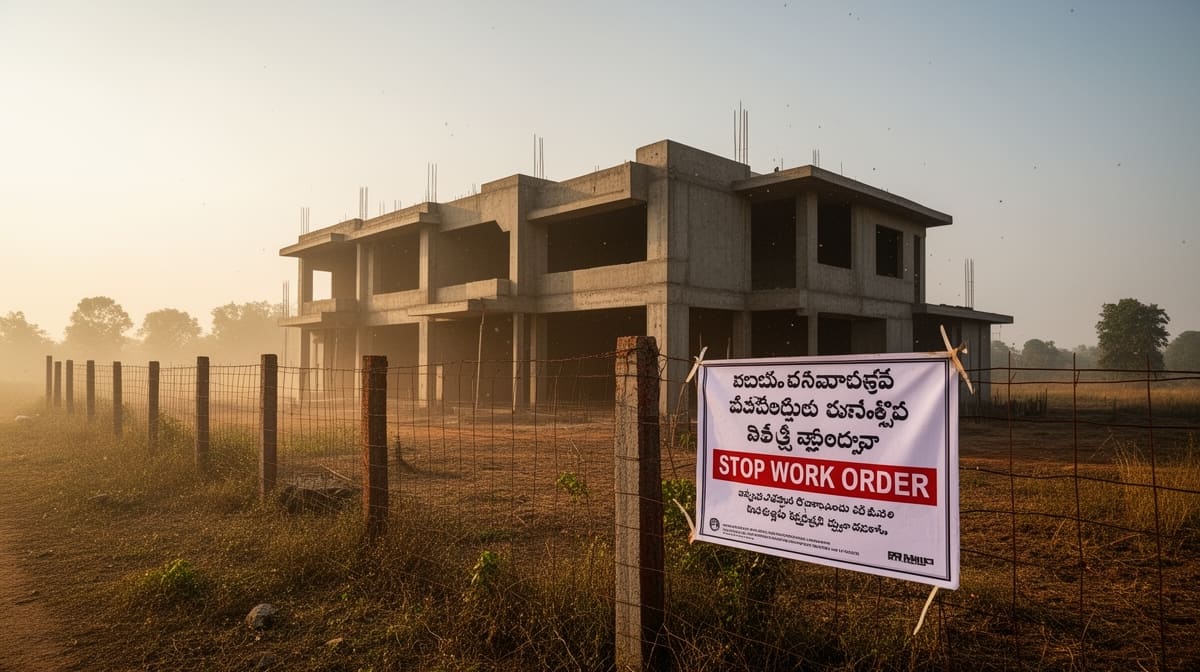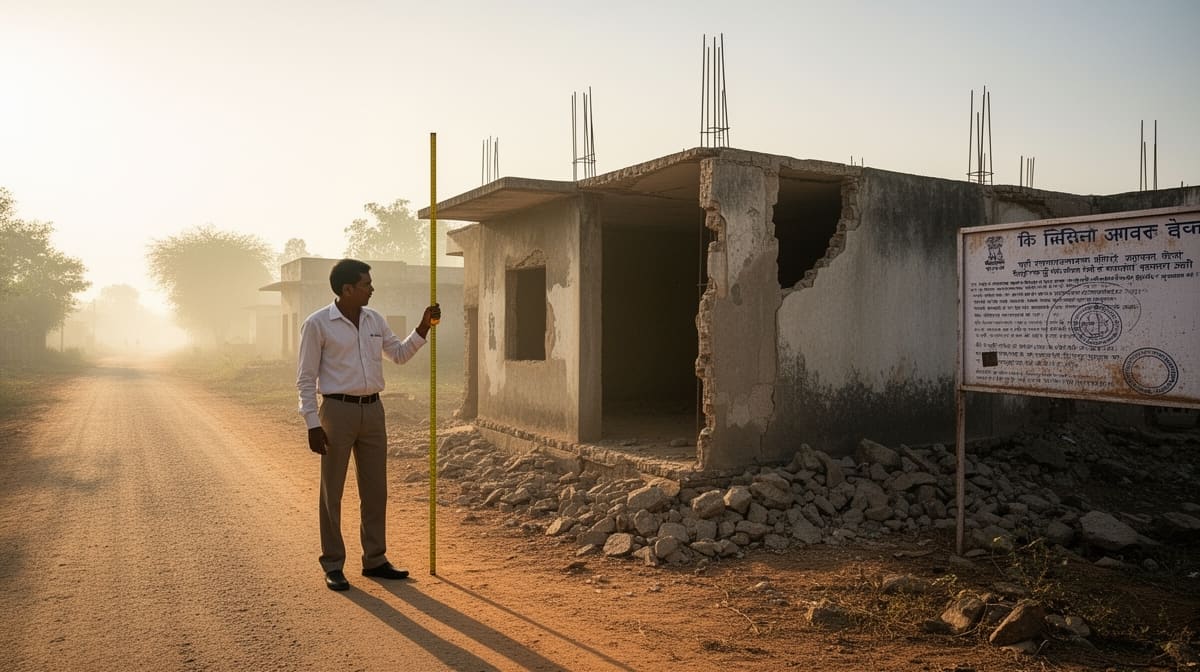
In a significant ruling on jurisdictional authority under the Andhra Pradesh Metropolitan Region and Urban Development Authority Act, 2016 (APMR & UDA Act), the Andhra Pradesh High Court has clarified that the power to issue provisional orders for the removal of unauthorized constructions is exclusively vested in the Metropolitan Commissioner or Vice-Chairperson. The Court’s interim order underscores the importance of adhering to statutory mandates in administrative actions, setting aside a provisional order issued by an authority lacking jurisdiction.
Background & Facts
The Dispute
The petitioners, owners of premises bearing Door/Plot Nos. 40 and 41 in Survey No. 682 at Datlavaripalem, H/o. Thalarlapalli Village, challenged a provisional order dated 25.06.2026 issued by the 4th respondent under Sections 89(1) and 89(2) read with Sections 82 and 90(1) of the APMR & UDA Act. The order alleged unauthorized construction on the petitioners’ property and directed remedial action. The petitioners contended that the 4th respondent acted without jurisdiction, as the APMR & UDA Act expressly vests such powers in the Metropolitan Commissioner or Vice-Chairperson.
Key Facts
- The petitioners own the property in question, located at Survey No. 682, Datlavaripalem
- On 25.06.2026, the 4th respondent issued a provisional order under Sections 89(1), 89(2), 82, and 90(1) of the APMR & UDA Act, alleging unauthorized construction
- The petitioners argued that Section 89(3) read with Sections 82 and 90(1) of the Act confers the power to issue such orders exclusively on the Metropolitan Commissioner or Vice-Chairperson
- The impugned order was issued by an authority lacking statutory jurisdiction, rendering it void ab initio
Procedural History
- 25.06.2026: 4th respondent issued the impugned provisional order
- 02.07.2026: Petitioners filed Writ Petition No. 17571 of 2026 before the Andhra Pradesh High Court
- 02.07.2026: The High Court, upon hearing submissions, directed status quo pursuant to the impugned order for eight (8) weeks
- 13.08.2026: Matter posted for further hearing
Relief Sought
The petitioners sought:
- Quashing of the provisional order dated 25.06.2026 issued by the 4th respondent
- Declaration that the 4th respondent lacked jurisdiction to issue the impugned order under the APMR & UDA Act
- Interim relief in the form of status quo to prevent coercive action pursuant to the impugned order
The Legal Issue
The central question before the Court was whether Sections 89(1), 89(2), 82, and 90(1) of the APMR & UDA Act empower an authority other than the Metropolitan Commissioner or Vice-Chairperson to issue provisional orders for the removal of unauthorized constructions. Specifically, the Court had to determine if the 4th respondent’s action was ultra vires the statutory scheme.
Arguments Presented
For the Petitioners
The petitioners’ counsel argued that:
- A plain reading of Section 89(3) read with Sections 82 and 90(1) of the APMR & UDA Act reveals that the power to issue notices and provisional orders for unauthorized constructions is exclusively vested in the Metropolitan Commissioner or Vice-Chairperson
- The 4th respondent, by issuing the impugned order, acted without authority or jurisdiction, rendering the order wholly without legal effect
- The impugned order was a nullity and liable to be set aside on this ground alone
For the Respondent
(Note: The judgment does not record submissions from the respondent, likely due to the interim nature of the order.)
The Court's Analysis
The High Court, while not delivering a final verdict, engaged in a preliminary examination of the jurisdictional question. The Court observed that the petitioners’ contention regarding the exclusive authority of the Metropolitan Commissioner/Vice-Chairperson under Section 89(3) read with Sections 82 and 90(1) merited serious consideration. The Court noted:
"A plain reading of Section 89(3) read with Sections 82 and 90(1) of the APMR & UDA Act makes it evident that the power to issue notice and thereafter pass a provisional order directing removal of unauthorized constructions is vested exclusively in the Metropolitan Commissioner/Vice-Chairperson."
The Court further emphasized that statutory powers must be exercised strictly in accordance with the law, and any deviation renders the action jurisdictionally infirm. By granting interim relief in the form of status quo, the Court implicitly acknowledged the prima facie strength of the petitioners’ argument that the 4th respondent lacked the requisite authority.
The Verdict
The Court did not finally adjudicate the matter but granted interim relief in the following terms:
- Status quo was directed pursuant to the impugned order dated 25.06.2026
- The status quo was to remain in effect for eight (8) weeks
- The matter was posted for further hearing on 13.08.2026
- Certified copies of the order were directed to be issued the same day
What This Means For Similar Cases
Jurisdictional Limits Are Non-Negotiable
This interim order serves as a critical reminder for administrative authorities and practitioners that:
- Statutory powers are not transferable unless expressly provided by law. Authorities must act strictly within the four corners of the empowering provision
- Section 89(3) of the APMR & UDA Act is a jurisdictional gatekeeper - only the Metropolitan Commissioner or Vice-Chairperson can issue orders under it. Any action by a subordinate authority is void ab initio
- Practitioners should scrutinize the empowering provision before challenging or defending administrative orders. A jurisdictional defect can invalidate the entire proceeding without further inquiry into merits
Interim Relief as a Litigation Strategy
- Status quo orders can be a powerful tool to halt coercive administrative actions pending final adjudication
- Courts are willing to grant interim relief where a prima facie jurisdictional defect is demonstrated, even without a full hearing on merits
- Timely challenge is crucial - petitioners must approach the Court before compliance deadlines to maximize chances of interim relief
Implications for Urban Development Authorities
- Metropolitan Commissioners/Vice-Chairpersons must personally exercise powers under Section 89(3) - delegation to subordinate officers is not permissible unless the statute explicitly allows it
- Unauthorized constructions remain a high-priority enforcement area, but authorities must strictly follow procedural mandates to avoid judicial set-asides
- Record-keeping and internal checks are essential to ensure that orders are issued by competent authorities to prevent legal challenges