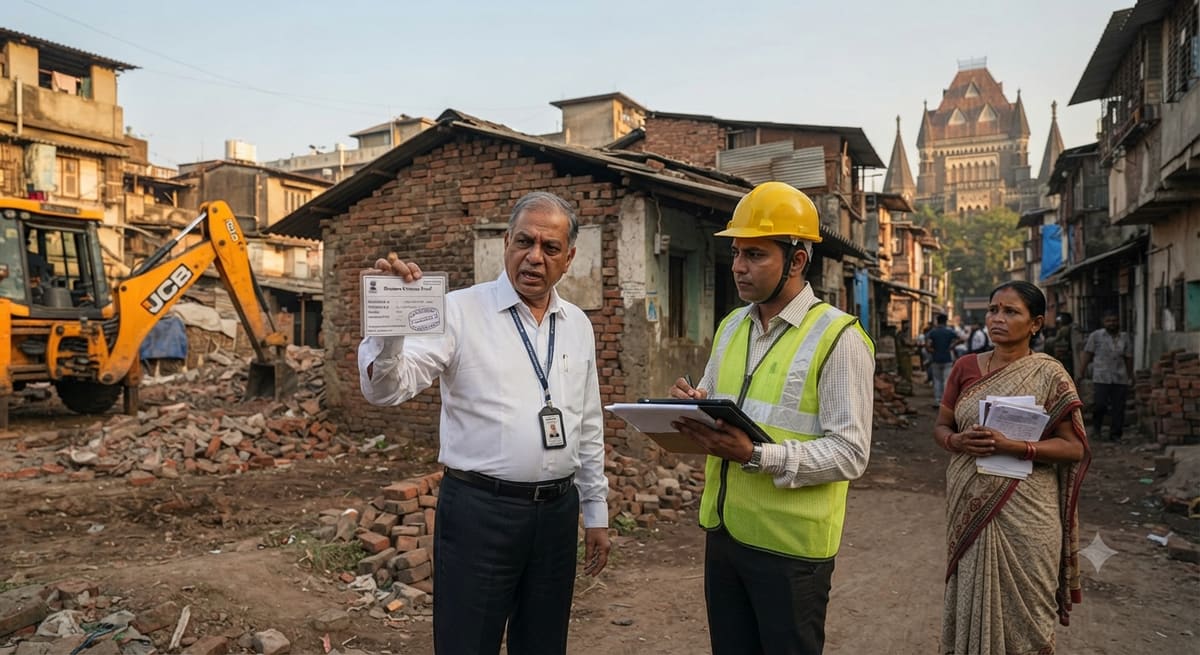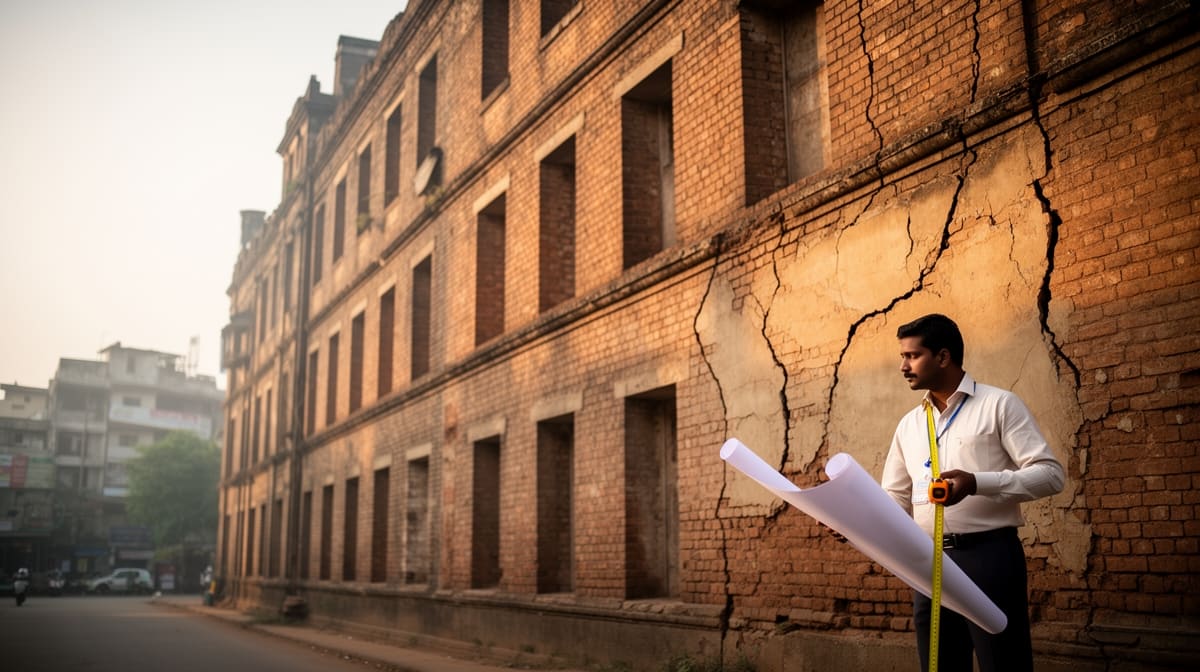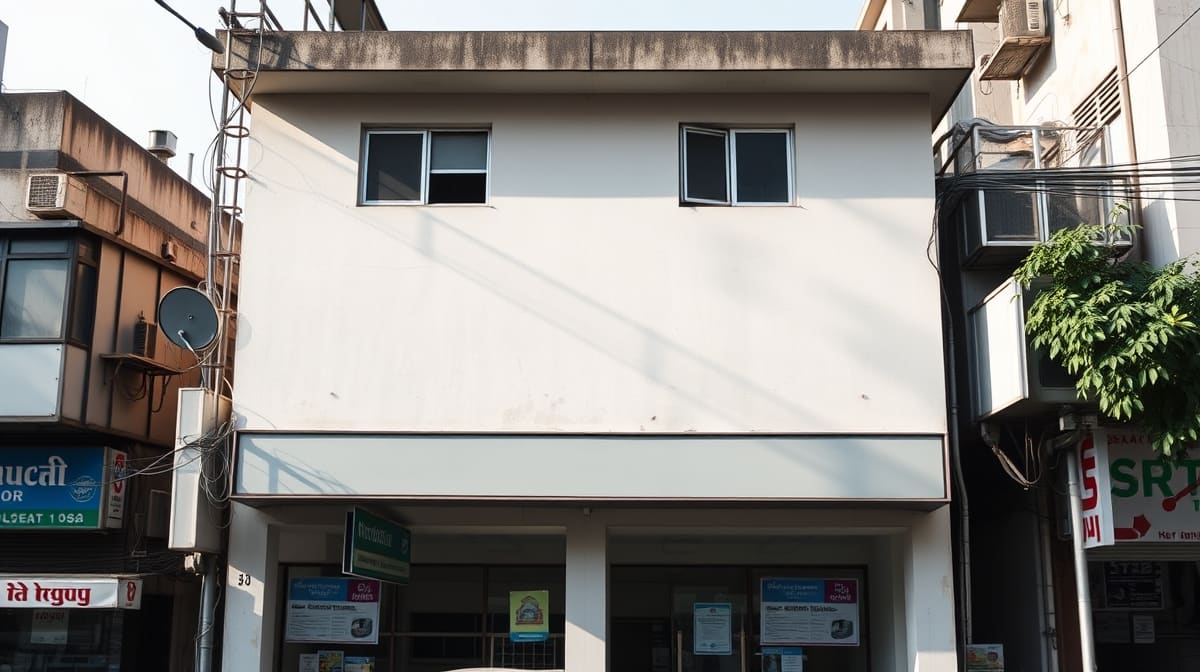
The Bombay High Court has clarified that municipal authorities cannot rely solely on photographic evidence to classify a structure as an unauthorized first floor when documentary proof suggests it is a pre-existing mezzanine floor. The judgment underscores the necessity of a full trial to resolve factual disputes over structural classification under the Mumbai Municipal Corporation Act.
Background & Facts
The Dispute
The appellant, Naresh Roopchand Kothari, operates a guest house in Shop No.13, Netaji Market, Chembur, Mumbai. The structure has been in continuous use since before 1980. In 2019, the appellant purchased the property from the previous owner. The Municipal Commissioner of Greater Mumbai (MCGM) issued a Show Cause Notice dated 27.09.2025 under Section 351 of the Mumbai Municipal Corporation Act, 1888, alleging unauthorized construction of a first floor using brick masonry and AC sheets. The notice invoked Sections 337, 342, and 347 of the MMC Act. The appellant contested the notice, submitting documentary evidence and attending a personal hearing on 14.11.2025. A further reply was filed on 08.12.2025.
Key Facts
- The appellant has been lawfully operating a guest house on the premises since before 1980
- The property was purchased via Sale Deed dated 05.12.2019, which explicitly references a mezzanine floor
- The MCGM’s Show Cause Notice dated 27.09.2025 alleged the mezzanine floor was an unauthorized first floor
- The appellant submitted multiple documents including sale deed, pitch card, and prior municipal records
- The Designated Officer passed an order on 22.12.2025 directing demolition, rejecting all documentary evidence with identical, boilerplate remarks for all eight documents
- The appellant filed a civil suit on 02.02.2026 seeking injunction against demolition
- The Trial Court dismissed the interim application on 03.02.2026, relying on photographs to conclude the structure was a first floor
- The appellant appealed to the High Court on 17.02.2026
Procedural History
- Pre-1980: Structure in existence and in use as commercial establishment
- 1976 and 2000: Structure censused by MCGM
- 05.12.2019: Sale Deed executed, explicitly mentioning mezzanine floor
- 27.09.2025: Show Cause Notice issued by MCGM
- 10.10.2025: Appellant’s first reply to notice
- 14.11.2025: Personal hearing held
- 08.12.2025: Appellant’s additional reply filed
- 22.12.2025: Designated Officer’s order directing demolition, with mechanical rejection of all documents
- 02.02.2026: Civil Suit filed before Trial Court seeking injunction
- 03.02.2026: Trial Court dismissed interim application, relying on photographs
- 17.02.2026: Appeal From Order filed before Bombay High Court
- 02.04.2026: Judgment delivered by Bombay High Court
Relief Sought
The appellant sought quashing of the Designated Officer’s order dated 22.12.2025 and the Trial Court’s order dated 03.02.2026, along with an injunction against demolition, and a direction to decide the suit on merits after full evidence.
The Legal Issue
The central question was whether a municipal authority may rely exclusively on photographic evidence to classify a structure as an unauthorized first floor, when documentary evidence, including a sale deed, indicates the existence of a mezzanine floor predating the alleged violation.
Arguments Presented
For the Appellant
The appellant’s counsel argued that the structure above the ground floor has always been a mezzanine floor, as explicitly referenced in the 2019 Sale Deed. She contended that the Designated Officer’s order was mechanically drafted, with identical remarks applied to all eight documents, indicating non-application of mind. She emphasized that the structure was censused in 1976 and 2000, and that MCGM’s own records confirm its pre-existing status. The appellant argued that the burden to prove unauthorized construction lay with the Corporation, which failed to adduce any evidence of recent construction.
For the Respondent
The Municipal Corporation’s counsel defended the order, asserting that photographs submitted to the Trial Court clearly showed a first floor constructed above the ground level. He argued that the Sale Deed’s reference to a mezzanine floor was insufficient without structural plans or prior municipal approvals. He maintained that the Trial Court’s reliance on visual evidence was reasonable and that the appellant had failed to discharge the burden of proving lawful existence of the mezzanine floor.
The Court's Analysis
The Court observed that the Designated Officer’s order dated 22.12.2025 exhibited a complete failure to engage with the documentary evidence. The identical remarks applied to all eight documents constituted a mechanical, non-reasoned decision, violating principles of natural justice. The Trial Court, in turn, erred by basing its conclusion on photographs alone, without considering the Sale Deed’s explicit mention of a mezzanine floor.
"The learned Trial Court has proceeded on the basis of the fact that reference to the first floor was not mentioned in the Sale Deed which has been relied upon by Plaintiff. Perusal of the said Sale Deed prima facie shows that reference to the mezzanine floor has been specifically mentioned in the Sale Deed."
The Court noted that the Corporation never alleged the mezzanine floor was demolished and replaced. Instead, its case was that the appellant had constructed a first floor - implying the mezzanine floor was already present. The Court further held that since the structure was censused in 1976 and 2000, the doctrine of datum-line did not apply, and the structure was protected under MCGM’s policy.
The Court emphasized that classification of a structure as mezzanine or first floor is a factual dispute requiring evidence, cross-examination, and expert testimony - none of which occurred at the interim stage. The Court declined to determine the merits of the claim but held that the interim order could not stand on the basis of superficial visual assessment.
The Verdict
The appellant succeeded. The Bombay High Court set aside the Trial Court’s order dated 03.02.2026 and the Designated Officer’s order dated 22.12.2025. The Court directed the Trial Court to decide the suit on merits, allowing both parties to lead evidence. No demolition order may be executed pending trial. The Court explicitly preserved the rights of both parties to prove or rebut the nature of the structure.
What This Means For Similar Cases
Documentary Evidence Trumps Visual Assumptions
- Practitioners must insist that municipal authorities cannot rely on photographs alone to classify structures - sale deeds, census records, and prior approvals are decisive
- In cases involving mezzanine floors, the burden shifts to the authority to prove recent construction, not to the owner to disprove it
- Courts must reject mechanical orders that apply identical remarks to multiple documents
Pre-Existing Structures Are Protected Under Municipal Policy
- Structures censused prior to 1980 or under recognized municipal surveys are entitled to protection, even without formal building permits
- The doctrine of datum-line does not apply where a structure has been continuously in existence and recorded by the authority
- Municipalities must distinguish between structural modification and structural classification
Interim Relief Must Not Prejudice Trial Rights
- Courts must not grant or uphold interim orders that effectively decide the merits of a case without evidence
- Demolition orders based on preliminary assessments violate the right to a fair hearing under Article 14 and 21
- Parties must be given full opportunity to present expert testimony, architectural plans, and historical records at trial