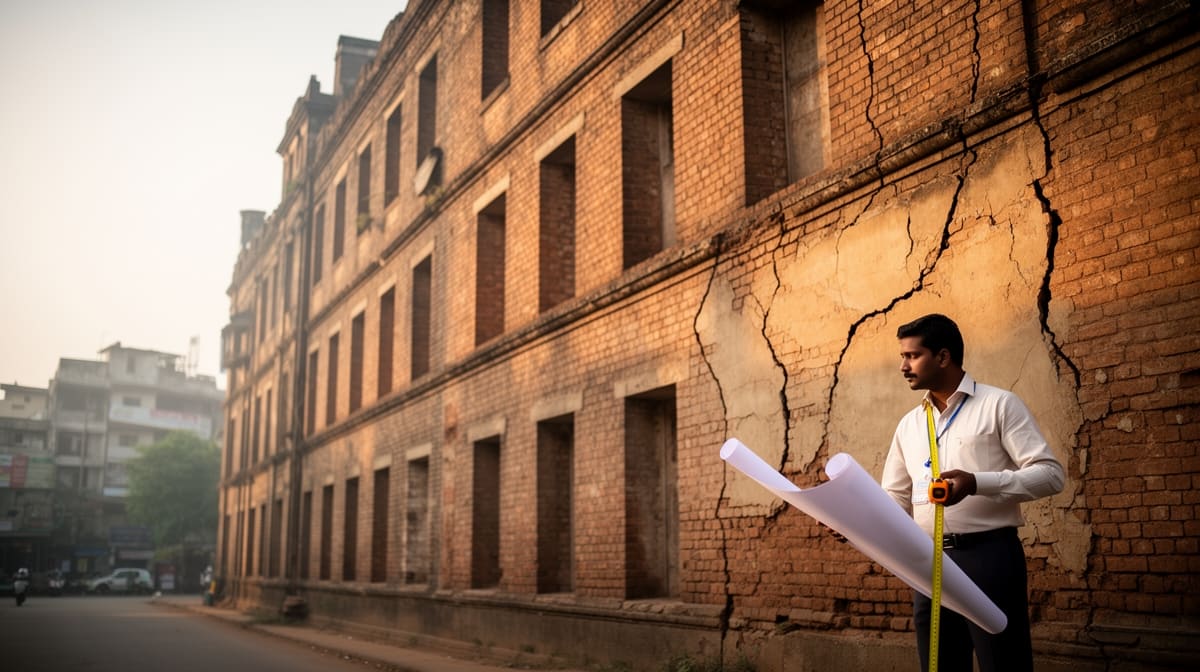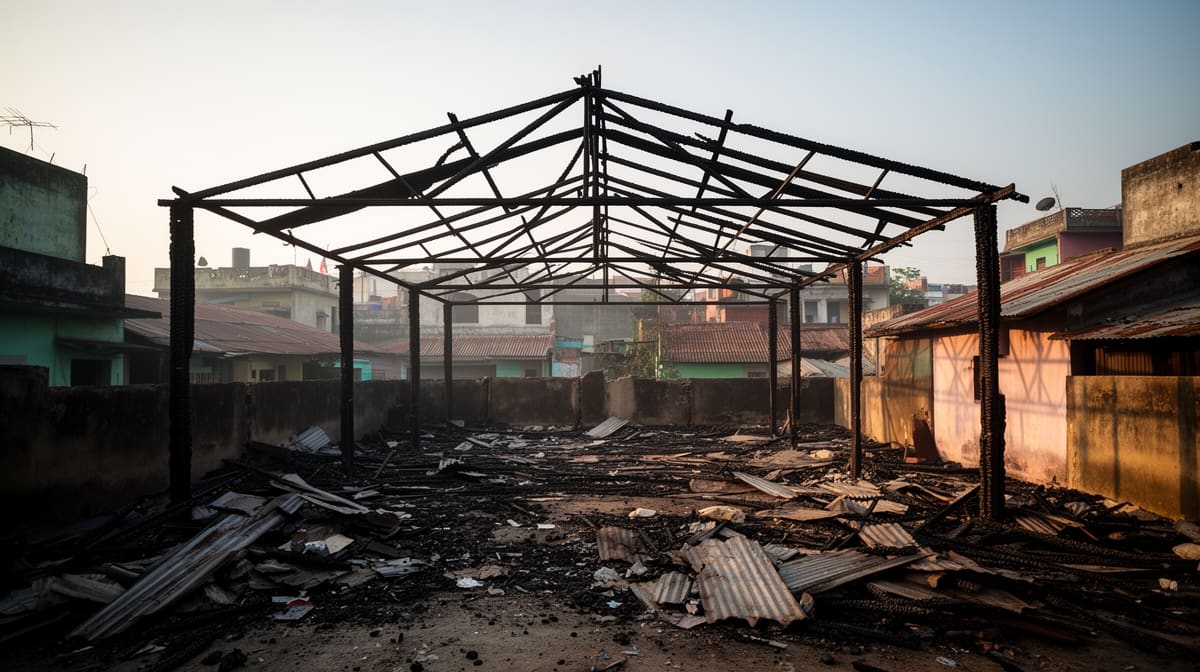
The Calcutta High Court has clarified that any structure rebuilt after a fire that destroys more than half its cubical volume qualifies as a 'new building' under statutory definitions, requiring prior sanction regardless of prior lawful existence. This ruling reinforces strict compliance with municipal building regulations and closes loopholes for post-disaster reconstruction without approval.
Background & Facts
The Dispute
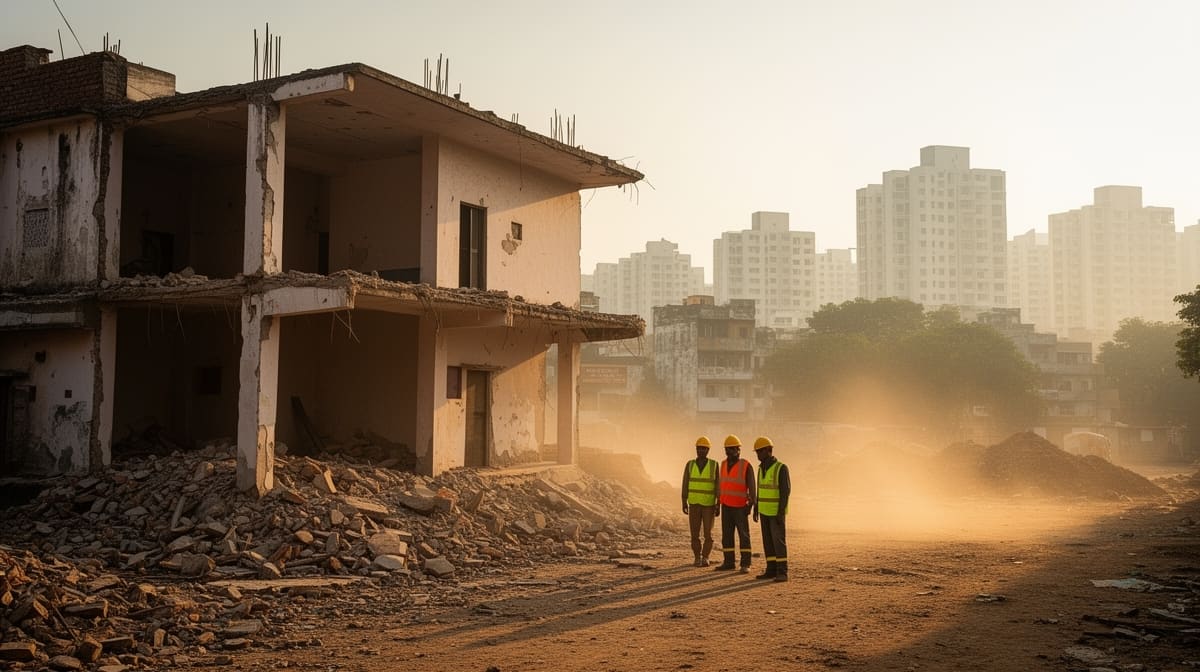
The petitioner, Sanjay Ghosh, sought to reconstruct a tin-shed iron frame structure on the premises of Ashoka Hotel in Siliguri, following a fire that destroyed the original building on 23 February 2023. The Siliguri Municipal Corporation issued a demolition notice under Section 287 of the West Bengal Municipal Corporation Act, 2006, asserting that the new structure was erected without any sanctioned building plan. The petitioner contended that the reconstruction was merely a restoration of a structure originally built by his father in the 1960s, and that the Corporation’s action was arbitrary and violative of equitable principles.
Procedural History
- 2023: A writ petition (WPA 1136 of 2023) was filed by a third party, Krishna Devi, challenging the unauthorized construction.
- 06.06.2023: The High Court directed the Municipal Corporation to conclude proceedings under Section 287 and issue a reasoned order.
- 19.07.2023: The Corporation conducted a hearing under Section 287, directing the petitioner to remove the structure.
- 06.01.2025: The Corporation issued the impugned demolition order, reaffirming that no prior sanction existed for either the original or reconstructed structure.
- 26.09.2024: The High Court directed a fresh hearing, which was conducted, leading to the same outcome.
- 05.03.2026: The present writ petition was heard and decided.
Relief Sought
The petitioner sought quashing of the demolition order, arguing that the reconstruction was a continuation of a pre-existing lawful structure and that the Corporation’s refusal to grant permission was unreasonable and discriminatory.
The Legal Issue
The central question was whether reconstruction of a building after it has been burnt down by more than half its cubical extent constitutes a 'new building' under Section 2(65)(b) of the West Bengal Municipal Corporation Act, 2006, thereby mandating prior sanction under Section 261A and Rule 11(1) of the Building Rules, 2007.
Arguments Presented
For the Petitioner
The petitioner argued that the structure was not a new construction but a restoration of a lawful building erected in 1963 - 64 by his father, who had been in continuous possession. He relied on equitable principles of possession and historical occupancy, asserting that the fire did not extinguish his title or right to rebuild. He submitted that the Corporation’s refusal to grant permission was arbitrary, especially since no prior enforcement action had been taken against the original structure. He also cited his pending title suit (No. 65 of 2023) to assert ownership and possession.
For the Respondent/State
The Municipal Corporation and private respondent contended that Section 2(65)(b) explicitly defines a structure rebuilt after being burnt down by more than half its cubical extent as a 'new building'. They emphasized that Section 261A prohibits any erection without prior sanction, and Rule 11(1) mandates a building permit for reconstruction. They cited precedents including Dipak Kumar Mukherjee v. Kolkata Municipal Corporation and Ghanashyam Das v. Kolkata Municipal Corporation, which held that post-fire reconstruction triggers the same regulatory requirements as new construction. They further noted that the petitioner had never applied for a building plan, even after the fire, and that the Corporation’s records confirmed no prior sanction existed.
The Court's Analysis
The Court examined the statutory definitions under the West Bengal Municipal Corporation Act, 2006, and the Building Rules, 2007. It found that Section 2(65)(b) unambiguously classifies any structure reconstructed after being burnt down by more than half its cubical extent as a 'new building'. The Court rejected the petitioner’s argument that historical possession or prior lawful construction exempted him from obtaining sanction, noting that statutory compliance is not contingent on past usage but on present legal classification.
"The present structure is a fresh and new construction in terms of Section 2(65)(b) of the said Act, 2006 and was being erected without any sanction. There is no scope for regularization of the same under the provisions of the West Bengal Municipal Corporation Act, 2006."
The Court affirmed that Section 261A and Rule 11(1) impose a mandatory pre-condition for any construction, including reconstruction, and that failure to obtain sanction renders the structure unauthorized. It distinguished the petitioner’s claim of equity from statutory mandates, holding that equitable considerations cannot override clear legislative intent. The Court relied on its own coordinate bench’s decision in Kishori Lal Poddar v. Bidhannagar Municipal Corporation, which had similarly held that post-fire reconstruction triggers the full regulatory regime.
The Court acknowledged the petitioner’s long-standing possession and the hardship caused by the fire, but emphasized that such circumstances do not negate the legal requirement for sanction. It therefore upheld the demolition order as legally valid.
The Verdict
The petitioner’s writ application was dismissed. The Court held that reconstruction after fire exceeding half the cubical extent constitutes a new building under Section 2(65)(b), requiring prior sanction under Section 261A and Rule 11(1). The demolition order was upheld, but the petitioner was granted liberty to apply for sanction within 15 days.
What This Means For Similar Cases
Reconstruction Triggers Full Regulatory Regime
- Practitioners must treat any post-fire reconstruction as a 'new building' under Section 2(65)(b), regardless of prior lawful status.
- Municipal authorities are empowered to enforce demolition without discretion if no sanction is produced.
- Claims of historical possession or equitable hardship cannot override statutory mandates.
Sanction Must Be Sought Proactively, Not Reactively
- Applications for building permits must be filed immediately after a fire or demolition, not after construction begins.
- Delay in applying for sanction, even for reconstruction, renders the structure unauthorized from the outset.
- Municipal corporations may levy retrospective fees under Section 262, but this does not validate unauthorized construction.
Title Suits Do Not Override Municipal Regulations
- Pending civil suits over ownership or possession do not suspend or invalidate municipal demolition orders.
- Property rights under civil law must be exercised within the framework of municipal building laws.
- Practitioners must advise clients to pursue both civil remedies and municipal approvals concurrently, not sequentially.