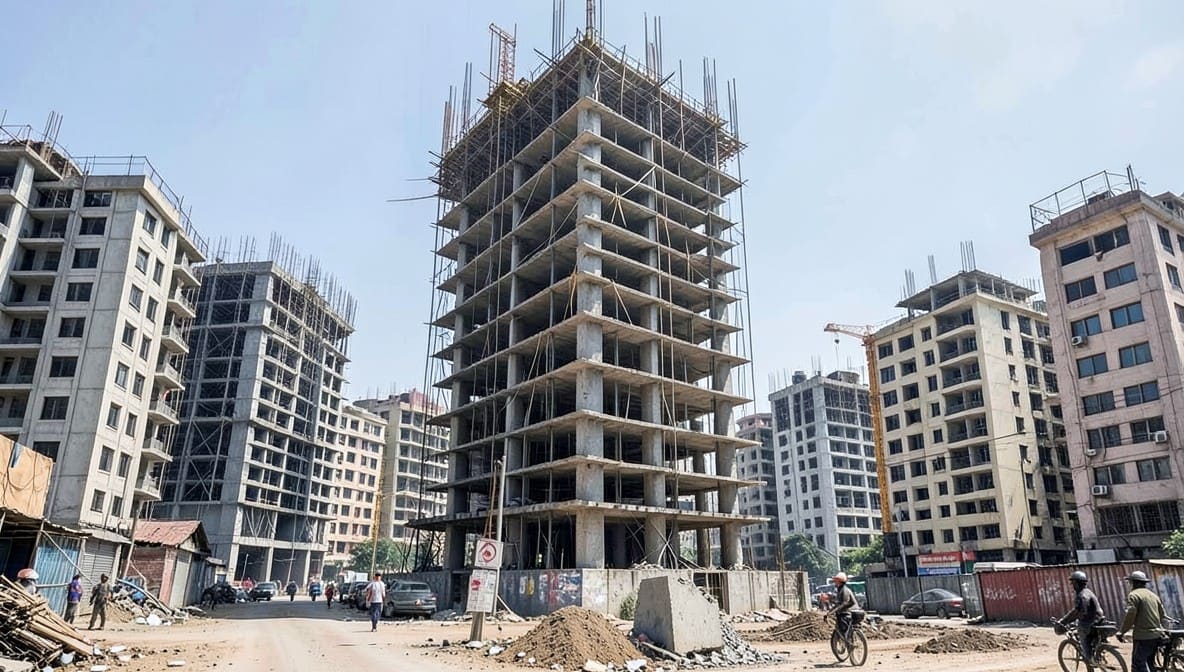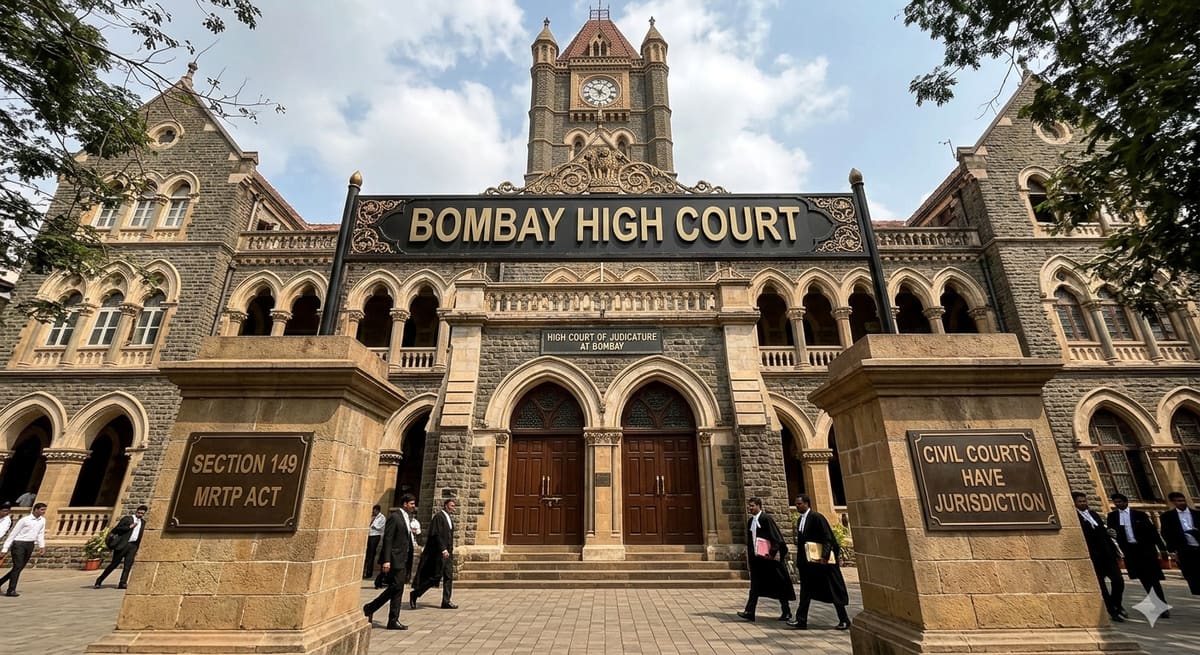
The Bombay High Court has clarified the scope of Section 149 of the Maharashtra Regional and Town Planning Act, 1966 (MRTP Act), which grants finality to orders and notices issued by planning authorities. While the provision bars civil court jurisdiction, the Court held that this exclusion does not apply if the impugned action is a nullity or suffers from jurisdictional errors. The judgment underscores that plaintiffs must prima facie demonstrate such defects to invoke civil court jurisdiction, rather than merely labeling notices as 'illegal' or 'void.'
Background & Facts
The Dispute
The Maharashtra Industrial Development Corporation (MIDC), a statutory body under the Maharashtra Industrial Development Act, 1961, allots industrial plots to entrepreneurs. The respondent, Shivam Govendra Singh, claimed to have acquired a plot (PAP-R-497, 300 sq. mtrs.) in TTC Industrial Area, Mahape, Navi Mumbai, through a Leave and Licence Agreement dated 02.05.2025, executed by Nikhil Keshav Patil, a partner of the lessee, M/s. Reyansh Hotel and Lodging Boarding. The respondent alleged unauthorized construction of a weighbridge on the plot and obtained requisite permissions for its operation.
Key Facts
02.05.2025: Respondent enters into a Leave and Licence Agreement for the suit premises, valid for 60 months.
16.06.2025: MIDC issues two notices to the respondent:
First Notice: Issued by the Executive Engineer under Sections 52 and 53(1) of the MRTP Act, alleging unauthorized construction of a weighbridge and directing removal within 32 days.
Second Notice: Issued by the Deputy Engineer at the instance of Vibha Amit Gupta (intervenor in IA/1631/2026), alleging unauthorized construction and directing cessation of activity and removal within 15 days.
The respondent contended that the notices were arbitrary, issued without inspection, and betrayed non-application of mind, particularly due to discrepancies in their content and timelines.
Procedural History
RCS/180/2025: Respondent files a civil suit before the Civil Judge, Belapur, seeking:
Declaration that the notices dated 16.06.2025 are illegal, null, and void.
Injunction restraining MIDC from demolishing the weighbridge.
Exhibit-17: MIDC files an application under Order VII Rule 11(a) and (d) of the Code of Civil Procedure (CPC) for rejection of the plaint, arguing:
The plaint discloses no cause of action.
The suit is barred by Section 149 of the MRTP Act.
29.07.2025: Trial court rejects MIDC’s application, holding that the plaint discloses a cause of action and the bar under Section 149 is not absolute.
CRA 413/2025: MIDC files a Civil Revision Application before the Bombay High Court challenging the trial court’s order.
IA/1631/2026: Vibha Amit Gupta, the intervenor, files an application seeking setting aside of the impugned order, claiming she lodged the complaint leading to the second notice.
Relief Sought
MIDC (Applicant in CRA): Quashing of the trial court’s order dated 29.07.2025 and rejection of the plaint under Order VII Rule 11 CPC.
Respondent (Plaintiff): Upholding of the trial court’s order and adjudication of the suit on merits.
Intervenor (Vibha Gupta): Setting aside of the impugned order to protect her business interests.
The Legal Issue
The central question was whether Section 149 of the MRTP Act completely ousts the jurisdiction of civil courts to examine notices issued by planning authorities, or whether such jurisdiction is retained if the notices are prima facie nullities or suffer from jurisdictional errors.
Arguments Presented
For the Applicant (MIDC)
Bar Under Section 149: Contended that Section 149 of the MRTP Act grants finality to notices issued by planning authorities and excludes civil court jurisdiction. The respondent’s plaint merely labels the notices as 'illegal' or 'null' without prima facie demonstrating their invalidity.
Precedents Cited:
Sarina Esmeralda Lopez v. Vijay Goverdhandas Kalantri (2015): Mere use of terms like 'illegal' or 'void' is insufficient to invoke civil court jurisdiction.
Laxman Barkya Wadkar v. Mumbai Municipal Corporation (2011): Civil courts retain jurisdiction only if the impugned action is a nullity.
Vandana Creations Pvt. Ltd. v. Municipal Corporation of Greater Mumbai (2016): Challenges to MRTP Act notices must prima facie show nullity.
Satish v. Gopal Ramnarayan Mundhada (2015): Bald assertions without substantiation cannot overcome the finality clause.
Clever Drafting: Argued that the respondent’s plaint was artfully drafted to create an illusion of a cause of action, which should be nipped in the bud.
For the Respondent (Plaintiff)
Cause of Action: The plaint adequately discloses how the notices are illegal, arbitrary, and issued without application of mind. The discrepancies between the two notices (different authorities, timelines, and allegations) demonstrate their nullity.
Non-Application of Mind: The notices were issued without prior inspection and at the behest of the intervenor, who is a rival weighbridge operator. This renders the notices void ab initio.
Bar Under Section 149 Not Absolute: Relied on precedents to argue that Section 149 does not oust civil court jurisdiction if the notices are nullities or suffer from jurisdictional errors.
For the Intervenor (Vibha Gupta)
Locus Standi: Claimed she lodged the complaint leading to the second notice and has a vested interest in the outcome of the suit.
Support for MIDC: Supplemented MIDC’s arguments, emphasizing that the respondent’s construction was unauthorized and detrimental to her business.
The Court's Analysis
The Court undertook a two-pronged analysis: (1) whether the plaint disclosed a cause of action, and (2) whether Section 149 of the MRTP Act barred the suit.
Cause of Action
The Court held that the plaint, read with the annexed documents, prima facie discloses a cause of action. The respondent alleged:
The notices were issued without prior inspection.
The notices were arbitrary and contradictory, issued by different authorities on the same day with disparate allegations and timelines.
The second notice was issued at the instance of the intervenor, suggesting mala fide intent.
These averments, if proven, could establish that the notices were nullities, warranting civil court intervention.
Bar Under Section 149 of the MRTP Act
The Court examined the scope of Section 149, which provides:
“Save as otherwise expressly provided in this Act, every order passed or direction issued by the State Government or order passed or notice issued by any Regional Board, Planning Authority or Development Authority under this Act shall be final and shall not be questioned in any suit or other legal proceedings.”
The Court observed that while Section 149 grants finality to notices and orders, this bar is not absolute. Civil courts retain jurisdiction if:
The impugned action is a nullity (e.g., issued without jurisdiction or in violation of statutory provisions).
The action suffers from jurisdictional errors or flagrant violation of natural justice.
The action is arbitrary or mala fide.
The Court relied on binding precedents to elucidate this principle:
Dhulabhai v. State of Madhya Pradesh (AIR 1969 SC 78): Civil courts retain jurisdiction if the statutory provisions are not complied with or the tribunal acts contrary to fundamental principles of judicial procedure.
Dhruv Green Field Ltd. v. Hukam Singh ((2002) 6 SCC 416): Even if a statute grants finality, civil courts can entertain suits if the impugned order is a nullity.
Shiv Kumar Chadha v. Municipal Corporation of Delhi ((1993) 3 SCC 161): Civil courts can intervene if the order is a nullity due to jurisdictional errors.
Dolhin Padharo Devi v. Indrajeet Tiwary ((2008) 14 SCC 508): The bar under a statute cannot operate if the impugned order is a nullity.
The Court emphasized that mere use of terms like 'illegal,' 'void,' or 'nullity' is insufficient. The plaintiff must prima facie demonstrate that the notices are nullities or suffer from jurisdictional defects. In this case, the respondent’s plaint adequately alleged that:
The notices were issued without inspection.
The notices were contradictory and arbitrary.
The second notice was issued at the behest of a rival operator, suggesting mala fide intent.
These allegations, if proven, could render the notices nullities, justifying civil court jurisdiction.
Discrepancies in the Notices
The Court highlighted glaring inconsistencies between the two notices dated 16.06.2025:
First Notice: Issued by the Executive Engineer under Sections 52 and 53(1) of the MRTP Act, alleging unauthorized construction of a weighbridge and directing removal within 32 days.
Second Notice: Issued by the Deputy Engineer at the instance of the intervenor, alleging unauthorized construction (without specifying its nature) and directing cessation of activity and removal within 15 days.
The Court observed:
“The two notices of even date are incongruous, to say the least. Not only the authorities who issued those two notices on the same day were different (and thereby bringing to the fore the issue of jurisdictional competence, especially that of Deputy Engineer, who issued the second notice) but also the nature of the alleged unauthorized construction appeared to be different.”
These discrepancies prima facie indicated non-application of mind and arbitrary exercise of power, warranting adjudication at trial.
The Verdict
The Bombay High Court dismissed the Civil Revision Application (CRA 413/2025), upholding the trial court’s order dated 29.07.2025. The Court held:
The plaint discloses a cause of action.
The bar under Section 149 of the MRTP Act is not absolute and does not preclude civil courts from examining notices that are prima facie nullities.
The discrepancies in the notices warrant adjudication at trial.
IA/1631/2026 (filed by the intervenor) was consequently disposed of.
The Court directed the trial court to expedite the hearing of RCS/180/2025.
What This Means For Similar Cases
Prima Facie Demonstration of Nullity Is Mandatory
Practitioners must go beyond labels: Merely alleging that a notice is 'illegal' or 'void' is insufficient. Plaintiffs must prima facie demonstrate that the notice is a nullity or suffers from jurisdictional errors.
Evidence of arbitrariness: Discrepancies in notices (e.g., different authorities, timelines, or allegations) can strengthen the case for nullity.
Mala fide intent: If a notice is issued at the behest of a third party with vested interests, it may be challenged as arbitrary or mala fide.
Civil Courts Retain Residual Jurisdiction
Section 149 is not a blanket bar: Civil courts can intervene if the impugned action is a nullity, suffers from jurisdictional errors, or violates principles of natural justice.
Precedents are binding: Courts will rely on Supreme Court judgments like Dhulabhai, Dhruv Green Field, and Shiv Kumar Chadha to determine jurisdiction.
Trial is essential: If the plaint prima facie discloses nullity, the suit cannot be dismissed at the threshold. The plaintiff must prove the allegations at trial.
Strategic Drafting of Pleadings
Specificity is key: Plaintiffs must clearly articulate how the notice violates statutory provisions or is a nullity.
Documentary evidence: Annexing notices, complaints, or inspection reports can bolster allegations of arbitrariness.
Avoid boilerplate language: Courts will reject vague assertions that do not substantiate nullity claims.