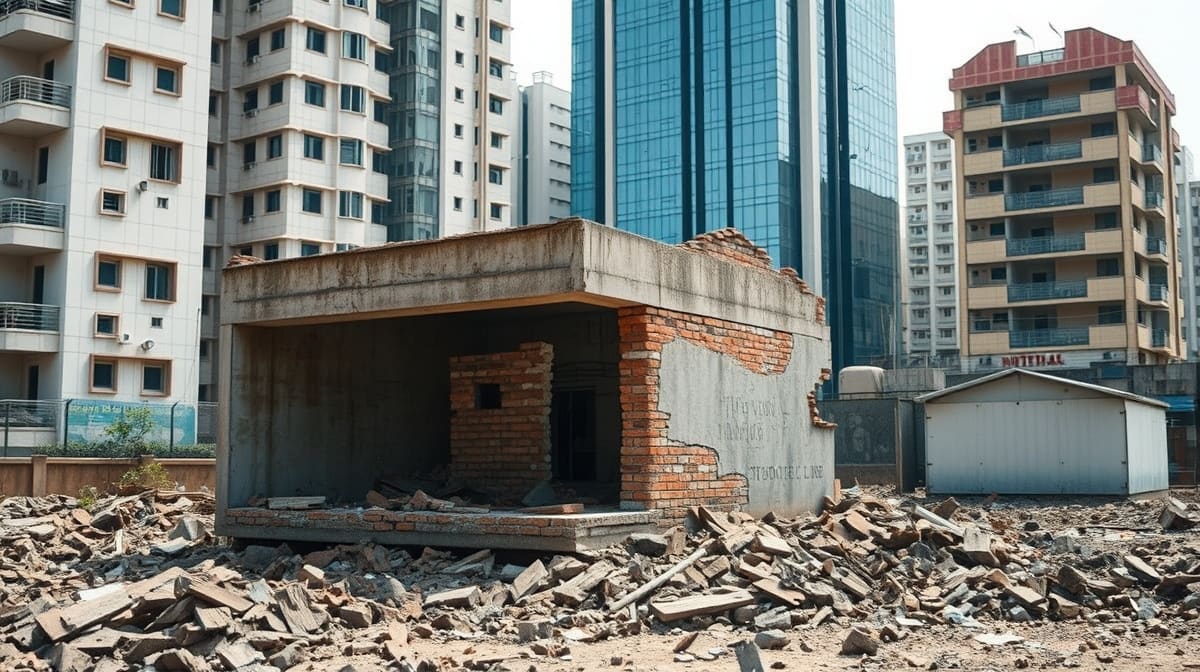
The Gauhati High Court has affirmed that the Guwahati Metropolitan Development Authority (GMDA) possesses legal jurisdiction to enforce building regulations and issue demolition orders in areas formally brought within the Guwahati Metropolitan Master Plan, even if those areas are geographically within a Gaon Panchayat. This ruling clarifies the hierarchy of planning authority in rapidly urbanizing peripheries of metropolitan cities.
Background & Facts
The Dispute
The petitioner, Dilip Kumar Thakuria, owner of Thakuria Auto Wheels, challenged a demolition order issued by the Guwahati Metropolitan Development Authority (GMDA) dated 11.07.2023, directing the removal of alleged unauthorized additions to a G+4 RCC building located at Dharapur Revenue Village, Khanamukh, under the 32 No. Dharapur Gaon Panchayat. The petitioner contended that the GMDA lacked territorial jurisdiction, as the property fell under the purview of the Assam Panchayat Act, 1994, and not the GMDA Act, 1985.
Key Facts
- The land, measuring 2 Kathas and covered by Dag No. 857 and Patta No. 524, was originally owned by Smti. Satyebati Kakati.
- On 30.11.2006, Smti. Satyebati Kakati obtained a No Objection Certificate (NOC) from the President of the 32 No. Dharapur Gaon Panchayat for construction of a G+4 RCC building with a boundary wall.
- Construction of the RCC building was completed between 2006 and 2007, with technical inspections conducted by Gaon Panchayat staff confirming compliance with the approved plan.
- The petitioner purchased the property through registered sale deeds dated 2016 and 2023.
- Mutation of the land in the petitioner’s name was duly recorded in the Integrated Land Records Management System (Dharitree).
- On 16.08.2021, the GMDA issued a communication to Thakuria Auto Wheels, seeking submission of building permissions and approved plans, following complaints from adjacent landowners (respondents 6 and 7).
- The petitioner submitted the 2006 Gaon Panchayat NOC, site plans, land documents, and revenue receipts.
- On 19.05.2023, the GMDA issued a show cause notice under Sections 87 and 88 of the GMDA Act, 1985, alleging deviations in setback areas, unauthorized extension of ground floor to boundary wall, construction of a toilet in the rear setback, and use of C.I. sheet roofing.
- On 01.06.2023, the petitioner replied, asserting that the property was outside GMDA jurisdiction and governed by the Assam Panchayat Act, 1994.
- On 11.07.2023, the GMDA issued the impugned demolition order, directing removal of unauthorized portions within 10 days.
- A site inspection was conducted on 24.07.2023, in the presence of the petitioner, confirming deviations in rear, left, and right setbacks.
- Respondent No. 5, Smti. Tutu Das, alleged that a portion of the petitioner’s 4th floor wall collapsed onto her shop, causing damage.
- The GMDA relied on Notification dated 25.09.1986 under the Assam Town and Country Planning Act, 1959, and Notification dated 09.06.2009 under Section 21 of the GMDA Act, 1985, to assert jurisdiction over Dharapur area.
Procedural History
- 30.11.2006: NOC issued by 32 No. Dharapur Gaon Panchayat for G+4 construction
- 2006 - 2007: Construction of G+4 RCC building completed
- 2016 & 2023: Registered sale deeds executed in favor of petitioner
- 16.08.2021: GMDA issues letter seeking building documents
- 19.05.2023: Show cause notice issued under Sections 87 and 88 of GMDA Act, 1985
- 01.06.2023: Petitioner submits reply disputing jurisdiction
- 11.07.2023: Impugned demolition order issued by GMDA
- 24.07.2023: Court-ordered site inspection confirms deviations
- 12.05.2026: Writ petition dismissed by Gauhati High Court
The Parties' Positions
For the Petitioner
- The property lies within the jurisdiction of the 32 No. Dharapur Gaon Panchayat, governed by the Assam Panchayat Act, 1994.
- The 2006 NOC from the Gaon Panchayat was valid and legally binding.
- No new construction occurred after 2007; the petitioner merely inherited the property.
- The GMDA failed to produce the original complaint petitions dated 27.07.2021 and 15.03.2023, depriving him of a fair opportunity to respond.
- The GMDA did not produce a valid notification placing Dharapur within its jurisdiction, despite the Court’s prior observation.
- Relied on Municipal Corporation, Ludhiana v. Inderjit Singh and Krishnadatt Awasthy v. State of Madhya Pradesh to argue violation of natural justice.
For the Respondents
- Dharapur village (despite spelling variation as "Dharampur" in 2009 notification) is included in the Master Plan under Notifications dated 25.09.1986 and 09.06.2009.
- The GMDA Act, 1985, supersedes local Panchayat permissions where a Master Plan is in force.
- Multiple deviations were confirmed during inspections: extension to boundary wall, C.I. roofing, rear setback toilet, and alleged G+5 floor.
- The petitioner did not dispute the factual findings of the inspection.
- The Gaon Panchayat lacks authority to permit construction beyond G+2 without Zilla Parishad approval.
- The demolition order targets only unauthorized additions, not the entire structure.
Relief Sought
The petitioner sought quashing of the show cause notice dated 19.05.2023 and the demolition order dated 11.07.2023, on grounds of lack of jurisdiction, violation of natural justice, and non-application of the Assam Panchayat Act, 1994.
The Legal Issue
The central question was whether the GMDA Act, 1985 can override a Gaon Panchayat-issued building permission when the land is formally included within the notified Master Plan of the Guwahati Metropolitan Area, and whether the failure to hold a personal hearing before a demolition order violates natural justice where the petitioner has been afforded an opportunity to submit a written reply.
Arguments Presented
For the Petitioner
The petitioner’s counsel, Mr. R. Sarma, argued that the 2006 NOC issued by the 32 No. Dharapur Gaon Panchayat was valid under the Assam Panchayat Act, 1994, and that construction was completed in 2007, long before any GMDA jurisdiction was extended. He contended that the GMDA’s jurisdictional claim was unsupported by a clear, unambiguous notification, and that the spelling discrepancy in the 2009 notification ("Dharampur" vs. "Dharapur") rendered it invalid. He further argued that the show cause notice and demolition order were issued without a personal hearing, violating the mandatory proviso to Section 88 of the GMDA Act, 1985, and that the failure to produce the original complaint petitions deprived him of a fair opportunity to rebut allegations. He relied on Municipal Corporation, Ludhiana v. Inderjit Singh to assert that non-compliance with the hearing requirement renders the order void, and on Krishnadatt Awasthy to argue that even if prejudice is not proven, the breach of mandatory procedure cannot be condoned.
For the Respondent
The Additional Advocate General, Mr. P. Nayak, countered that the 1986 and 2009 notifications clearly brought Dharapur within the GMDA’s jurisdiction, and that the spelling variation was a clerical error, not a jurisdictional defect. He submitted that the GMDA Act, 1985, being a special statute for metropolitan planning, prevails over general Panchayat laws. He emphasized that the petitioner was issued a show cause notice, submitted a detailed reply, and participated in a court-ordered inspection where deviations were confirmed. He argued that the proviso to Section 88 requires only a reasonable opportunity to show cause, not necessarily a personal hearing, and that the petitioner’s reply addressed the core issue of jurisdiction, not the factual deviations. He cited Krishnadatt Awasthy to argue that where facts are undisputed and no prejudice is shown, the order need not be set aside for procedural irregularity.
The Court's Analysis
The Court undertook a detailed examination of the statutory framework under the GMDA Act, 1985, and the nature of the notifications relied upon by the respondents. It noted that the preamble and Section 1(2) of the Act clearly establish its territorial ambit as the entire Guwahati Metropolitan Area, excluding Cantonment areas. The Court found that the 1986 notification under the Assam Town and Country Planning Act, 1959, and the 2009 notification under Section 21 of the GMDA Act, 1985, were valid instruments for extending the Master Plan’s reach to Dharapur. The minor spelling variation in the 2009 notification was held to be a clerical error, not a jurisdictional flaw, especially since no other village named "Dharampur" exists in Jalukbari Mouza.
The Court then turned to the issue of jurisdictional supremacy. It held that once an area is formally notified under a metropolitan Master Plan, the provisions of the GMDA Act, 1985, govern land use and construction, irrespective of prior permissions granted by local Panchayats. The Court observed:
"The authority of a Gaon Panchayat to grant building permissions cannot override the statutory framework of a notified Master Plan under a special metropolitan development statute. The GMDA Act, 1985, is a comprehensive legislation designed to ensure uniform planning in a rapidly urbanizing region."
Regarding the alleged violation of natural justice, the Court examined the proviso to Section 88, which mandates a reasonable opportunity to show cause before a demolition order. It held that the petitioner was afforded this opportunity through the show cause notice and written reply. The Court distinguished between a "personal hearing" and a "reasonable opportunity to show cause," noting that the latter is satisfied by written submissions when the issue raised is legal or jurisdictional, as opposed to factual. The Court further observed:
"The petitioner did not dispute the factual findings of the inspection report. He merely contested jurisdiction. Where the facts of deviation are undisputed and the objection is purely legal, the failure to hold a personal hearing does not constitute a fatal flaw if the party has been heard on the core issue."
The Court also relied on Krishnadatt Awasthy to conclude that no prejudice was caused to the petitioner, as he had full opportunity to respond, and the deviations were confirmed in his presence during the inspection. The Court rejected the argument that the GMDA was required to produce the original complaint petitions, holding that the show cause notice and inspection report were sufficient to initiate proceedings.
The Verdict
The writ petition was dismissed. The Court upheld the demolition order dated 11.07.2023, holding that the GMDA had jurisdiction under the GMDA Act, 1985, and that the petitioner was afforded a reasonable opportunity to show cause. The unauthorized portions of the construction - including the extension to the boundary wall, C.I. sheet roofing, and rear setback toilet - are to be demolished within 30 days from the date of this judgment. The GMDA is directed to recover demolition expenses from the petitioner as arrears of land revenue, as permitted under Section 88(1). No costs are awarded.
What This Means For Similar Cases
Municipal Jurisdiction Supersedes Panchayat Permissions in Notified Areas
- Practitioners must verify whether a property lies within a notified Master Plan before relying on Gaon Panchayat permissions.
- A Panchayat-issued NOC does not immunize construction from enforcement under metropolitan planning laws.
- Legal challenges based solely on Panchayat jurisdiction will fail if the area is formally included in a metropolitan Master Plan.
Written Reply Suffices for Natural Justice in Jurisdictional Disputes
- A personal hearing is not mandatory if the party has submitted a detailed written reply addressing the core legal issue.
- Where the factual deviations are confirmed in the presence of the owner, and the objection is jurisdictional, courts may find no prejudice.
- Authorities must ensure written replies are considered, but need not conduct oral hearings unless the case involves disputed facts.
Inspection Reports Are Critical Evidence in Demolition Cases
- Demolition orders are more likely to be upheld if supported by inspection reports conducted in the presence of the owner.
- Photographs, signed verification reports, and site maps should be systematically maintained as evidence.
- Failure to conduct a site inspection in the owner’s presence may render the order vulnerable to challenge.