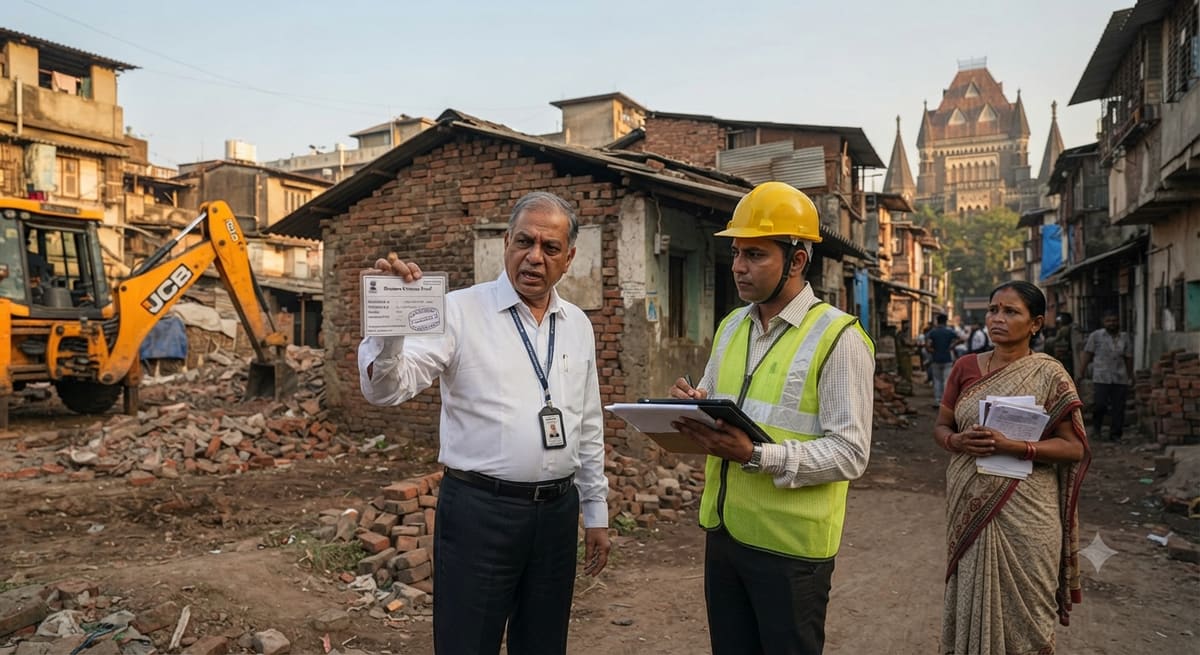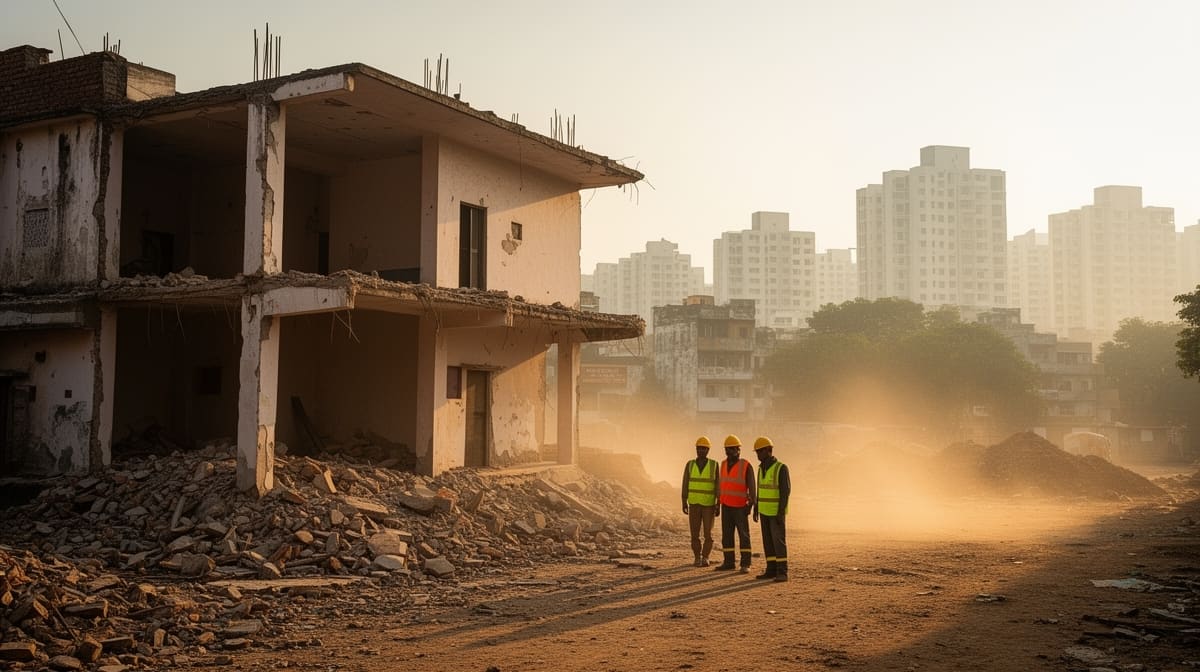
The Bombay High Court has clarified that authorities cannot proceed with demolition or regularization of structures on government land under the Slum Areas (Improvement and Clearance) Act, 1971, without first determining whether the land falls within a notified slum area. This foundational requirement ensures procedural fairness and prevents arbitrary action against occupants who may have legitimate claims based on prior judicial orders or government allotments.
Background & Facts
The Dispute
The petitioners in these consolidated writ petitions challenge the demolition of structures situated on Survey No.263, CTS No.7, Marve Road, Malad (West), Mumbai, which were originally allotted by the State of Maharashtra to thirteen families affected by a natural calamity in 1996. The structures were erected pursuant to a Government order dated 26 June 2000, which directed the Deputy Collector (ENC), Mumbai Suburban District, to permit the families to build shelters on the land. Despite judicial protection and reconstruction orders, the State later issued notices under the Slum Act and demolished parts of the structures.
Key Facts
- In 1996, thirteen families lost their homes in a natural calamity at Sanjay Nagar, Kurla
- On 26 June 2000, the Secretary, Ministry of Housing and Special Assistance, ordered that the affected families be permitted to construct shelters on Survey No.263, CTS No.7
- On 17 July 2001, the Tahsildar (ENC), Borivali, requested police protection for construction on the allotted land
- The thirteen families constructed structures on the land, including one measuring 20 x 15 feet (300 sq. ft.) allotted to Patel Maulanabee
- On 29 July 2002, the City Civil Court granted an interim injunction restraining the State from demolishing the structures
- Despite the injunction, the State demolished the structures in 2002
- On 22 July 2003, the Bombay High Court allowed Writ Petition No.2618 of 2002, directing reconstruction of the thirteen structures and awarding Rs.10,000/- each as costs
- On 25 February 2005, the Division Bench upheld the 2003 order, emphasizing the need for personal hearing before eviction
- Patel Maulanabee reconstructed her structure and obtained a photopass (No.80/H/MG/93/700) and electricity connection
- The structure was later transferred to Narendra Laxmanprasad Sharma via agreement dated 25 October 2011, and subsequently to the petitioner, Mohammed Bashir Ansari
- On 20 November 2010, Respondent No.2 issued notice under Section 3Z-2 of the Slum Act, demanding proof of existence of the structure prior to 1 January 1995
- On 29 March 2012, the Deputy Collector (ENC) ordered demolition, holding the structure unauthorized and in violation of photopass conditions
- On 31 March 2012, a portion of the structure was demolished without serving the order or affording opportunity to challenge it
- Appeal No.212 of 2012 was filed on 29 March 2012, challenging the demolition order
- On 29 October 2012, the Administrator and Divisional Commissioner dismissed the appeal, holding that the transfer was invalid and no proof of prior existence was established
- On 7 November 2012, the structure was fully demolished after a public notice was pasted, with goods left exposed on the site
Procedural History
- 1996: Natural calamity destroys homes of thirteen families at Sanjay Nagar, Kurla
- 26 June 2000: Government order permits reconstruction on Survey No.263
- 17 July 2001: Tahsildar requests police protection for construction
- 29 July 2002: City Civil Court grants interim injunction against demolition
- 22 July 2003: Bombay High Court allows Writ Petition No.2618 of 2002, orders reconstruction and awards Rs.10,000/- to each petitioner
- 25 February 2005: Division Bench upholds 2003 order, mandates personal hearing before eviction
- 20 November 2010: Notice under Section 3Z-2 of the Slum Act issued to predecessor
- 29 March 2012: Order of demolition passed by Deputy Collector (ENC)
- 31 March 2012: Partial demolition of structure without serving order
- 29 March 2012: Appeal No.212 of 2012 filed before Administrator and Divisional Commissioner
- 29 October 2012: Appeal dismissed; no service of order to petitioner
- 7 November 2012: Full demolition after public notice; goods left exposed
- 2012: Writ Petitions filed under Articles 226 and 227 of the Constitution
The Parties' Positions
The petitioners contend that:
- The structures were erected pursuant to lawful government orders and judicial directions
- The photopass and electricity connection validate their possession
- The transfer of rights was legitimate and recognized under circulars issued in January 2012
- The State acted in breach of injunctions and denied natural justice by demolishing without service or hearing
- The land is not a notified slum area, making the Slum Act inapplicable
The State contends that:
- The structure was not in existence prior to 1 January 1995, as required under Section 3Z-2
- The photopass conditions were violated by unauthorized transfer
- The appellate authority correctly held that the transfer via power of attorney was invalid
- The demolition was lawful under the Slum Act
Relief Sought
The petitioners seek:
- Setting aside of the demolition order dated 29 March 2012 and appellate order dated 29 October 2012
- Restoration of the structure or compensation for its destruction
- Direction to the State to consider regularization of the structure under applicable policies
- Declaration that the land is not a notified slum area
- Costs and damages for illegal demolition and loss of business
The Legal Issue
The central question is whether the authorities can invoke the Slum Areas (Improvement and Clearance) Act, 1971, to demolish or deny regularization of structures on government land without first determining whether the land falls within a notified slum area.
Arguments Presented
For the Petitioner
Learned counsel for the petitioners argued that the Slum Act applies only to structures within notified slum areas. The petitioners submitted that Survey No.263 is not part of any notified slum area under the Act. They relied on the Government order of 26 June 2000 and the High Court’s 2003 order directing reconstruction as evidence of lawful possession. They further cited the January 2012 circular permitting regularization of structures with photopass upon payment of penalty, arguing that the State’s refusal to consider regularization despite judicial recognition violated principles of legitimate expectation and equality.
For the Respondent
The State contended that the petitioner failed to establish the structure’s existence prior to 1 January 1995, a mandatory condition under Section 3Z-2. It argued that the photopass was issued to the original allottee, Patel Maulanabee, and that subsequent transfers without permission violated Condition Nos.3 and 12. The State maintained that the appellate authority’s findings were factual and not liable to interference under writ jurisdiction, and that the demolition was lawful in the absence of valid proof of prior occupation.
The Court's Analysis
The Court emphasized that the Slum Act is a special statute with limited applicability. Its provisions, including Section 3Z-2 and Section 32-2(4), are triggered only when the structure is situated within a notified slum area. The Court held that the determination of whether land is a notified slum area is not a mere procedural formality but a jurisdictional precondition. Without this determination, any action under the Slum Act is ultra vires.
"The issue whether the structures are situated within a slum area or not is a foundational fact which must be first determined before any exercise of regularisation is taken."
The Court rejected the State’s argument that the petitioner’s failure to prove pre-1995 existence justified demolition. It noted that the original construction was sanctioned by the State itself in 2000, and that the High Court had previously directed reconstruction in 2003. The Court observed that the State’s conduct - first permitting construction, then demolishing despite judicial orders, and now invoking the Slum Act - amounted to an abuse of power.
The Court further held that the failure to serve the demolition order before carrying out demolition violated the principles of natural justice. The appellate order, which was never served on the petitioner, could not serve as a basis for final demolition. The Court also noted that the January 2012 circular, which provided a regularization pathway for photopass holders, was not considered by the authorities despite its applicability.
The Verdict
The petitioners succeeded. The Court directed Respondent No.2 to first ascertain whether the structures are situated within a notified slum area. If the land is not within a notified slum area, Respondent No.2 shall consider the petitioners’ request for regularization and transfer in accordance with law, applicable policies, and the January 2012 circular. The determination must be completed within twelve weeks of receipt of the regularization proposal. All pending interim applications are disposed of. No costs are awarded.
What This Means For Similar Cases
Slum Area Status Is Jurisdictional
- Authorities cannot invoke the Slum Act unless the land is formally notified as a slum area under Section 2(1)(a) of the Act
- Any demolition or regularization order passed without this determination is void ab initio
- Practitioners must raise this as a preliminary objection in all Slum Act proceedings
Judicial Orders Override Administrative Denials
- Structures reconstructed pursuant to court orders cannot be treated as unauthorized merely due to lack of pre-1995 proof
- The State is estopped from denying legitimacy of structures it previously sanctioned or courts have ordered to be restored
- Past judicial directions must be integrated into regularization assessments
Circulars Create Legitimate Expectations
-
Government circulars providing regularization pathways create enforceable expectations for eligible occupants
-
Denial of regularization under such schemes without reasoned justification violates Article 14
-
Petitioners must be given opportunity to produce documents under circulars, even if formal title is disputed
-
Always verify if the land is notified as a slum area before filing or defending any Slum Act proceeding
-
Preserve all government orders, court judgments, and circulars relating to construction or allotment
-
Demand service of all orders before any demolition and challenge non-service as violation of natural justice