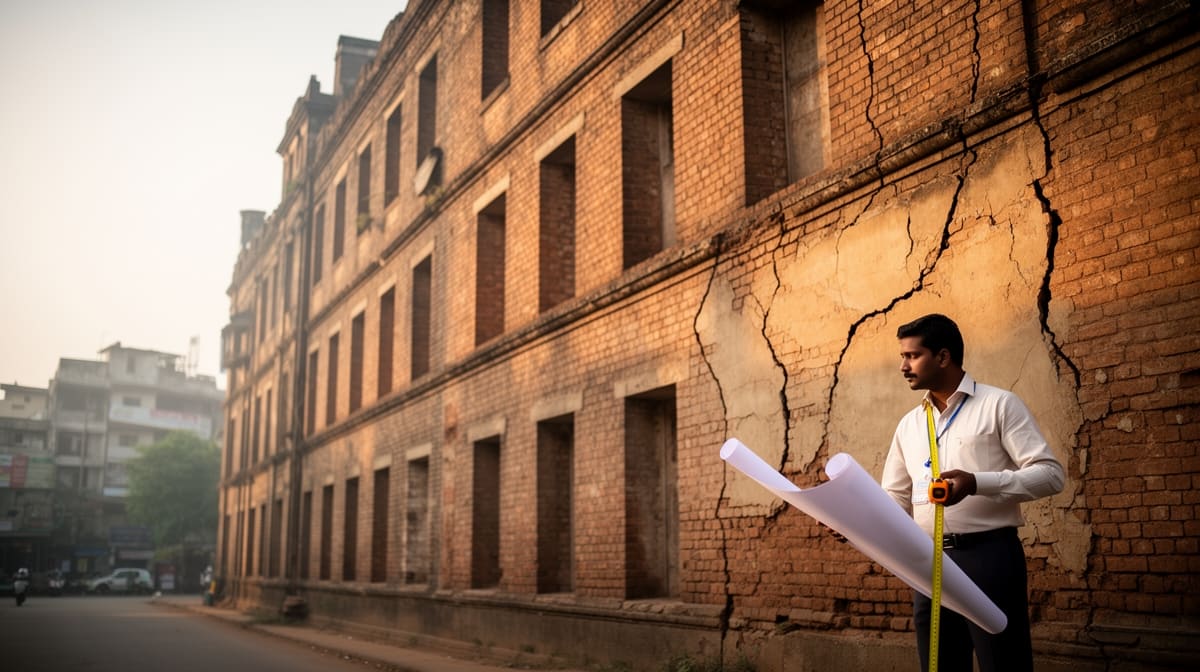
The Andhra Pradesh High Court has clarified that municipal authorities cannot act on partial structural assessments when demolition is proposed in multi-occupant buildings. The judgment underscores that public safety and procedural fairness demand a holistic evaluation of structural integrity, not a fragmented approach driven by private disputes.
Background & Facts
The Dispute
The dispute centers on a 89-year-old building at D.No. 27-6-117, Vijayawada, divided into two portions: D.No. 27-6-117A (occupied by the petitioner in WP No. 15721 of 2025) and D.No. 27-6-117B (purchased by the petitioner in WP No. 28064 of 2025). The latter, Padarthi Sridhar, claims ownership and seeks to replace the deteriorating Madras terrace roof with an asbestos shed. The former, Parvindar Singh Kohlee, alleges unauthorized construction and fears structural collapse during demolition of 117B will damage his portion. Both parties have engaged in prolonged litigation over possession, rent, and trespass.
Procedural History
- 2010: Padarthi Sridhar purchased portion of building and obtained separate door number D.No. 27-6-117B.
- 2013: Sridhar filed eviction suit against Kohlee; dismissed by Rent Control Court and affirmed on appeal.
- 2019: Kohlee filed criminal complaint for trespass and theft; accused (including Sridhar) convicted by Metropolitan Magistrate.
- 2024: Kohlee filed OS No. 1727 of 2024 seeking injunction against demolition; granted by Civil Judge.
- August 2024: Vijayawada Municipal Corporation (VMC) issued notice to Sridhar under Section 636 of the Municipal Corporation Act, 1955, citing structural instability.
- September 2024: Structural assessment by Siddhardha Engineering College recommended immediate dismantling of D.No. 27-6-117B.
- September 2025: VMC issued impugned notice to Kohlee (not Sridhar) directing removal of unauthorized shed on first floor.
- October 2025: High Court stayed coercive action pending final hearing.
Relief Sought
Kohlee sought a writ of mandamus to declare VMC’s inaction and selective enforcement illegal, and to direct removal of unauthorized construction by Sridhar. Sridhar sought quashing of the notice issued to him, arguing it was arbitrary and violated his right to property under Article 300-A.
The Legal Issue
The central question was whether a municipal corporation may issue a demolition notice under Section 636 of the Municipal Corporation Act, 1955 against a non-owner occupant based solely on a structural assessment of a separately owned portion of a shared building, without evaluating the structural impact on the entire edifice.
Arguments Presented
For the Petitioner (Kohlee)
Kohlee’s counsel argued that the VMC’s notice to him was procedurally flawed and violative of natural justice, as he was neither the owner nor the constructor of the structure assessed. The structural report pertained only to D.No. 27-6-117B, yet the notice targeted Kohlee’s portion. He cited State of U.P. v. Mohd. Noor to emphasize that administrative action must be based on relevant, complete, and impartial evidence. The selective enforcement, he contended, was a tool to circumvent the civil injunction and favor Sridhar.
For the Respondent (VMC and Sridhar)
VMC argued that the structural assessment was valid and that the notice to Kohlee was issued because he was in possession of the building and had allegedly erected the unauthorized shed. Sridhar contended that the shed on the first floor was erected for safety reasons and that the notice was merely procedural. Both parties denied collusion, asserting that VMC acted independently based on engineering advice.
The Court's Analysis
The Court examined the nature of the structural assessment and the scope of municipal authority under Section 636 of the Municipal Corporation Act, 1955. It held that while the assessment by Siddhardha Engineering College was admissible, its limited scope - focusing only on D.No. 27-6-117B - was insufficient to justify action affecting the entire building. The Court emphasized that a building constructed 89 years ago, with shared load-bearing walls and foundations, cannot be treated as two independent units for safety purposes.
"The structural stability certificate, though relevant, was confined to a portion of the building. The entire edifice, constructed as a single unit, must be assessed holistically before any demolition is contemplated."
The Court rejected the notion that a notice issued to one party could be used to enforce action against another, particularly where the latter is not the owner or constructor. It noted that the VMC’s failure to serve the notice on Sridhar, the actual owner of the structure under assessment, further undermined procedural legitimacy. The Court also observed that the VMC had not sought an independent assessment from a reputed institution like NIT or JNTU, as required by best practices in urban safety governance.
The Court distinguished between the legality of unauthorized construction and the necessity of structural safety. While the shed on Kohlee’s portion was indeed unauthorized, the remedy lay in issuing a proper notice to the actual violator - not the occupant. The Court held that public safety cannot be subordinated to private litigation, and that municipal authorities have a fiduciary duty to act on comprehensive, unbiased data.
The Verdict
The petitioner in WP No. 15721 of 2025 succeeded. The Court held that municipal demolition notices must be based on a structural assessment of the entire building, not isolated portions. The notice issued to Kohlee was quashed. The petitioner in WP No. 28064 of 2025 failed, as no evidence showed he obtained permission for the shed, and the Court declined to interfere with the notice issued to him under Section 636. Both petitions were disposed of with no costs.
What This Means For Similar Cases
Structural Assessment Must Be Holistic
- Municipal authorities must commission structural evaluations of the entire building when shared walls, foundations, or load-bearing elements are involved.
- Partial assessments targeting only one unit cannot justify demolition notices affecting other occupants.
- Practitioners should challenge notices based on fragmented reports by invoking the principle of res ipsa loquitur in structural safety cases.
Notice Must Target the Actual Violator
- A notice under Section 636 of the Municipal Corporation Act, 1955 must be served on the person who constructed or owns the unauthorized structure.
- Serving notices on innocent occupants or tenants to pressure owners is a violation of natural justice and will be set aside.
- Lawyers should file applications for joinder of proper parties before any demolition proceedings commence.
Municipal Action Cannot Be a Proxy for Civil Disputes
- Municipal corporations must remain neutral arbiters in private property disputes.
- Any action perceived as favoring one litigant over another will be viewed as mala fide.
- Courts will intervene where municipal machinery is used to circumvent civil injunctions or enforce private claims.
Procedural Compliance Is Non-Negotiable
- Failure to serve notices on the correct party invalidates proceedings, regardless of the underlying safety concern.
- Registered post service does not cure defective service if the intended recipient is not the proper party.
- Practitioners should demand proof of service and identity of the notice recipient in all municipal enforcement cases.