Bombay High Court judgments

2128 Bombay High Court judgments explained in plain English: what was decided, the law applied and why it matters. Page 16 of 89.

Anticipatory Bail Under BNSS | Dispute Over Land Compensation Entitlement Does Not Constitute Prima Facie Forgery Without Investigative Confirmation : Bombay HC
Case Law Analysis
|Bombay High Court

Anticipatory Bail Under BNSS | Dispute Over Land Compensation Entitlement Does Not Constitute Prima Facie Forgery Without Investigative Confirmation : Bombay HC

The Bombay High Court granted anticipatory bail to an applicant accused of forging Gram Panchayat receipts for Bullet Train compensation, holding that a civil dispute over land boundaries and entitlement cannot, by itself, establish criminal forgery. This clarifies that mere discrepancies in documentation during compensation claims do not automatically trigger criminal liability, protecting landowners from premature arrest in complex land acquisition cases.

MCS Act Section 91(1) | Pendency of Election Petition Does Not Suspended Elected Committee’s Tenure or Function: Bombay HC
Case Law Analysis
|Bombay High Court

MCS Act Section 91(1) | Pendency of Election Petition Does Not Suspended Elected Committee’s Tenure or Function: Bombay HC

The Bombay High Court has ruled that the mere filing of an election petition under Section 91(1) of the Maharashtra Co-operative Societies Act does not invalidate or suspend the authority of a newly elected managing committee. Elected members may immediately assume office and conduct society affairs, ensuring democratic continuity and preventing administrative paralysis by prolonging provisional committees.

Parity Principle in Regular Bail | No Antecedents + Completed Investigation + Co-Accused Released Justifies Release Under BNSS Section 483 : Bombay HC
Case Law Analysis
|Bombay High Court

Parity Principle in Regular Bail | No Antecedents + Completed Investigation + Co-Accused Released Justifies Release Under BNSS Section 483 : Bombay HC

The Bombay High Court granted regular bail to an accused in a copper theft case, holding that the absence of criminal antecedents, completion of investigation, and the release of co-accused collectively negate the need for continued custody - reinforcing that parity and personal liberty under Article 14 must guide bail decisions even in non-bailable offences. This sets a clear benchmark for trial courts weighing pre-trial detention in multi-accused property crimes.

Land Acquisition Compensation | 75% Deduction for Small Plots Excessive; 50% Deduction + 10% Annual Escalation Mandatory : Bombay HC Aurangabad
Case Law Analysis
|Bombay High Court

Land Acquisition Compensation | 75% Deduction for Small Plots Excessive; 50% Deduction + 10% Annual Escalation Mandatory : Bombay HC Aurangabad

The Bombay High Court Aurangabad Bench has ruled that a 75% deduction from sale deed value for small land parcels is unjustified, setting 50% as the reasonable benchmark and requiring 10% annual escalation from the sale date to the Section 4 notification date. This standardizes valuation methodology for agricultural landowners across Maharashtra, ensuring fairer compensation and curbing arbitrary discounts by acquisition authorities.

Service Law | Approval Date Must Match Actual Appointment Date to Avoid Arbitrariness Under Article 14: Bombay HC
Case Law Analysis
|Bombay High Court

Service Law | Approval Date Must Match Actual Appointment Date to Avoid Arbitrariness Under Article 14: Bombay HC

The Bombay High Court has ruled that delaying approval of a government appointment years after service began violates Article 14 and constitutes administrative arbitrariness. The court mandated immediate correction of the approval date to match the original appointment date and ordered payment of full salary arrears, reinforcing that procedural delays cannot deprive employees of rightful benefits.

Section 276CC IT Act | Director Not Liable for Post-Resignation Failure to File Return: Bombay HC
Case Law Analysis
|Bombay High Court

Section 276CC IT Act | Director Not Liable for Post-Resignation Failure to File Return: Bombay HC

The Bombay High Court has ruled that a director who resigns before the due date for filing a company’s income tax return cannot be held criminally liable under Section 276CC for the company’s subsequent non-filing. This clarifies that liability under the provision is tied to active directorship at the time of the default, not retrospective attribution, offering critical protection to exiting directors in corporate tax compliance cases.

POCSO Act Overrides SCST Act Section 18 Bail Bar | Anticipatory Bail Permitted Despite Statutory Restriction : Bombay HC Aurangabad
Case Law Analysis
|Bombay High Court

POCSO Act Overrides SCST Act Section 18 Bail Bar | Anticipatory Bail Permitted Despite Statutory Restriction : Bombay HC Aurangabad

The Bombay High Court has ruled that when offenses under the POCSO Act and the SCST Act arise concurrently, the POCSO Act’s bail framework takes precedence over Section 18 of the SCST Act, which otherwise prohibits anticipatory bail. This sets a critical precedent for accused persons facing dual charges, ensuring that child protection laws do not get sidelined by procedural bars meant for caste-based atrocities.

Land Acquisition Compensation | Market Rate Evidence Overrides Uniform Enhancement Cap Under Section 23(1) LAA 2013: Bombay HC Aurangabad
Case Law Analysis
|Bombay High Court

Land Acquisition Compensation | Market Rate Evidence Overrides Uniform Enhancement Cap Under Section 23(1) LAA 2013: Bombay HC Aurangabad

The Bombay High Court ruled that claimants are entitled to compensation based on proven market value, even when other claimants received lower rates, striking down arbitrary caps tied to multipliers of the original offer. This affirms that individualized evidence of market rates supersedes blanket government policies, empowering landowners to seek just compensation under the Right to Fair Compensation Act.

Section 283, Indian Succession Act | Single Newspaper Publication + Incomplete Addresses Invalidate Service of Citation in Probate: Bombay HC
Case Law Analysis
|Bombay High Court

Section 283, Indian Succession Act | Single Newspaper Publication + Incomplete Addresses Invalidate Service of Citation in Probate: Bombay HC

The Bombay High Court has ruled that serving citation in probate proceedings requires more than a single newspaper publication and precise addresses for all legal heirs. Incomplete service violates natural justice and renders the probate grant vulnerable to revocation, affecting executors and heirs alike in succession disputes.

Muslim Personal Law | Child's Welfare Overrides Natural Father's Presumptive Custody Right: Bombay HC Aurangabad
Case Law Analysis
|Bombay High Court

Muslim Personal Law | Child's Welfare Overrides Natural Father's Presumptive Custody Right: Bombay HC Aurangabad

The Bombay High Court Aurangabad Bench ruled that under Muslim personal law, a father's natural guardian status cannot automatically override the child's welfare in custody disputes. The court emphasized direct judicial interaction with the child and the stability provided by the maternal uncle's care as decisive factors, setting a precedent for rejecting gendered presumptions in guardianship cases.

Fraud on Court via False Affidavit | Clean Hands Doctrine Bars Writ Petition; Rs.25,000 Costs Imposed : Bombay HC Nagpur Bench
|Bombay High Court

Fraud on Court via False Affidavit | Clean Hands Doctrine Bars Writ Petition; Rs.25,000 Costs Imposed : Bombay HC Nagpur Bench

The Bombay High Court dismissed a writ petition after finding the petitioner submitted a forged affidavit, verified by the notary’s register and sworn statement. The court invoked the clean hands doctrine, emphasizing that courts will not entertain litigants who deceive the judiciary - setting a clear precedent for accountability in constitutional litigation and deterring future misuse of judicial process.

Motor Vehicles Act | Filed Income Tax Returns Establish Deceased’s Income for Compensation, Even Without Signature: Bombay HC
Case Law Analysis
|Bombay High Court

Motor Vehicles Act | Filed Income Tax Returns Establish Deceased’s Income for Compensation, Even Without Signature: Bombay HC

The Bombay High Court ruled that income tax returns filed under the Income Tax Act, even if unsigned by tax authorities, are sufficient to establish the deceased’s income in motor accident claims - rejecting the insurer’s technical objection. This clarifies that the mere filing and acknowledgment by the IT department create a presumption of genuineness, significantly easing the burden on claimants and reinforcing ITRs as reliable evidence in dependency calculations under the MV Act.

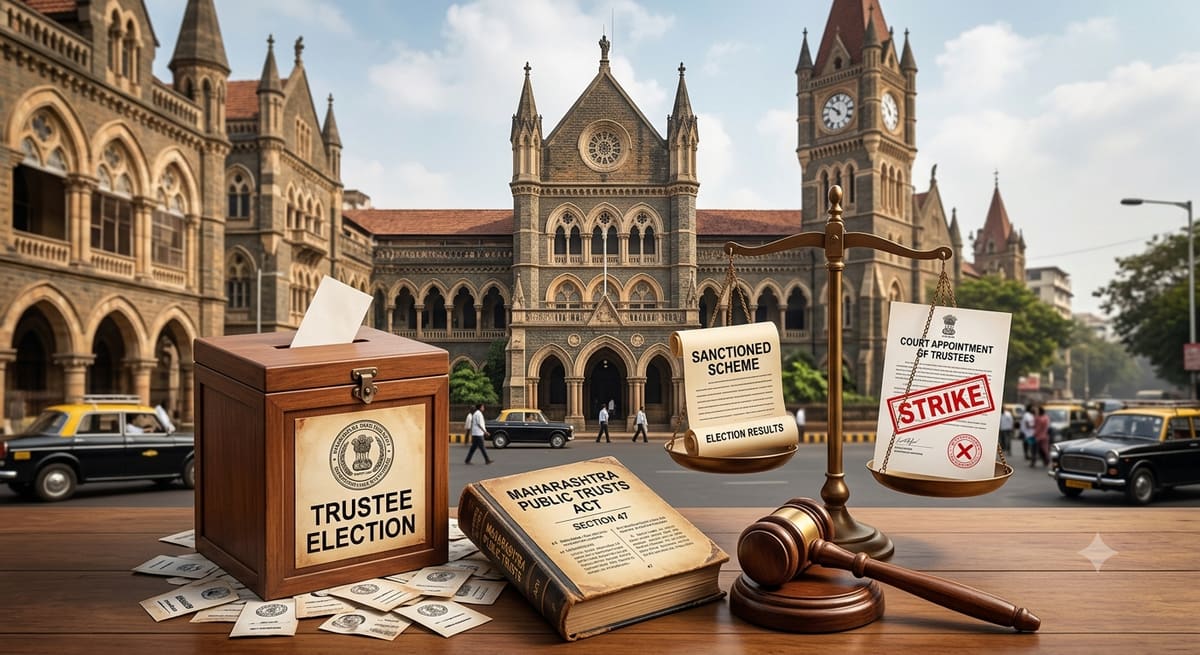
Section 47 Maharashtra Public Trusts Act | Court Cannot Appoint Trustees Post-Election Under Sanctioned Scheme: Bombay HC
Case Law Analysis
|Bombay High Court

Section 47 Maharashtra Public Trusts Act | Court Cannot Appoint Trustees Post-Election Under Sanctioned Scheme: Bombay HC

Bombay High Court ruled that Section 47 of the Maharashtra Public Trusts Act cannot be invoked to appoint trustees after elections have been held as per a sanctioned scheme. The Court quashed an order that effectively extended trustees' terms, emphasizing adherence to the sanctioned election process and directing fresh elections by October 1, 2026. This ruling reinforces the primacy of sanctioned schemes over administrative appointments in trust governance.

Section 9 Arbitration Act | Small Causes Court Jurisdiction Overrides Arbitration Clause in Licensor-Licensee Disputes : Bombay HC
Case Law Analysis
|Bombay High Court

Section 9 Arbitration Act | Small Causes Court Jurisdiction Overrides Arbitration Clause in Licensor-Licensee Disputes : Bombay HC

Bombay High Court holds that disputes relating to possession under licensor-licensee agreements fall exclusively under the Small Causes Court's jurisdiction, rendering arbitration clauses unenforceable. This ruling impacts commercial tenants and landlords seeking interim relief under the Arbitration Act, reinforcing the primacy of statutory jurisdiction over contractual arbitration.

RERA Condonation of Delay | 'Sufficient Cause' Requires Demonstrable Diligence, Not Mere Excuses: Bombay HC
Case Law Analysis
|Bombay High Court

RERA Condonation of Delay | 'Sufficient Cause' Requires Demonstrable Diligence, Not Mere Excuses: Bombay HC

Bombay High Court dismisses a developer's appeal for condonation of an 851-day delay under RERA, ruling that 'sufficient cause' mandates reasonable diligence beyond claims of inadvertence or resource constraints. The judgment reinforces that RERA appeals demand strict compliance with timelines, impacting real estate litigants seeking delay condonation.

Order VII Rule 11 CPC | Limitation Must Be Determined Solely From Plaint Averments, Not Defendant’s Contentions : Bombay HC
|Bombay High Court

Order VII Rule 11 CPC | Limitation Must Be Determined Solely From Plaint Averments, Not Defendant’s Contentions : Bombay HC

Bombay High Court reinforces that limitation under Order VII Rule 11 CPC is a pure question of law, to be decided exclusively on the plaint’s averments. The ruling revives a tenant’s suit for tenancy declaration, clarifying that the cause of action arose only post-reconstruction of the fire-destroyed property, not from the original tenancy date.

Majority Rule Governs Leadership Changes in Local Bodies | Bombay HC Upholds No-Confidence Motion Under Maharashtra Municipal Councils Act : Bombay HC Aurangabad Bench
|Bombay High Court

Majority Rule Governs Leadership Changes in Local Bodies | Bombay HC Upholds No-Confidence Motion Under Maharashtra Municipal Councils Act : Bombay HC Aurangabad Bench

Bombay High Court rules that leadership changes in municipal councils, including no-confidence motions, are governed by majority decisions under the Maharashtra Municipal Councils Act, 1965. The judgment limits whip violations to voting contexts, reinforcing democratic processes in local governance and dismissing challenges to groupleader changes.

Preponderance of Probabilities Standard | Domestic Enquiries Under MRTU & PULP Act Require Only Balance of Evidence, Not Beyond Reasonable Doubt: Bombay HC
Case Law Analysis
|Bombay High Court

Preponderance of Probabilities Standard | Domestic Enquiries Under MRTU & PULP Act Require Only Balance of Evidence, Not Beyond Reasonable Doubt: Bombay HC

The Bombay High Court has ruled that in domestic enquiries under the MRTU & PULP Act, employers need only prove misconduct on a preponderance of probabilities-not beyond reasonable doubt. This lowers the evidentiary bar for disciplinary actions, directly impacting employee rights in industrial disputes and reinforcing the tribunal’s deference to internal investigations.

Section 154B-8 MCS Act | Mandatory Disqualification for Delayed Document Supply Upheld as Statutory Transparency Duty : Bombay HC
Case Law Analysis
|Bombay High Court

Section 154B-8 MCS Act | Mandatory Disqualification for Delayed Document Supply Upheld as Statutory Transparency Duty : Bombay HC

Bombay HC rules that failure to supply society records within 45 days under Section 154B-8 of the Maharashtra Co-operative Societies Act triggers automatic disqualification, rejecting 'substantial compliance' arguments. The judgment reinforces statutory transparency obligations for co-operative society office-bearers, impacting committee members across Maharashtra.

Section 15 Maharashtra Nurses Act | Statutory Autonomy Trumps State Appointment Power: Bombay HC Quashes Registrar Appointments
Case Law Analysis
|Bombay High Court

Section 15 Maharashtra Nurses Act | Statutory Autonomy Trumps State Appointment Power: Bombay HC Quashes Registrar Appointments

Bombay HC Aurangabad Bench ruled that under Section 15 of the Maharashtra Nurses Act, 1966, only the Maharashtra Nursing Council-not the State-holds authority to appoint its Registrar and Deputy Registrar. The court quashed the State’s appointments, reinforcing statutory autonomy of professional councils in public office appointments.

Maharashtra Government Servants Act, 2005 | Delay in Deciding Representations Triggers Mandatory Disciplinary Action: Bombay HC
Case Law Analysis
|Bombay High Court

Maharashtra Government Servants Act, 2005 | Delay in Deciding Representations Triggers Mandatory Disciplinary Action: Bombay HC

The Bombay High Court has ruled that persistent failure by a government official to decide representations submitted months earlier constitutes prima facie dereliction of duty under the Maharashtra Government Servants Act, 2005. This mandates immediate disciplinary inquiry by the appointing authority, reinforcing that administrative inaction is not mere delay but a breach of statutory obligation with consequences.

Section 16 Arbitration Act | Fraud Allegations Arbitrable Unless Affecting Public Interest: Bombay HC Reaffirms Vidya Drolia Test
Case Law Analysis
|Bombay High Court

Section 16 Arbitration Act | Fraud Allegations Arbitrable Unless Affecting Public Interest: Bombay HC Reaffirms Vidya Drolia Test

Bombay HC holds that commercial disputes involving fraud remain arbitrable unless the fraud affects public interest or involves serious criminal offenses. The court set aside the arbitrator's jurisdictional objection, emphasizing that mere allegations of fraud or third-party involvement do not render a dispute non-arbitrable under the Vidya Drolia test.

Maintenance and Welfare of Parents Act | Eviction Orders Void Without Strict Procedural Compliance: Bombay HC
Case Law Analysis
|Bombay High Court

Maintenance and Welfare of Parents Act | Eviction Orders Void Without Strict Procedural Compliance: Bombay HC

Bombay High Court sets aside an eviction order under the Maintenance and Welfare of Parents and Senior Citizens Act, 2007, ruling that procedural lapses-such as non-compliance with prescribed formats-render such orders legally unsustainable. The judgment reinforces that senior citizens' eviction proceedings must adhere to strict due process to avoid prejudice.