The Bombay High Court has reaffirmed the stringent standards governing condonation of delay under the Real Estate (Regulation and Development) Act, 2016 (RERA). In dismissing an appeal seeking condonation of an 851-day delay, the Court held that mere assertions of inadvertence or lack of resources do not constitute sufficient cause under the law. The judgment underscores that condonation of delay is not an act of judicial generosity but requires demonstrable reasonable diligence from the litigant.
Background & Facts
The Dispute
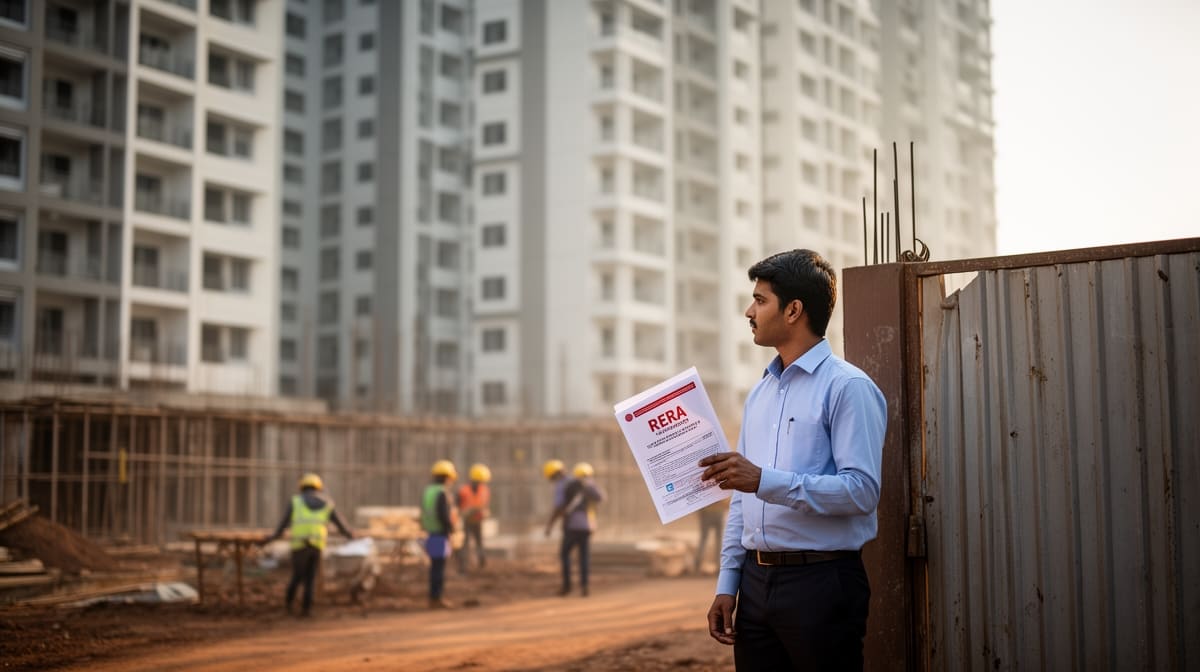
The appellant, Geetai Developers Private Limited, was developing a project under the Slum Rehabilitation Scheme in Mumbai. On 15 March 2013, the appellant executed an agreement for sale of a flat (457 sq.ft., A Wing, first floor) to the respondent, Shekhar Baban Thorat, for a consideration of Rs. 55,37,500. The agreement stipulated delivery of possession by 31 December 2015. Upon the appellant’s failure to deliver possession, the respondent filed a complaint before the Maharashtra Real Estate Regulatory Authority (MahaRERA).
Key Facts
- Agreement Date: 15 March 2013
- Consideration Amount: Rs. 55,37,500
- Scheduled Possession Date: 31 December 2015
- Complaint Filed: Before MahaRERA for delayed possession
- Order Date: 31 January 2019 (MahaRERA directed payment of interest under Rule 18 of the Maharashtra RERA Rules, 2017 from 1 January 2019)
- Non-Compliance Order: 29 April 2022 (issuance of recovery warrant under Section 40(1) of RERA)
- Recovery Warrant Issued: 30 May 2023
Procedural History
- 31 January 2019: MahaRERA directed payment of interest for delayed possession
- 29 April 2022: Non-compliance order issued for failure to comply with the 2019 order
- 30 May 2023: Recovery warrant issued
- 22 October 2023: Appellant filed appeal before the Maharashtra Real Estate Appellate Tribunal with a delay of 851 days
- 19 December 2025: Appellate Tribunal rejected the application for condonation of delay
- 17 June 2026: Bombay High Court reserved judgment
- 1 July 2026: Present judgment pronounced
The Appellant’s Position
The appellant sought condonation of delay on the following grounds:
- Bonafide Impression: The appellant believed all allottees, including the respondent, had amicably settled and agreed to a revised possession date
- Focus on Project Completion: The appellant was engrossed in completing the project and inadvertently overlooked the complaint status
- Lack of Resources: Multiple proceedings before MahaRERA and the Appellate Tribunal made it impossible to track each case
- Non-Receipt of Notice: The appellant changed the project’s email ID in March 2022 and notified the authorities, allegedly missing the non-compliance notice
Relief Sought
The appellant sought condonation of the 851-day delay in filing the appeal against the non-compliance order dated 29 April 2022 and the recovery warrant dated 30 May 2023.
The Legal Issue
The central question was whether the Appellate Tribunal erred in rejecting the application for condonation of delay under Section 58 of RERA, 2016, despite the appellant’s assertions of inadvertence, lack of resources, and non-receipt of notice. Specifically, the Court had to determine:
- Whether the appellant’s reasons constituted sufficient cause under the law
- Whether the liberal approach to condonation of delay could be extended to cases involving negligence, lack of bonafides, or deliberate inaction
Arguments Presented
For the Appellant
Mr. Makarand V. Raut, counsel for the appellant, contended:
- The Appellate Tribunal adopted a rigid view and failed to follow the well-recognized principles governing condonation of delay
- The appellant demonstrated sufficient cause by asserting non-receipt of the non-compliance notice
- Rejection of the application prejudiced the appellant and rendered it remediless
- A substantial question of law arose as to whether the Appellate Tribunal erred in not adhering to the principles of condonation of delay
For the Respondent
Ms. Rishika Mehra, counsel for the respondent, argued:
- The appellant failed to ascribe any cause, much less a sufficient one, for the delay
- The appellant’s assertions amounted to excuses, not explanations
- The Appellate Tribunal correctly rejected the application as the appellant exhibited casualness and lack of diligence
The Court's Analysis
The Court undertook a detailed examination of the principles governing condonation of delay, relying on binding precedents from the Supreme Court. The analysis can be distilled into the following key observations:
Liberal Approach vs. Substantive Justice
The Court acknowledged that condonation of delay is ordinarily governed by a liberal approach, as procedural technicalities should not override substantive justice. However, this liberalism is not unfettered and must be informed by reasonableness and bona fides.
"Undoubtedly, in the matter of condonation of delay, ordinarily, the Courts/Tribunals adopt liberal approach. Such liberal approach is informed by the recognition that the procedure which is handmaid of justice should not be allowed to score a march over the substantive justice. The Courts/Tribunals draw their legitimacy from deciding the matters on merits rather than on technicalities."
The Test of Sufficient Cause
The Court emphasized that sufficient cause is an elastic concept but cannot be stretched to condone negligence or want of bonafides. The litigant must demonstrate reasonable diligence in prosecuting the proceedings. The Court relied on Basawaraj and Anr. v. Special Land Acquisition Officer (2013) 14 SCC 81, which held:
"The law on the issue can be summarised to the effect that where a case has been presented in the court beyond limitation, the applicant has to explain the court as to what was the ‘sufficient cause’ which means an adequate and enough reason which prevented him to approach the court within limitation. In case a party is found to be negligent, or for want of bonafide on his part in the facts and circumstances of the case, or found to have not acted diligently or remained inactive, there cannot be a justified ground to condone the delay."
Explanation vs. Excuse
The Court drew a critical distinction between an explanation and an excuse, citing Sheo Raj Singh v. Union of India (2023) 10 SCC 531:
"An ‘explanation’ is designed to give someone all of the facts and lay out the cause for something. It helps clarify the circumstances of a particular event and allows the person to point out that something that has happened is not his fault, if it is really not his fault. Care must however be taken to distinguish an ‘explanation’ from an ‘excuse’. Although people tend to see ‘explanation’ and ‘excuse’ as the same thing and struggle to find out the difference between the two, there is a distinction which, though fine, is real."
The Court held that the appellant’s reasons - bonafide impression of settlement, focus on project completion, lack of resources, and non-receipt of notice - were excuses, not explanations. These assertions betrayed a casual approach and lack of due diligence.
Judicial Generosity vs. Public Policy
The Court cautioned against condoning delay as an act of judicial generosity, citing Thirunagalingam v. Lingeswaran (2025 INSC 672):
"It is a well-settled law that while considering the plea for condonation of delay, the first and foremost duty of the court is to first ascertain the bona fides of the explanation offered by the party seeking condonation rather than starting with the merits of the main matter. Only when sufficient cause or reasons given for the delay by the litigant and the opposition of the other side is equally balanced or stand on equal footing, the court may consider the merits of the main matter for the purpose of condoning the delay. Further, this Court has repeatedly emphasised in several cases that delay should not be condoned merely as an act of generosity. The pursuit of substantial justice must not come at the cost of causing prejudice to the opposing party."
The Court also relied on H. Guruswamy v. A. Krishnaiah (2025 SCC Online SC 54), which held that liberal approach and substantial justice cannot frustrate the law of limitation. The length of delay is a relevant factor, and negligence or inaction cannot be condoned under the guise of liberalism.
Application to the Present Case
Applying these principles, the Court held:
- The appellant failed to ascribe sufficient cause for the 851-day delay
- The appellant’s casual approach and lack of diligence were evident from its assertions
- The Appellate Tribunal’s discretion in rejecting the application was impeccable
- Even if the merits were considered, the balance of justice did not favor condonation
The Verdict
The appeal was dismissed. The Court held:
- The Appellate Tribunal correctly rejected the application for condonation of delay
- The appellant’s reasons did not constitute sufficient cause under the law
- Interim Application No. 1642 of 2026 was also disposed of in view of the dismissal of the appeal
What This Means For Similar Cases
Sufficient Cause Requires Reasonable Diligence
Practitioners must note that condonation of delay is not automatic under Section 58 of RERA or any other statute. The litigant must:
- Demonstrate reasonable diligence in prosecuting the proceedings
- Provide a bona fide explanation, not mere excuses
- Account for each day of delay with cogent reasons
Excuses Will Not Suffice
- Bonafide impressions, lack of resources, or non-receipt of notices will not constitute sufficient cause unless supported by documentary evidence
- Casualness or oversight will be viewed as negligence, warranting rejection of the application
Length of Delay Matters
- Longer delays (e.g., 851 days) face stricter scrutiny
- Judicial generosity cannot override public policy or limitation laws
- Prejudice to the opposing party is a critical factor in denying condonation
Practical Takeaways for Developers and Allottees
- Developers must track all proceedings diligently, even if multiple cases are pending
- Allottees can rely on this judgment to oppose frivolous condonation applications
- Tribunals will not condone delay based on vague assertions or lack of diligence