The Bombay High Court has clarified that allegations of forgery in land compensation claims, arising from disputed entitlements rather than clear fraudulent intent, do not justify pre-arrest detention without due investigation. In granting anticipatory bail, the Court emphasized that procedural fairness and protection of personal liberty must prevail at the preliminary stage when factual disputes remain unresolved.
Background & Facts
The Dispute
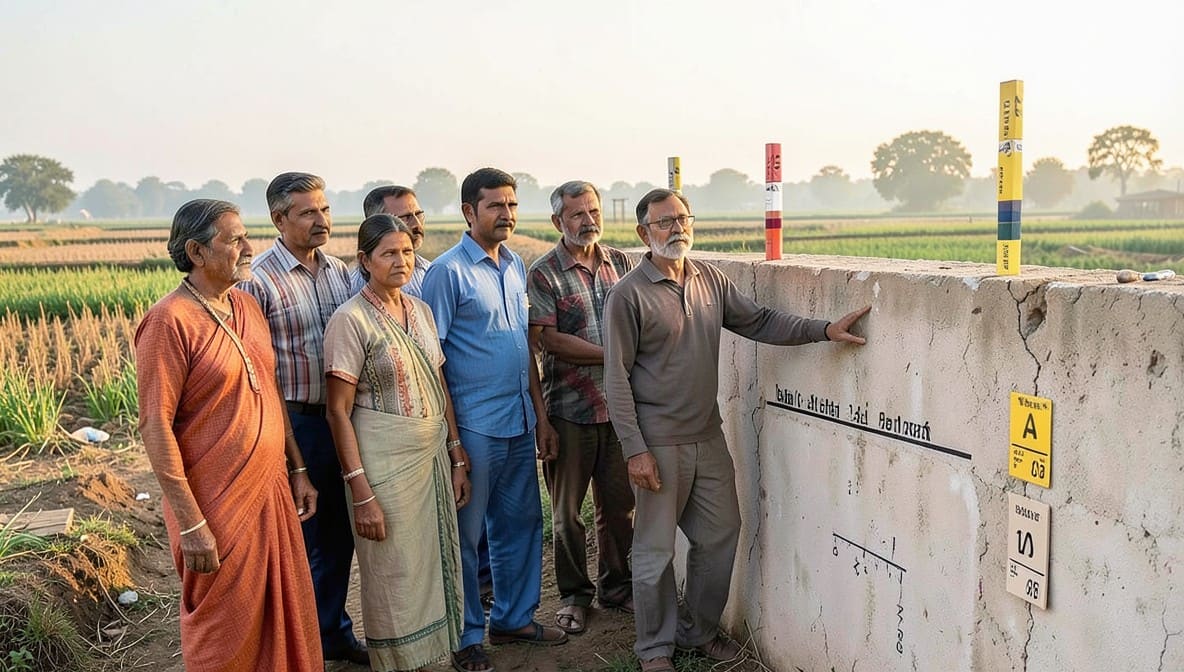
The applicant, Haresh Ramji Bhanushali, is apprehending arrest in Crime No. 329 of 2026 registered at Naigaon Police Station for offences under Sections 420, 465, 467, 468, 471 and 34 of the Indian Penal Code, 1860. The allegations stem from the acquisition of land for the Bullet Train project. The complainant alleges that the applicant falsely inserted the land survey number on a Gram Panchayat receipt to claim compensation for an entire building, despite only a portion of the structure being situated on land bearing Survey No. 165, which was allocated to him. The remainder of the building, according to the complainant, lies on Survey No. 164, which was not his share.
Key Facts
- The land acquisition was undertaken for the Mumbai-Ahmedabad Bullet Train project
- The applicant was allotted land bearing Survey No. 165 as his share
- A portion of a building/office structure stood on Survey No. 164, which belonged to another party
- The applicant submitted a Gram Panchayat receipt showing Survey No. 165 as the location of the entire building to claim full compensation
- The complainant contends this constitutes forgery, as the building straddled two survey numbers
- The applicant claims the entire building was legally his share and the survey number was correctly recorded
- No forensic or documentary evidence has been presented to conclusively establish falsification at this stage
Procedural History
- Date of Alleged Incident: Prior to filing of FIR (exact date not specified in judgment)
- Date of FIR Registration: Crime No. 329 of 2026 registered at Naigaon Police Station (exact date not specified)
- Date of Bail Application: Anticipatory Bail Application No. 1405 of 2026 filed before Bombay High Court
- Date of Hearing: 30th June, 2026
- Date of Order: 30th June, 2026
- Next Listing Date: 21st July, 2026
The Parties' Positions
The applicant contends that the dispute is essentially civil in nature - a disagreement over land demarcation and entitlement to compensation - and that the criminal charges are being misused to exert pressure. He asserts that the survey number on the receipt accurately reflects his share and that no intentional forgery occurred.
The complainant, represented by intervenor counsel, alleges deliberate manipulation of official documents to secure undue financial benefit, constituting criminal forgery under the IPC.
Relief Sought
The applicant seeks anticipatory bail under Section 482 of the Bharatiya Nagarik Suraksha Sanhita, 2023, to prevent arrest in Crime No. 329 of 2026, pending investigation and adjudication of factual disputes.
The Legal Issue
The central question was whether the mere allegation of inserting a survey number on a Gram Panchayat receipt, in the context of a disputed land entitlement for compensation, constitutes a prima facie case of criminal forgery warranting pre-arrest detention under Section 482 of the BNSS.
Arguments Presented
For the Appellant/Petitioner
Learned Senior Counsel Ashok Mundargi argued that the dispute is fundamentally civil - concerning ownership and allocation of compensation - and that criminal prosecution is an abuse of process. He emphasized that the applicant has not fled, has no prior criminal record, and is willing to cooperate with the investigation. He cited Arnesh Kumar v. State of Bihar to underscore that arrest cannot be automatic in non-heinous offences and that investigation must precede detention. He further contended that the allegations, even if true, do not establish dishonest intent at the time of submission.
For the Respondent/State
The Additional Public Prosecutor contended that the insertion of a false survey number on an official receipt to claim compensation constitutes a clear case of forgery under Sections 467 and 468 IPC, which are non-bailable. He argued that the act of altering official documents to secure financial gain is inherently criminal and that the applicant’s conduct undermines public trust in land records.
The Court's Analysis
The Court examined the nature of the allegations and found that the core issue is not the falsification of documents per se, but the disputed ownership of the land on which the building stood. The Court noted that the applicant’s share included Survey No. 165, and the compensation was claimed against that survey number - not Survey No. 164. The Court observed that the complainant’s version, while plausible, remains uncorroborated by documentary or survey evidence at this stage.
"Although attention is invited to the Gram Panchayat receipts, in any case, these allegations are part of investigation and, at this stage, no conclusion can be drawn about the forgery committed by the applicant for the purpose of seeking compensation."
The Court further held that the dispute is better resolved through investigation and production of land records, survey maps, and ownership documents, rather than immediate arrest. It emphasized that personal liberty must be protected unless there is a clear, established case of criminal intent. The Court distinguished this from cases of deliberate fabrication of documents to claim property not belonging to the accused, noting the absence of evidence showing the applicant had no claim whatsoever to the structure.
The Court also noted that the applicant is not a flight risk and has offered to cooperate fully with the investigation. The Court rejected the notion that the mere existence of a non-bailable offence automatically negates the possibility of anticipatory bail.
The Verdict
The applicant succeeded. The Court granted anticipatory bail subject to the following conditions: (1) If arrested, the applicant shall be released on a personal bond of Rs. 50,000 with a solvent surety of like amount; (2) The applicant must report to Naigaon Police Station every Monday and Friday between 10.00 a.m. and 5.00 p.m., and on any other day summoned by the Investigating Officer; (3) The applicant shall not tamper with evidence or influence witnesses; (4) The applicant shall produce all relevant documents before the Investigating Officer upon demand without delay. The State is permitted to file an affidavit-in-reply by the next hearing on 21st July, 2026.
What This Means For Similar Cases
Disputes Over Entitlement Do Not Automatically Equal Forgery
- Practitioners must distinguish between civil disputes over property rights and criminal forgery - mere misstatement of survey numbers in compensation claims does not, by itself, establish criminal intent
- Where ownership is contested, courts must examine whether the accused had any legitimate claim to the property before treating document alteration as criminal
- The burden remains on the prosecution to demonstrate dishonest intent at the time of submission, not merely to prove a discrepancy
Anticipatory Bail Is Available Even in Non-Bailable Offences
- Courts must apply the triple test from Arnesh Kumar v. State of Bihar: gravity of offence, likelihood of flight, and possibility of tampering
- Non-bailable offences under IPC do not preclude anticipatory bail if the facts do not justify immediate arrest
- Cooperation with investigation and willingness to produce documents are strong indicators for granting bail
Documentary Evidence Must Be Verified Before Arrest
- In land compensation cases, survey records, revenue records, and ownership documents must be examined before initiating criminal proceedings
- Arrest should not be the first step - investigation and document verification must precede it
- Courts should encourage submission of evidence by both parties before deciding on arrest