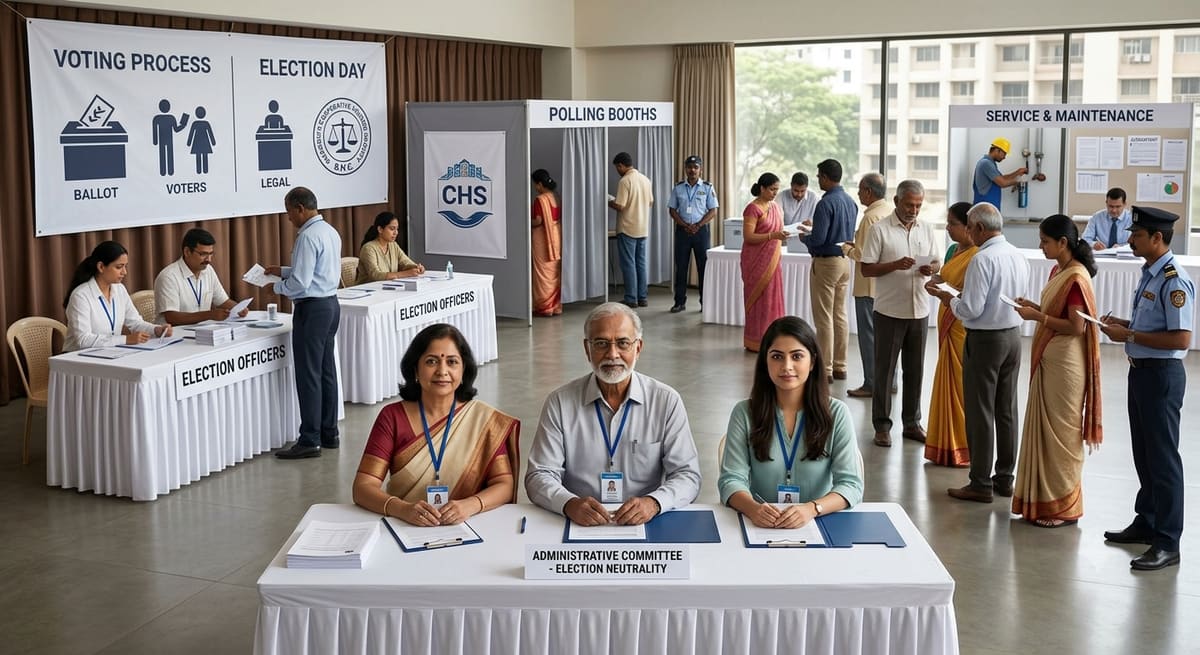
The Bombay High Court has clarified that the mere pendency of an election petition under the Maharashtra Co-operative Societies Act does not invalidate or suspend the authority of a newly elected managing committee. This ruling reinforces the principle that electoral outcomes must be respected until formally set aside by a competent court, ensuring continuity in co-operative governance.
Background & Facts
The Dispute
The petitioner, Avant Heritage II Co-operative Housing Society Ltd., challenged a communication dated 30 March 2026 issued by the Assistant Registrar, Co-operative Societies (Eastern and Western Suburbs), Slum Rehabilitation Authority, Mumbai. The communication directed that, pending the disposal of Election Petition No. 39 of 2026, the tenure of the previous provisional Managing Committee would continue, effectively barring the newly elected committee from assuming office.
Key Facts
- The Managing Committee elections for the petitioner society were conducted on 08.02.2026.
- Following the election, the newly elected members held internal elections for office bearers on 18.02.2026.
- On 25.02.2026, Election Petition No. 39 of 2026 was filed before the Co-operative Court under Section 91(1) of the Maharashtra Co-operative Societies Act, 1960, challenging the validity of the election results.
- The Assistant Registrar, relying on the pendency of the election petition, issued the impugned communication on 30.03.2026, directing the continuation of the previous provisional committee.
- The petitioner contended that the elected committee had been lawfully constituted and was entitled to function immediately.
Procedural History
- 08.02.2026: Managing Committee elections held.
- 18.02.2026: Office bearer elections conducted by the newly elected committee.
- 25.02.2026: Election Petition No. 39 of 2026 filed before the Co-operative Court.
- 30.03.2026: Assistant Registrar issued communication directing continuation of provisional committee.
- 12.04.2026: Writ Petition No. 4227 of 2026 filed before the Bombay High Court.
- 01.07.2026: Hearing concluded and judgment delivered.
Relief Sought
The petitioner sought quashing of the communication dated 30.03.2026 and a direction to recognize and allow the newly elected Managing Committee to function without hindrance.
The Legal Issue
The central question was whether the mere pendency of an election petition under Section 91(1) of the Maharashtra Co-operative Societies Act, 1960 automatically suspends the authority of a newly elected managing committee and necessitates the continuation of the previous provisional committee.
Arguments Presented
For the Petitioner
The petitioner argued that the election was conducted in accordance with the society’s bye-laws and the provisions of the Act. The filing of an election petition is a challenge to the validity of the result, not an automatic stay. The court must issue a specific stay order to suspend the elected committee’s functioning. Reliance was placed on the principle that elections are the democratic foundation of co-operative societies and their outcomes must be respected until overturned by due process.
For the Respondent
The Respondent-SRA and the State contended that the pendency of an election petition creates legal uncertainty and that allowing the elected committee to function could lead to irreparable harm if the petition succeeds. They argued that continuity of governance required the provisional committee to remain in place until the court finally adjudicates the election dispute.
The Court's Analysis
The Court examined the statutory framework under Section 91(1) of the Maharashtra Co-operative Societies Act, 1960, which permits challenges to elections but does not prescribe automatic suspension of the elected body. The Court observed that no provision in the Act or the rules framed thereunder empowers the Registrar to suspend an elected committee merely because an election petition is pending.
"Mere filing or pendency of election petition cannot amount to automatic suspension of result of the election."
The Court emphasized that the elected committee, having been chosen by the members through a lawful process, is vested with authority from the date of declaration of results. The burden to seek an interim stay lies with the petitioner in the election dispute, not with the Registrar to suspend the outcome ex parte. The Registrar’s action in continuing the provisional committee was found to be an unauthorized assumption of judicial power.
The Court further noted that allowing provisional committees to remain in office indefinitely during litigation undermines democratic accountability and creates administrative paralysis. The proper course is for the Co-operative Court to decide the petition on merits and, if necessary, grant an interim stay through a reasoned order.
The Verdict
The writ petition was allowed. The communication dated 30 March 2026 was set aside. The newly elected Managing Committee of Avant Heritage II Co-operative Housing Society Ltd. is directed to assume office immediately. There shall be no order as to costs.
What This Means For Similar Cases
Election Outcomes Are Provisionally Valid Until Stayed
- Practitioners must now argue that the mere filing of an election petition does not nullify the elected committee’s authority.
- Co-operative societies may proceed with meetings, financial decisions, and maintenance activities under the elected committee without awaiting court verdicts.
- Any stay on functioning must be sought and granted by the Co-operative Court under Section 91(1), not by the Registrar.
Registrar Cannot Act as De Facto Adjudicator
- The Assistant Registrar’s role is administrative, not judicial. Issuing orders that suspend elected bodies exceeds statutory authority.
- All co-operative societies must be informed that Registrar directives suspending elected committees without a court stay are legally invalid.
- Future election disputes must be confined to the Co-operative Court, with interim relief sought through proper application.
Continuity Requires Legal Authority, Not Administrative Convenience
- The principle of democratic legitimacy overrides administrative expediency.
- Societies should document the date of election results and the assumption of office by the new committee to preempt future challenges.
- Legal notices to third parties (e.g., contractors, banks) should reference the elected committee’s valid tenure from the date of declaration, not the date of court clearance.