Topic

property rights

Property rights in Indian law protect ownership, possession, and use of land and assets under Article 300A and other statutes, requiring due process before state or private interference.

141 articlesLatest 2 weeks ago
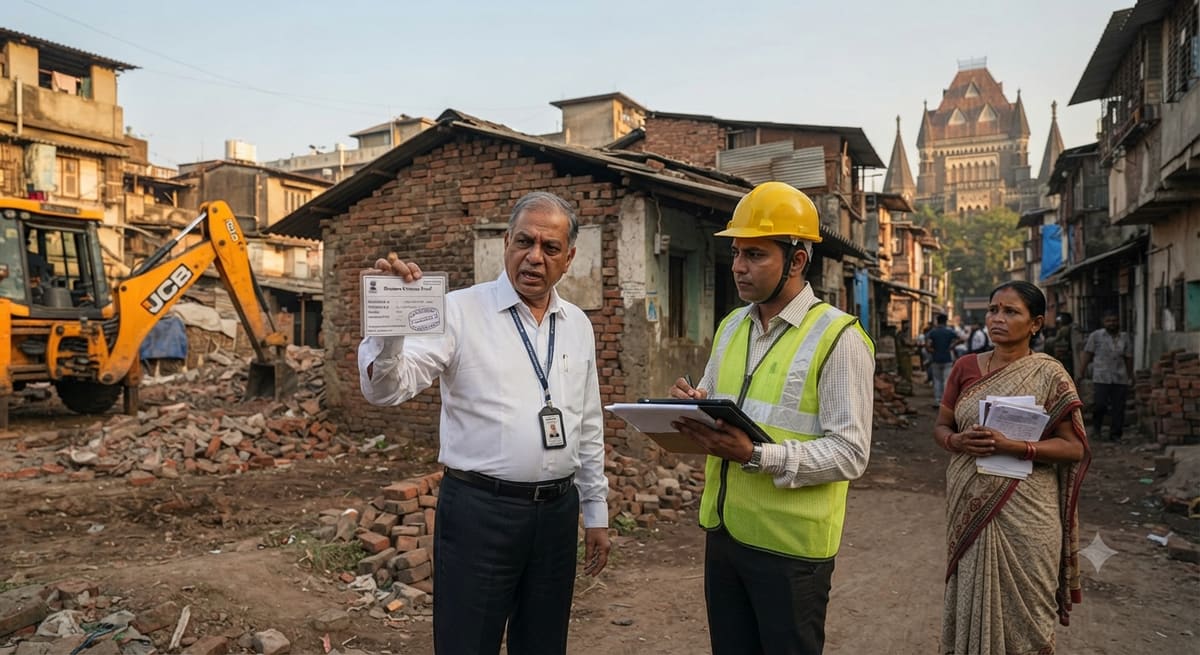
Section 32 Maharashtra Slum Areas Act | Prima Facie Proof of Structure Existence Triggers Mandatory Inspection Before Demolition : Bombay HC
Case Law Analysis
|Bombay High Court

Section 32 Maharashtra Slum Areas Act | Prima Facie Proof of Structure Existence Triggers Mandatory Inspection Before Demolition : Bombay HC

Bombay High Court rules that mere prima facie evidence of a slum structure's existence under the Maharashtra Slum Areas Act mandates a fresh inspection before any demolition notice can be upheld. The judgment reinforces procedural safeguards for slum dwellers, requiring authorities to verify structural details on-site before taking coercive action.

Section 65-B Evidence Act | Hyper-Technical Rejection of Digital Evidence Overturned in Property Demolition Case : Bombay HC
Case Law Analysis
|Bombay High Court

Section 65-B Evidence Act | Hyper-Technical Rejection of Digital Evidence Overturned in Property Demolition Case : Bombay HC

Bombay High Court rules that substantive justice prevails over procedural technicalities, admitting photographic and digital evidence under Section 65-B of the Evidence Act despite minor procedural lapses. The judgment reinforces that trial courts must avoid hyper-technical approaches that undermine the merits of a case, particularly in property disputes involving demolition.

Section 17 SARFAESI Act | DRT Must Decide Stay Application Before E-Auction to Uphold Natural Justice : Andhra Pradesh HC
Case Law Analysis
|Andhra Pradesh High Court

Section 17 SARFAESI Act | DRT Must Decide Stay Application Before E-Auction to Uphold Natural Justice : Andhra Pradesh HC

Andhra Pradesh High Court rules that Debt Recovery Tribunals must adjudicate stay applications under Section 17 of the SARFAESI Act before proceeding with e-auctions of mortgaged properties. The judgment reinforces that coercive measures without prior adjudication violate principles of natural justice and property rights under Article 300-A.

Seized Property | Owner Entitled to Interim Custody After Investigation Concludes, Subject to Conditions : Kerala HC
Case Law Analysis
|Kerala High Court

Seized Property | Owner Entitled to Interim Custody After Investigation Concludes, Subject to Conditions : Kerala HC

The Kerala High Court has ruled that once a criminal investigation is complete, the owner of a seized vehicle is entitled to interim custody, provided they furnish a bond and agree to restrictions on inter-state movement. This clarifies that prolonged retention of property without trial violates property rights under Article 300A and sets a precedent for timely return of assets in pending cases.

Section 24(2) Right to Fair Compensation Act | Land Acquisition Notifications Published Post-01.01.2014 Void : Allahabad HC
Case Law Analysis
|Allahabad High Court

Section 24(2) Right to Fair Compensation Act | Land Acquisition Notifications Published Post-01.01.2014 Void : Allahabad HC

Allahabad High Court rules that land acquisition proceedings under the repealed Land Acquisition Act, 1894 are invalid if Section 4 notifications were published after 01.01.2014, regardless of the notification date. The court directed recalculation of compensation under the Right to Fair Compensation Act, 2013, reinforcing the publication date as the decisive factor for initiation of proceedings.

MOFA Section 14 | Competent Authority Must Grant Deemed Conveyance Despite Title Disputes or Overbroad Claims : Bombay HC
Case Law Analysis
|Bombay High Court

MOFA Section 14 | Competent Authority Must Grant Deemed Conveyance Despite Title Disputes or Overbroad Claims : Bombay HC

The Bombay High Court has ruled that under MOFA Section 14, the Competent Authority has a statutory duty to grant deemed conveyance to housing societies regardless of pending title disputes or exaggerated land claims by developers. This clarifies that procedural objections to title ownership cannot override the legislature’s intent to protect flat purchasers’ rights, reinforcing legal certainty for co-operative societies nationwide.

Form-8 Mutation Notices Under Andhra Pradesh Rights in Land Act Must Be Followed by Speaking Orders: AP HC Reinforces Natural Justice | Revenue Mutations Require Post-Objection Adjudication
Case Law Analysis
|Andhra Pradesh High Court

Form-8 Mutation Notices Under Andhra Pradesh Rights in Land Act Must Be Followed by Speaking Orders: AP HC Reinforces Natural Justice | Revenue Mutations Require Post-Objection Adjudication

The Andhra Pradesh High Court ruled that Form-8 mutation notices under the Andhra Pradesh Rights in Land Act are not final orders. Authorities must pass reasoned speaking orders after hearing objections, ensuring compliance with natural justice principles. This judgment mandates procedural fairness in revenue mutations, impacting landowners and revenue authorities across the state.

Article 300A | Excess Land Taken Without Compensation Must Be Paid: Bombay HC
Case Law Analysis
|Bombay High Court

Article 300A | Excess Land Taken Without Compensation Must Be Paid: Bombay HC

The Bombay High Court has ruled that taking possession of land beyond the area specified in the acquisition award violates Article 300A of the Constitution, entitling landowners to a supplementary compensation award. This sets a binding precedent for all government projects in Maharashtra, requiring strict adherence to awarded land boundaries and immediate redress for unauthorized takings.

Due Process Mandated for Municipal Demolitions | Notice, Hearing & Reasoned Order Required Under Municipal Corporation Act : MP HC
Case Law Analysis
|Madhya Pradesh High Court

Due Process Mandated for Municipal Demolitions | Notice, Hearing & Reasoned Order Required Under Municipal Corporation Act : MP HC

The Madhya Pradesh High Court has ruled that no demolition of property by a municipal corporation can proceed without issuing a statutory notice, providing a meaningful hearing, and passing a reasoned order. This reinforces the constitutional guarantee of procedural fairness under Article 21 and binds all municipal authorities to comply with the Municipal Corporation Act before depriving citizens of property.

Article 14, 21 & 300-A | Municipal Survey Without Title Document Verification Violates Property Rights : Andhra Pradesh HC
Case Law Analysis
|Andhra Pradesh High Court

Article 14, 21 & 300-A | Municipal Survey Without Title Document Verification Violates Property Rights : Andhra Pradesh HC

Andhra Pradesh High Court rules that municipal authorities must conduct surveys based on title documents before initiating public works on private land. The judgment mandates due process under Articles 14, 21, and 300-A, ensuring property owners are protected from arbitrary encroachment without statutory acquisition or notice.

Article 226 & Writ of Mandamus | State Barred from Encroaching on TUDA-Approved Layout Without Due Process : AP HC
Case Law Analysis
|Andhra Pradesh High Court

Article 226 & Writ of Mandamus | State Barred from Encroaching on TUDA-Approved Layout Without Due Process : AP HC

Andhra Pradesh High Court restrains state authorities from forcibly taking over a developer’s TUDA-approved residential layout for public project construction without prior notice or hearing. The ruling reinforces that layout approvals under planning laws create enforceable rights, and any encroachment must comply with principles of natural justice and Article 21.

Agreement to Sell Does Not Confer Standing in Partition Suit | Decree for Specific Performance Required Before Impleadment: Karnataka HC (Dharwad)
Case Law Analysis
|Karnataka High Court

Agreement to Sell Does Not Confer Standing in Partition Suit | Decree for Specific Performance Required Before Impleadment: Karnataka HC (Dharwad)

The Karnataka High Court holds that a buyer under an agreement to sell cannot implead as a party in a partition suit involving the vendor’s property unless they first obtain a decree for specific performance. This clarifies that equitable rights under contract are not sufficient to intervene in ownership disputes - only a judicially enforced title grants standing, protecting co-owners from speculative claims.

U.P. Revenue Code Section 30 | Status Quo Mandated & 3-Month Deadline Imposed for Unregistered Property Disputes: Allahabad HC
Case Law Analysis
|Allahabad High Court

U.P. Revenue Code Section 30 | Status Quo Mandated & 3-Month Deadline Imposed for Unregistered Property Disputes: Allahabad HC

The Allahabad High Court has ordered that pending revenue disputes under Section 30 of the U.P. Revenue Code, even if unregistered for over a year, must be decided within three months and that parties must maintain status quo on the disputed property. This prevents unauthorized alienation and protects claimants from procedural neglect by revenue authorities, reinforcing judicial oversight in land rights cases.