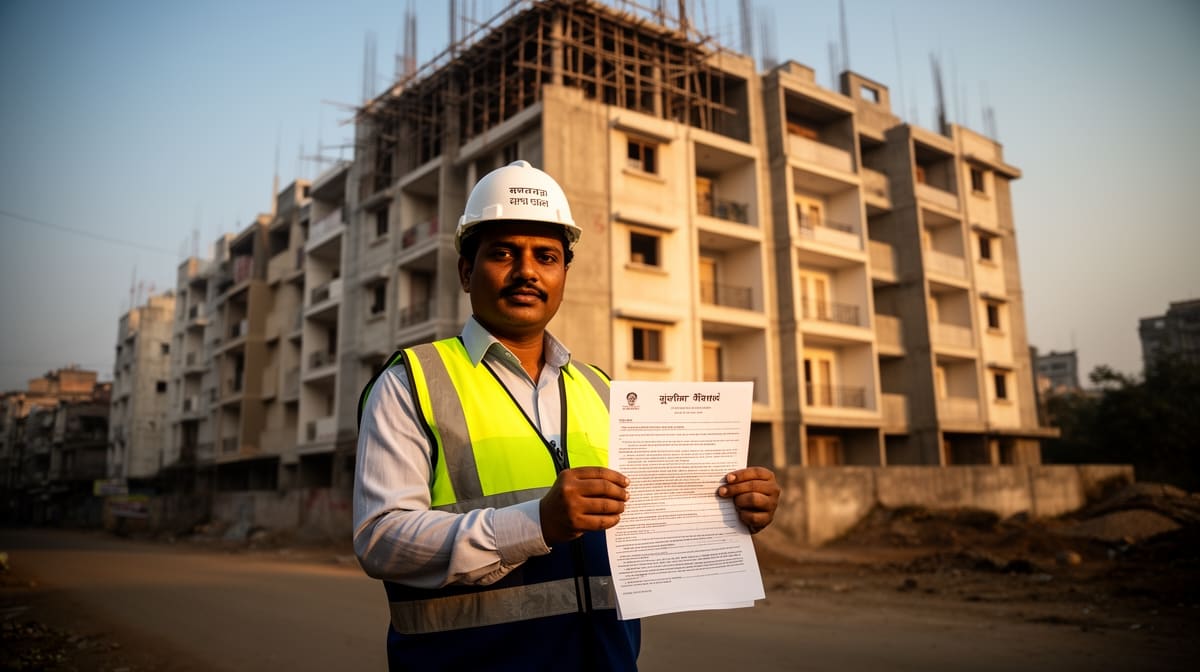
The Madhya Pradesh High Court has reaffirmed that no municipal authority may proceed with the demolition of a property without strictly adhering to the principles of natural justice. This ruling underscores the non-negotiable requirement of notice, hearing, and reasoned decision-making even in cases involving alleged unauthorized construction.
Background & Facts
The Dispute
The petitioner, Sudhir Holkar, owns a residential property located at 14/3 New Palasia, Block 613, Scheme No. 2C, Indore. He has been paying property tax regularly and holds a title certificate (Annexure P/1) as proof of ownership. The petitioner was informed orally by officials of the Indore Municipal Corporation that his property would be demolished. No written notice, show cause order, or opportunity for hearing was provided prior to this threat.
Key Facts
- The petitioner is the lawful owner of the residential property, evidenced by title certificate (Annexure P/1)
- Property tax payments have been made regularly without default
- No formal notice under the Municipal Corporation Act was issued to the petitioner
- The threat of demolition was communicated orally, without any documented proceedings
- The petitioner has not been given any opportunity to present his case or submit documents
Procedural History
- 25 June 2026: Writ Petition No. 23514 of 2026 filed before the High Court of Madhya Pradesh, Indore
- 25 June 2026: Hearing conducted before Justice Deepak Khot
- 25 June 2026: Order passed disposing of the petition with directions
The Parties' Positions
For the Petitioner: Learned counsel Sumeet Samvatsar and Kaustubh Fadnis submitted that the threat of demolition without notice violates fundamental rights under Article 21 of the Constitution and the principles laid down by the Supreme Court in In Re: Directions in the matter of demolition of structures. They emphasized that the petitioner holds valid title and has complied with all statutory obligations.
For the Respondent: Advocate Rishi Tiwari appeared on advance notice and conceded that any action against the petitioner’s property would be taken strictly in accordance with law, including issuance of a show cause notice and opportunity of hearing.
Relief Sought
The petitioner sought:
- Quashing of the proposed demolition action
- Direction to the Municipal Corporation not to proceed without due process
- Any other relief deemed appropriate by the Court
The Legal Issue
The central question was whether a municipal corporation may initiate demolition of a property without issuing a statutory notice, affording a hearing, or recording a reasoned order, even where the owner holds title and pays taxes regularly.
Arguments Presented
For the Petitioner
The petitioner’s counsel relied on the Supreme Court’s observations in In Re: Directions in the matter of demolition of structures, particularly paragraphs 90 and 91, which mandate that no structure shall be demolished without prior notice, opportunity of hearing, and a speaking order. They argued that oral threats violate Article 14 and Article 21, and that possession coupled with title and tax compliance creates a legitimate expectation of procedural fairness.
For the Respondent
The respondent’s counsel did not contest the legal principles but affirmed that any action would be taken only after following due process. This concession aligned with the petitioner’s诉求 and facilitated a swift judicial response.
The Court's Analysis
The Court examined the absence of any procedural compliance by the Municipal Corporation. It noted that the petitioner’s ownership was not disputed, tax payments were regular, and no statutory notice had been issued. The Court emphasized that the right to property, though no longer a fundamental right, remains a constitutional right under Article 300A, and cannot be extinguished without due process.
"The principle of audi alteram partem is not a mere formality but a substantive guarantee against arbitrary state action. Even in matters of urban planning, the state must act fairly and transparently."
The Court rejected the notion that oral communication can substitute for legal notice. It held that the Supreme Court’s directives in the demolition case are binding and apply to all municipal authorities. The absence of a show cause notice, hearing, or reasoned order renders any proposed demolition legally unsustainable.
The Verdict
The petition was disposed of with directions. The Indore Municipal Corporation is prohibited from proceeding with any demolition of the petitioner’s property unless it first issues a show cause notice, provides a reasonable opportunity of hearing, and passes a reasoned, speaking order. The Court directed compliance with these procedural safeguards before any action is taken.
What This Means For Similar Cases
Due Process Is Non-Negotiable in Demolition Cases
- Practitioners must insist on notice and hearing in all municipal demolition proceedings, regardless of the nature of the alleged violation
- Oral threats or informal communications cannot substitute for statutory notice under the Municipal Corporation Act
- Title documents and tax payment receipts are strong evidence of legitimate possession and must be considered before any action
Municipal Authorities Cannot Act on Assumptions
- The burden lies on the authority to prove illegality, not on the owner to prove legality
- Absence of a building permit does not automatically justify demolition without procedural compliance
- Courts will intervene where authorities bypass statutory procedures, even if the underlying structure may be in violation
Precedent Reinforces Constitutional Safeguards
- The ruling reinforces In Re: Directions in the matter of demolition of structures as binding precedent for all state agencies
- Article 300A protections apply even when property rights are not constitutionally fundamental
- Reasoned orders are mandatory - generic or boilerplate orders will be struck down