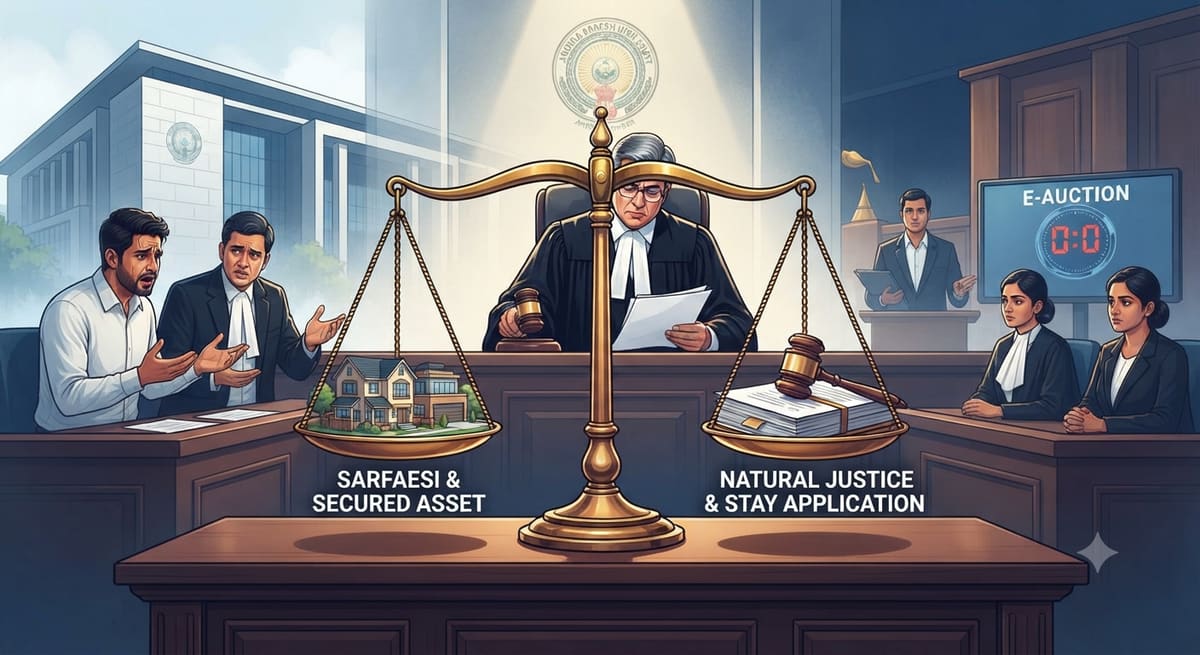
The Andhra Pradesh High Court has intervened in a critical matter under the Securitisation and Reconstruction of Financial Assets and Enforcement of Security Interest Act, 2002 (SARFAESI Act), directing the Debt Recovery Tribunal (DRT) to dispose of a stay application within two weeks. The Court stayed the e-auction of the petitioner’s property, scheduled for 07.07.2026, until the DRT decides the application. This judgment underscores the importance of procedural fairness and timely adjudication in recovery proceedings.
Background & Facts
The Dispute
The petitioner, Ravi Murali Mohan, availed two loans amounting to Rs. 6.50 crores and Rs. 10.20 crores from Indian Overseas Bank for his enterprise, Sai Kaarthik City Center. These loans were secured by mortgaging a property measuring 4,961 sq. yards situated in Sy.No.152/1, Chilakaluripeta, Andhra Pradesh. Following default, the bank initiated recovery proceedings under the SARFAESI Act, 2002.
Key Facts
02.08.2025: The bank issued a demand notice for Rs. 15,11,96,596 (principal and interest)
The petitioner submitted a representation requesting a moratorium/holiday period due to law and order issues affecting business operations
05.11.2025: The bank issued a symbolic possession notice under Rule 8(1) of the Security Interest (Enforcement) Rules, 2002
07.02.2026: The bank issued a public notice for e-auction of the mortgaged property
13.03.2026: The petitioner filed W.P.No. 7271 of 2026 challenging the e-auction notice, which was dismissed as infructuous due to lack of bidders
27.06.2026: The petitioner filed an application under Section 17 of the SARFAESI Act before the Debt Recovery Tribunal (DRT), Visakhapatnam in S.A.No. 189 of 2026
15.06.2026: The bank issued a fresh e-auction notice proposing to sell the property on 07.07.2026
27.06.2026: The petitioner filed I.A.No. 2881 of 2026 (stay application) in S.A.No. 189 of 2026, which remained pending
Procedural History
13.03.2026: W.P.No. 7271 of 2026 dismissed as infructuous
27.06.2026: Application under Section 17 SARFAESI Act filed before DRT (S.A.No. 189 of 2026)
27.06.2026: Stay application (I.A.No. 2881 of 2026) filed in S.A.No. 189 of 2026
15.06.2026: E-auction notice issued for 07.07.2026
03.07.2026: Present writ petition (W.P.No. 17963 of 2026) filed under Article 226 seeking mandamus
Relief Sought
The petitioner sought:
A writ of mandamus declaring the DRT’s inaction on the stay application as illegal, arbitrary, and violative of natural justice
Stay of the e-auction notice dated 15.06.2026 until disposal of I.A.No. 2881 of 2026
Directions to the DRT to dispose of the stay application in accordance with law
The Legal Issue
The primary question before the Court was whether the Debt Recovery Tribunal could proceed with the e-auction of the petitioner’s property without first deciding the stay application filed under Section 17 of the SARFAESI Act, thereby violating principles of natural justice and Article 300-A of the Constitution of India.
Arguments Presented
For the Petitioner
The DRT’s failure to decide the stay application before proceeding with the e-auction was arbitrary and violative of natural justice
The e-auction notice dated 15.06.2026 was issued while I.A.No. 2881 of 2026 was pending, prejudicing the petitioner’s rights
The petitioner’s representation for moratorium was disregarded without valid reasons
Reliance was placed on Article 300-A (right to property) and principles of fair hearing
For the Respondents
(No arguments were recorded in the judgment, as notice to respondents was dispensed with.)
The Court's Analysis
The Court observed that:
"It is an undisputed fact that the S.A.No. 189 of 2026 is pending before the Debts Recovery Tribunal, Visakhapatnam and the respondent-Bank issued e-auction notice, dated 15.06.2026 and the petitioner filed stay application under Section 17 of the Act in S.A.No.189 of 2026 on 27.06.2026 and it is pending."
The Court emphasized that procedural fairness must be upheld in recovery proceedings. While the SARFAESI Act empowers banks to enforce security interests, the DRT’s role as an adjudicatory body cannot be bypassed. The Court noted that the stay application was pending and that proceeding with the e-auction without its disposal would prejudice the petitioner’s rights.
The Court relied on the principle that no party should be condemned unheard, especially in matters involving deprivation of property. The judgment underscored that Article 300-A (right to property) and natural justice require that adjudicatory bodies must decide stay applications before proceeding with coercive measures like e-auctions.
The Verdict
The Court disposed of the writ petition with the following directions:
The Debt Recovery Tribunal, Visakhapatnam (Respondent No. 2) is directed to consider and dispose of the stay application (I.A.No. 2881 of 2026) in S.A.No. 189 of 2026 within two weeks from the date of receipt of the order
The e-auction notice dated 15.06.2026 shall remain in abeyance until disposal of the stay application
No order as to costs
What This Means For Similar Cases
DRT Must Adjudicate Stay Applications Before Coercive Action
Practitioners must ensure that stay applications under Section 17 of the SARFAESI Act are decided before banks proceed with e-auctions or possession notices
Failure to do so may render recovery proceedings arbitrary and violative of natural justice, inviting writ remedies under Article 226
Natural Justice Prevails Over Expediency
The judgment reinforces that expeditious recovery under SARFAESI Act cannot override procedural fairness
Article 300-A (right to property) mandates that adjudicatory bodies must provide a fair hearing before depriving a party of their assets
Banks and financial institutions must ensure compliance with due process even in recovery proceedings
Strategic Filing of Stay Applications
Borrowers facing e-auction notices should immediately file stay applications under Section 17 to halt coercive measures
Writ petitions under Article 226 remain a viable remedy where DRTs delay adjudication of stay applications
Interim relief (like stay of e-auction) can be sought from High Courts pending disposal of Section 17 applications