Topic

Employees Compensation Act

The Employees' Compensation Act, 1923, governs monetary relief to workers or their dependents for injuries or death arising out of employment in India, regardless of employer fault.

17 articlesLatest August 2026
Employer-Liability Policy Excludes Interest - Insurer Not Liable for Compensation Interest | Employees' Compensation Act, 1923 : Gujarat HC
Case Law Analysis
|Gujarat High Court

Employer-Liability Policy Excludes Interest - Insurer Not Liable for Compensation Interest | Employees' Compensation Act, 1923 : Gujarat HC

Gujarat High Court ruled that an insurer cannot be compelled to pay interest on workmen's compensation when the employer-liability policy expressly excludes such liability. The decision overturns the Labour Court's interest award, reinforcing the primacy of policy terms. Employers and insurers must review policy wording to avoid unexpected interest obligations.


Actual Wages Apply Post-2009 Amendment | Employees Compensation Act : Bombay HC (Aurangabad)
Case Law Analysis
|Bombay High Court

Actual Wages Apply Post-2009 Amendment | Employees Compensation Act : Bombay HC (Aurangabad)

Bombay HC rejects review plea challenging compensation calculation under the Employees Compensation Act, 1923, affirming that actual wages must be considered post-2009 amendment despite a government notification imposing a cap. The ruling clarifies that the 2009 amendment removed the deeming cap on monthly wages, extending compensation based on actual earnings.

Employee's Compensation Act Section 3 | Insurer Not Liable for Interest Only If Proving Employer's Non-Compliance : Kerala HC
|Kerala High Court

Employee's Compensation Act Section 3 | Insurer Not Liable for Interest Only If Proving Employer's Non-Compliance : Kerala HC

The Kerala High Court ruled that insurers seeking to avoid interest liability under the Employee's Compensation Act must affirmatively prove the employer failed to comply with statutory obligations; silence in the written statement or mere assertion is insufficient. This shifts the burden of proof squarely onto insurers, reinforcing accountability and protecting dependants' right to timely compensation.

Employees Compensation Act, 1923 | Personal Execution of Work Overrides Tender Arrangement to Establish Employer-Employee Relationship : Kerala HC
Case Law Analysis
|Kerala High Court

Employees Compensation Act, 1923 | Personal Execution of Work Overrides Tender Arrangement to Establish Employer-Employee Relationship : Kerala HC

The Kerala High Court ruled that even when work is awarded via public tender, an individual who personally performs the tasks - such as welding or construction - qualifies as an employee under the Employees Compensation Act, 1923. This clarifies that contractual form cannot override substantive control and hands-on involvement, extending protection to informal workers often excluded by employers through sham contractor arrangements.

Employees' Compensation Act | Insurer Liable for Cleaner/Driver Death Despite Lack of Formal Contract if Premium Paid : Delhi HC
Case Law Analysis
|Delhi High Court

Employees' Compensation Act | Insurer Liable for Cleaner/Driver Death Despite Lack of Formal Contract if Premium Paid : Delhi HC

Delhi High Court rules that an insurer remains liable under the Employees' Compensation Act if an additional premium was paid for cleaner/driver coverage, even without a formal employment contract. The court held that the employer’s admission of the deceased’s role and premium payment triggered the insurer’s indemnity obligation, ensuring compensation for workplace fatalities.

Employees' Compensation Act | Cardiac Death Due to Work Stress During Long-Haul Driving Constitutes Accidental Death : MP HC
Case Law Analysis
|Madhya Pradesh High Court

Employees' Compensation Act | Cardiac Death Due to Work Stress During Long-Haul Driving Constitutes Accidental Death : MP HC

MP High Court rules that cardiac arrest triggered by employment-related stress and fatigue during long-distance driving qualifies as an 'accidental death' under the Employees' Compensation Act, 1923. The judgment reinforces that employers are liable for compensation where a causal nexus exists between work conditions and fatal health events, even in the absence of external injury.

Employees Compensation Act | Insurer’s Liability Survives Policy Violation If Death Occurs in Course of Employment : Allahabad HC
Case Law Analysis
|Allahabad High Court

Employees Compensation Act | Insurer’s Liability Survives Policy Violation If Death Occurs in Course of Employment : Allahabad HC

The Allahabad High Court has ruled that an insurer cannot escape liability under the Employees Compensation Act merely because the employer violated policy terms-so long as the worker’s death occurred during employment. The insurer retains a right to recover from the employer later, but the statutory duty to compensate dependents is absolute and non-negotiable, reinforcing the welfare-centric intent of the law.

Lok Adalat Award | Interest at 6% Mandatory on Delayed Payment Even for Bona Fide Delays : MP HC Jabalpur
Case Law Analysis
|Madhya Pradesh High Court

Lok Adalat Award | Interest at 6% Mandatory on Delayed Payment Even for Bona Fide Delays : MP HC Jabalpur

The Madhya Pradesh High Court has ruled that interest under a Lok Adalat settlement is enforceable regardless of whether the delay in payment is bona fide, rejecting the Commissioner’s attempt to excuse non-compliance due to bank account restraint. This sets a critical precedent for claimants: compromise awards are binding contracts, and delays-even those beyond the insurer’s immediate control-trigger automatic interest liability as stipulated in the award.

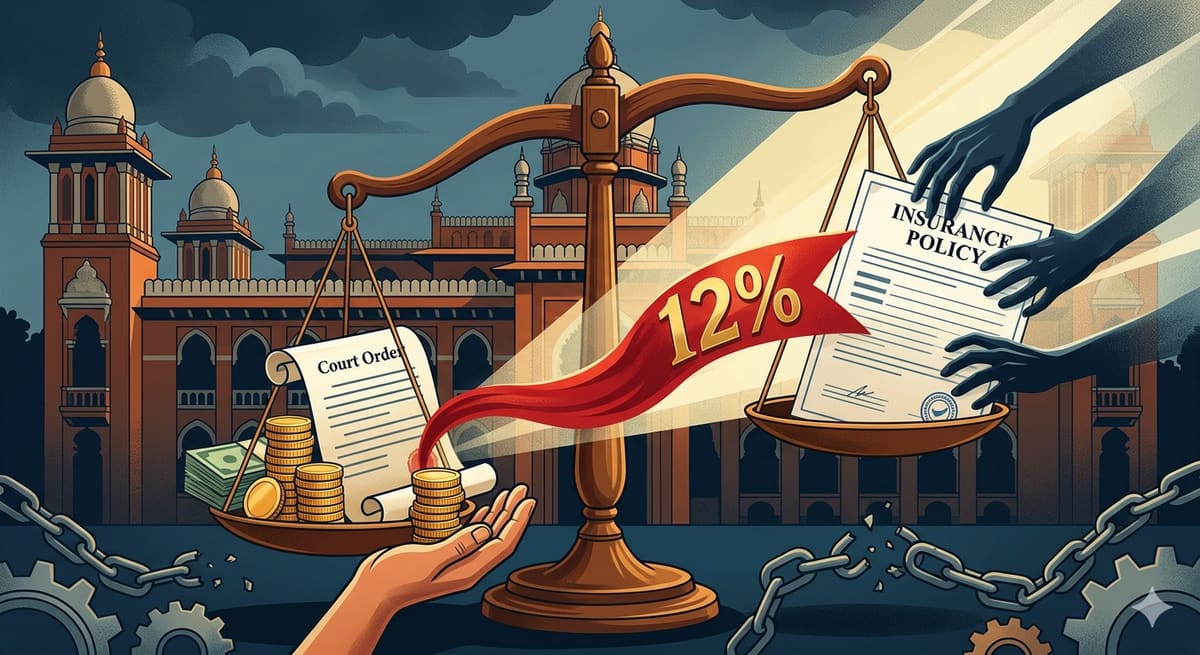
Employees' Compensation Act | Insurer Cannot Escape 12% Statutory Interest on Delayed Compensation Despite Policy Exclusion : Madras HC
Case Law Analysis
|Madras High Court

Employees' Compensation Act | Insurer Cannot Escape 12% Statutory Interest on Delayed Compensation Despite Policy Exclusion : Madras HC

Madras High Court rules that insurers under the Employees' Compensation Act, 1923, must pay 12% statutory interest on delayed compensation, even if the policy excludes it, provided the accident was reported on time. The ruling reinforces that statutory obligations override contractual exclusions, directly impacting insurers' liability in workmen compensation claims.

Strict Liability Under UHBVN 2019 Policy | Electrocution Compensation Mandated Irrespective of Fault : Punjab & Haryana HC
Case Law Analysis
|Punjab and Haryana High Court

Strict Liability Under UHBVN 2019 Policy | Electrocution Compensation Mandated Irrespective of Fault : Punjab & Haryana HC

The Punjab & Haryana High Court ruled that Uttar Haryana Bijli Vitran Nigam (UHBVN) is strictly liable for fatal electrocution accidents on its public network under its 2019 policy, mandating compensation under the Employees Compensation Act, 1923. The ruling underscores that electricity distribution is a hazardous activity, making UHBVN liable regardless of fault or the cause of the accident.

Employee's Compensation Act | Contractual Workers Entitled to Compensation if Employment Nexus Proven, Even Without Formal Appointment Docs: Bombay HC
Case Law Analysis
|Bombay High Court

Employee's Compensation Act | Contractual Workers Entitled to Compensation if Employment Nexus Proven, Even Without Formal Appointment Docs: Bombay HC

The Bombay High Court affirmed that contractual workers killed in work-related accidents are entitled to compensation under the Employee's Compensation Act, even in the absence of formal appointment letters or salary records, if the employment nexus is established through circumstantial evidence. This ruling expands employer liability and protects vulnerable informal workers by prioritizing factual employment over documentary formalities.

Employee's Compensation Act | Loss of Earning Capacity Must Account for Pre-existing and Accident-Induced Disabilities Combined : Delhi HC
Case Law Analysis
|Delhi High Court

Employee's Compensation Act | Loss of Earning Capacity Must Account for Pre-existing and Accident-Induced Disabilities Combined : Delhi HC

Delhi High Court rules that compensation under the Employee's Compensation Act must reflect the cumulative impact of pre-existing disabilities and accident-induced injuries on earning capacity. The court remanded the case for recalculation at 50% disability, directing immediate release of deposited amounts to the workman.

Employees' Compensation Act | Legal Heirs Can Continue Pending Claims Even If Not Statutory Dependents : Bombay HC
Case Law Analysis
|Bombay High Court

Employees' Compensation Act | Legal Heirs Can Continue Pending Claims Even If Not Statutory Dependents : Bombay HC

Bombay High Court rules that legal heirs of a deceased claimant under the Employees’ Compensation Act may pursue pending compensation claims, even if they are not statutory dependents. The judgment underscores the Act’s welfare objective, ensuring vested claims do not extinguish upon the claimant’s death, offering critical relief to families of deceased workers.