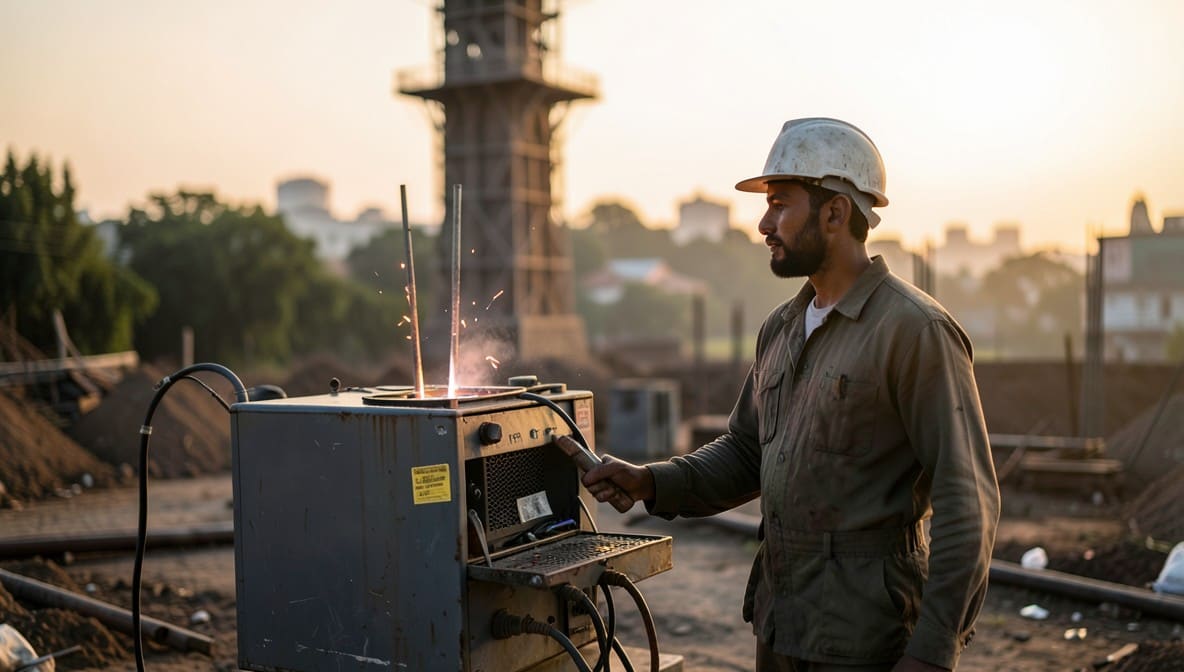
The Kerala High Court has clarified that a person who enters into a contract for work through a tender process but personally participates in its execution cannot be excluded from the definition of an employee under the Employees Compensation Act, 1923. This ruling reinforces the Act’s protective intent and rejects formalistic distinctions that undermine its humanitarian purpose.
Background & Facts
The Dispute
The dispute arose after Anilkumar C.V., aged 45, died on 16.07.2011 due to electrocution while welding an iron pipe on the roof of the office building of the Kannur District Police Co-operative Society Ltd. The respondents, his widow and two children, filed a claim for compensation before the Employees’ Compensation Commissioner, Kozhikode, alleging that Anilkumar was an employee of the appellant society at the time of the accident. They claimed Rs. 10,36,640 as compensation, based on his monthly wage of Rs. 12,000.
Key Facts
- Anilkumar submitted the lowest quotation in response to a public notice issued by the appellant society on 05.06.2011 for the construction of an iron roof sheeting.
- The work was awarded to him on 10.06.2011.
- On 16.07.2011, while welding a GI pipe near a high-tension electric line, he was electrocuted and died instantly.
- He was working alongside two other workers: Rajeesh and Shijil.
- An FIR (Ext.A1) was lodged on the same day by Rajeesh, stating that Anilkumar was actively engaged in welding and had picked up the pipe that came into contact with the live wire.
- After Anilkumar’s death, his widow, the first respondent, was permitted by the appellant to complete the remaining work and received the balance payment.
- The appellant society paid Rs. 50,000 from its common benefit fund as a humanitarian gesture but denied legal liability.
- The appellant claimed Anilkumar was an independent contractor who employed others and did not work personally.
Procedural History
- 16.07.2011: Death of Anilkumar C.V. due to electrocution during roofing work.
- 18.07.2011: FIR (Ext.A1) lodged at Nettur Police Station.
- 15.09.2013: Claim petition filed before the Employees’ Compensation Commissioner, Kozhikode (ECC No.137/2014).
- 28.02.2017: Commissioner held that Anilkumar was an employee, fixed monthly wage at Rs. 8,000, awarded compensation of Rs. 6,77,760, 12% interest from 16.07.2011, and Rs. 5,000 for funeral expenses.
- 28.03.2017: Appeal filed by the appellant society before the High Court (M.F.A.(ECC) No.95/2017).
- 29.05.2026: Final hearing concluded.
- 05.06.2026: Judgment delivered by the High Court.
Relief Sought
The appellant sought to set aside the Commissioner’s order dated 28.02.2017, arguing that no employer-employee relationship existed. The respondents sought confirmation of the compensation award, including interest and funeral expenses.
The Legal Issue
The central question was whether a person who submits a quotation and enters into a contract for work, but personally participates in its execution, can be considered an ‘employee’ under the Employees Compensation Act, 1923, despite the absence of a traditional employment contract.
Arguments Presented
For the Appellant
The appellant’s counsel argued that Anilkumar was an independent contractor because he submitted a quotation, was paid a lump sum, and employed other workers. She contended that the construction of a roof was not part of the society’s trade or business, and therefore Section 12 of the Act did not apply. She relied on Ext.B1 to show the tender process and asserted that the accident resulted from Anilkumar’s own negligence.
For the Respondent
The respondents’ counsel argued that the Employees Compensation Act is a beneficial statute requiring liberal interpretation. She emphasized that Anilkumar was personally engaged in welding, as confirmed by the FIR and the fact that his widow completed the work. She relied on Chief Post Master General, Tvm. v. Lekha to establish that maintenance of premises falls within the scope of ‘business’ under Section 12.
The Court's Analysis
The Court examined the nature of Anilkumar’s engagement and rejected the appellant’s contention that a tender process automatically converts a worker into an independent contractor. The Court emphasized that the decisive factor is whether the person agreed to work personally.
"Both the learned counsel have placed reliance on the case of Dharangadhra Chemical Works Ltd. v. State of Saurashtra... The broad distinction between a workman and independent contractor lies in this that while the former agrees himself to work the latter agrees to get other persons to work. Now a person who agrees himself to work and does so work and is, therefore, a workman does not cease to be such by reason merely of the fact that he gets other persons to work along with him and that those persons are controlled and paid by him."
The Court found that Ext.A1, the FIR, was a critical piece of evidence. It clearly stated that Anilkumar was actively welding alongside Rajeesh and Shijil, and that he was the one who picked up the pipe that caused the electrocution. This demonstrated direct, personal involvement in the work.
The Court further held that the maintenance of the society’s office building, including roofing repairs, falls squarely within the expression ‘business’ under Section 12 of the Act, as affirmed in Chief Post Master General v. Lekha. The Court rejected the narrow interpretation that only core commercial activities qualify as ‘trade or business’.
The Court concluded that adopting a pedantic approach to exclude persons who hire assistants would defeat the humanitarian purpose of the Act. The mere fact that Anilkumar employed others did not negate his status as an employee, provided he himself was actively engaged in the work.
The Verdict
The appeal was dismissed. The High Court upheld the order of the Employees’ Compensation Commissioner dated 28.02.2017. The respondents are entitled to compensation of Rs. 6,77,760, interest at 12% per annum from 16.07.2011 until realization, and Rs. 5,000 for funeral expenses. The judgment is final.
What This Means For Similar Cases
Personal Participation Overrides Contractual Form
- Practitioners must now focus on actual work participation, not contractual labels, when determining employee status under the Employees Compensation Act.
- A tender-based engagement does not automatically disqualify a worker from being an employee if they are physically involved in execution.
- FIRs, witness statements, and post-accident conduct (e.g., continuation of work by family) are critical evidence.
Maintenance Work Is Part of ‘Business’ Under Section 12
- Any activity essential to maintaining the premises where business is conducted qualifies as part of the ‘business’ under Section 12.
- Roofing, painting, plumbing, and electrical repairs to office buildings are now clearly covered.
- Employers cannot avoid liability by outsourcing routine maintenance to contractors who work on-site.
Burden of Proof Shifts to Employers
- Employers must now prove that a worker was not personally involved in the task, not merely that a contract existed.
- The absence of a payroll or appointment letter is not decisive; actual work performance is paramount.
- Commissioners must conduct a fact-specific inquiry into the nature of engagement, not rely on surface-level documentation.