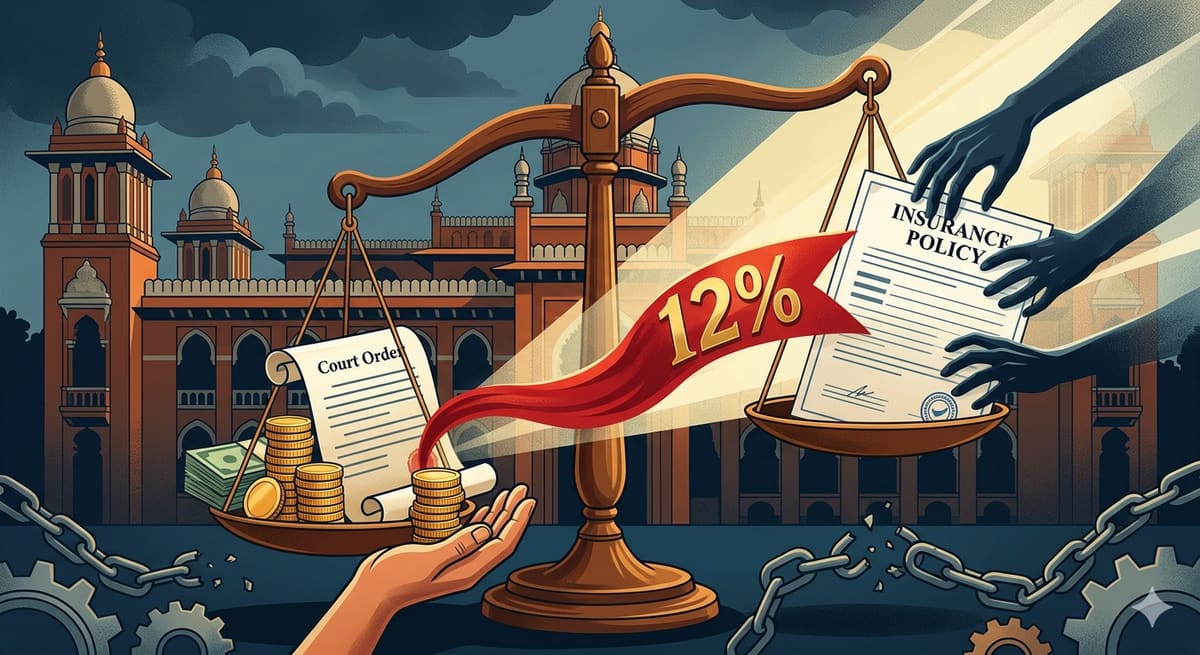
The Kerala High Court has clarified that insurers under the Employee's Compensation Act, 1923 cannot automatically exclude liability for interest on compensation merely by invoking policy exclusions. The judgment establishes that such exclusions are conditional and require affirmative proof of non-compliance by the employer or claimant.
Background & Facts
The Dispute
This case arises from a claim for compensation under the Employee's Compensation Act, 1923, filed by the dependants of a deceased worker employed by M/s Poabs Enterprises Private Limited. The worker died in an accident on 12.04.2021 while performing duties at the Vandiperiyar estate in Idukki District, Kerala. The dependants, Respondent Nos. 2 and 3, filed an application before the Employees Compensation Commissioner seeking compensation for the death.
Key Facts
- The deceased employee was engaged by M/s Poabs Enterprises Private Limited, the employer
- The employer had taken a group insurance policy with New India Assurance Co. Ltd. for coverage under the Employee's Compensation Act
- The policy contained an exclusion clause permitting the insurer to avoid liability for interest if the employer failed to comply with statutory requirements
- The Commissioner determined the monthly wage of the deceased at Rs. 10,206/- and awarded compensation of Rs. 6,12,360/- under Section 4 of the Act
- The Commissioner also awarded simple interest at 12% per annum from the date of accident (12.04.2021) until payment, Rs. 5,000/- for funeral expenses, and Rs. 1,225/- for court fees
- The insurer, Respondent No. 1, did not file any written statement before the Commissioner alleging non-compliance by the employer or claimant
- No evidence was adduced by the insurer before the Commissioner to establish any breach of statutory obligations under the Act
Procedural History
- 12.04.2021: Death of employee in workplace accident
- 20.06.2021: Application for compensation filed before Employees Compensation Commissioner
- 15.03.2023: Commissioner passed award in favour of dependants: Rs. 6,12,360/- compensation, 12% interest from 12.04.2021, Rs. 5,000/- funeral expenses, Rs. 1,225/- court fees
- 18.05.2023: Appeal filed by New India Assurance Co. Ltd. before the High Court (MFA(ECC) No. 27 of 2023)
- 08.09.2025: High Court allowed the appeal, holding insurer not liable for interest, reducing compensation to Rs. 4,54,013/- and directing employer to pay Rs. 1,58,347/- with interest
- 15.06.2026: Review Petition heard by Division Bench
- 22.06.2026: Judgment delivered reviewing the 08.09.2025 order
The Parties' Positions
- Review Petitioners (Employer): Argued that the insurer should bear full liability including interest, as no non-compliance was established
- Respondent No. 1 (Insurer): Contended that under New India Assurance Co. Ltd. v. Harshadbhai Amrutbhai Modhiya and Kunnel Engineers, interest liability is excluded unless employer complies with provisional payment obligations under Section 4-A(2)
- Respondent Nos. 2 & 3 (Dependants): Maintained entitlement to full award including interest from either insurer or employer
Relief Sought
The Review Petitioners sought review and modification of the High Court’s 08.09.2025 judgment, specifically to restore the Commissioner’s award of interest on the full compensation amount of Rs. 6,12,360/-, and to hold the insurer liable for such interest.
The Legal Issue
The central question was whether an insurer under the Employee's Compensation Act, 1923 can avoid liability to pay interest on compensation merely by invoking a policy exclusion clause, without proving in writing or through evidence that the employer or claimant failed to comply with statutory requirements under the Act.
Arguments Presented
For the Appellant/Petitioner
The learned counsel for the Review Petitioners relied on two binding Division Bench judgments of the Kerala High Court: New India Assurance Co. Ltd. v. J. Chellappan [2017: KER:39705] and Branch Manager, New India Assurance Co. Ltd. v. Kaleeswari [2017 (5) KHC 844]. He argued that the exclusion of interest is not absolute but conditional. To invoke the exclusion, the insurer must: (i) specifically plead in the written statement that the employer or claimant failed to comply with statutory obligations under the Act; (ii) specify the exact requirement breached; and (iii) prove such failure through evidence. He further cited National Insurance Co. Ltd. v. Jaya [2026:KER:33981] and New India Assurance Co. Ltd. v. Federal Bank Ltd. [2026 (2) KHC SN 27], emphasizing that exclusion clauses must be narrowly construed and the burden of proving exceptions lies on the insurer. He submitted that the High Court’s 2025 judgment failed to consider these binding precedents.
For the Respondent/State
The counsel for the insurer relied on New India Assurance Co. Ltd. v. Harshadbhai Amrutbhai Modhiya [2006 (2) KLT 667 (SC)] and Kunnel Engineers and Contractors Private Limited v. New India Assurance Co. Ltd. [(2023) 15 SCC 776]. He contended that Section 4-A(2) mandates provisional payment by the employer, and failure to make such payment absolves the insurer of interest liability. He argued that since the employer did not make any provisional payment, the insurer was entitled to the exclusion. He maintained that the 2025 judgment was legally sound and no error was apparent on the face of the record to warrant review.
The Court's Analysis
The Court observed that while the Supreme Court decisions in Harshadbhai and Kunnel Engineers recognize the possibility of excluding interest under certain conditions, these rulings were not intended to create an automatic or blanket exemption. The Kerala High Court’s own Division Bench in Chellappan and Kaleeswari had already examined these Supreme Court judgments and held that the exclusion is conditional, not absolute. The Court emphasized that the insurer must actively plead and prove non-compliance.
"The Insurance Company ought to have stated in their written statement that the applicant or the employer had failed to comply with the requirements laid down under the Act; that the Insurance Company should have specified the particulars of the requirement which the applicant had failed to comply under the Act; and that the Insurance Company should have proved their contention also in evidence."
The Court noted that in the present case, the insurer filed no written statement before the Commissioner alleging any breach of statutory obligations. No witness was examined. No document was produced to show that the employer failed to make provisional payment under Section 4-A(2). The insurer’s silence before the Commissioner rendered its later reliance on the exclusion clause legally untenable.
The Court further held that the principle of contra proferentem applies to insurance policies: exclusion clauses must be interpreted narrowly, and the burden of proving their applicability rests squarely on the insurer. The failure to meet this burden nullifies the exclusion. The Court concluded that the 2025 judgment erred by overlooking the binding precedents of Chellappan and Kaleeswari, which directly governed the issue.
The Verdict
The Review Petition was allowed. The High Court set aside its 08.09.2025 judgment and restored the Commissioner’s award in full. The insurer, New India Assurance Co. Ltd., is directed to pay interest at 12% per annum from 12.04.2021 until realization on the compensation amount of Rs. 4,54,013/-. The employer, M/s Poabs Enterprises Private Limited, is directed to pay interest at 12% per annum from 12.04.2021 until realization on Rs. 1,58,347/-. Funeral expenses of Rs. 5,000/- and court fees of Rs. 1,225/- are confirmed. All directions are to be complied with within 8 weeks.
What This Means For Similar Cases
Exclusion Clauses Require Active Proof
- Practitioners must now ensure insurers plead specific statutory non-compliance in written statements before the Commissioner
- Blanket reliance on policy exclusions without pleading or proof will not suffice
- Failure to examine witnesses or produce documents on non-compliance renders the exclusion inapplicable
Burden of Proof Lies with the Insurer
- The insurer bears the burden of proving both the existence of a breach and its causal connection to the exclusion
- Courts will interpret exclusion clauses narrowly, especially in social welfare statutes like the EC Act
- Insurance policies cannot override statutory rights unless conditions are strictly met and proven
Precedent Binding Across Jurisdictions
- Kerala HC’s Chellappan and Kaleeswari judgments now form binding precedent for all EC Act cases in Kerala
- Other High Courts may follow this reasoning where similar policy exclusions are invoked
- Claims practitioners should cite these judgments to counter insurer objections to interest