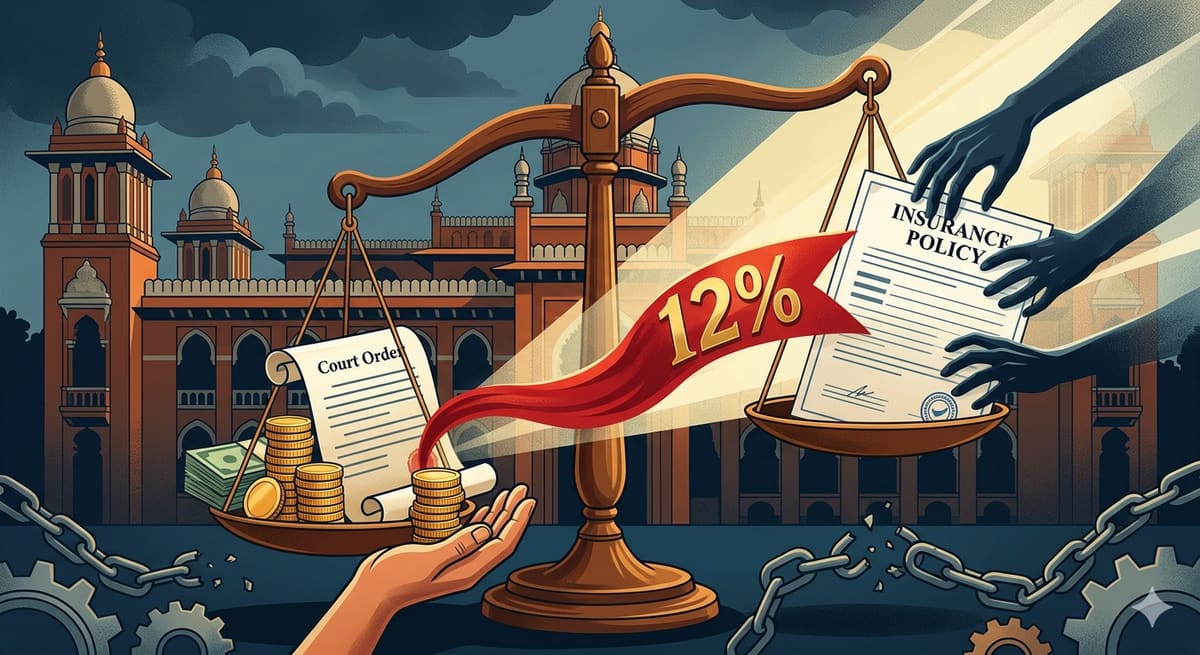
The Madras High Court has clarified that an insurance company cannot evade its statutory obligation to pay interest on delayed compensation under the Employees' Compensation Act, 1923, merely because its policy excludes such liability - provided the employer timely intimated the incident. This ruling reinforces the primacy of statutory duties over contractual limitations in workers' compensation claims.
Background & Facts
The Dispute
The dispute arose from a workplace accident involving Mr. Deepak Sharma, a 40-year-old employee of M/s. Golden Hills Estate Private Ltd. (1st respondent), who suffered a catastrophic injury on 03.06.2018 while operating a Rotorvane machine in the factory’s Rolling Room. His right hand was crushed and subsequently amputated above the elbow. He was hospitalized from 03.06.2018 to 19.07.2018 and declared permanently disabled with total loss of earning capacity. He filed a claim for compensation under the Employees’ Compensation Act, 1923, seeking Rs. 10,00,000.
Key Facts
The 1st respondent had an active Employees’ Compensation Insurance policy (No. 650600411710000002) with the National Insurance Co. Ltd. (2nd respondent/appellant)
The accident was reported to the insurer within three days, as required under the policy
The claimant’s monthly wage was determined to be Rs. 8,000 based on salary certificate Ex.R1 and cross-examination
The claimant was aged 44 years at the time of injury
Medical evidence (Ex.A1 and Ex.A2) confirmed employment and injury occurring in the course of employment
The insurance policy (Ex.R1) contained a clause excluding liability for interest on compensation
Procedural History
03.06.2018: Workplace accident resulting in amputation of right upper limb
19.07.2018: Claimant discharged from hospital
2019: Claim filed before Commissioner for Employee’s Compensation, Coonoor (E.C. No. 279 of 2019)
05.10.2020: Commissioner awarded compensation of Rs. 6,62,477 with 12% interest from 03.06.2018 until payment
05.10.2021: Appellant filed Civil Miscellaneous Appeal (CMA No. 2846 of 2021) before Madras High Court
17.03.2026: Judgment reserved
30.04.2026: Judgment pronounced
The Parties' Positions
For the Appellant (National Insurance Co. Ltd.)
Argued that the insurance policy explicitly excluded liability for interest
Relied on New India Assurance Co. Ltd. v. Harshadbhai Amrutbhai Modhiya (2006) to assert that insurance is a contract of indemnity and insurers cannot be forced to assume liabilities not contracted for
Contended that statutory interest under Section 4A(3) does not bind insurers unless expressly agreed
For the Respondents (Claimant and Employer)
Argued that the insurer received timely notice under the policy and failed to discharge its indemnity obligation
Emphasized that interest under Section 4A(3) is not contractual but statutory, arising from statutory default
Relied on L.R. Ferro Alloys Ltd. v. Mahavir Mahto (2002) to assert that interest is inseparable from compensation liability
Highlighted that the insurer’s failure to pay within one month triggered statutory interest
Relief Sought
The appellant sought to set aside the Commissioner’s order to the extent it imposed 12% interest on the compensation amount. The respondents sought confirmation of the award and dismissal of the appeal.
The Legal Issue
Whether an insurance company, which has been timely notified of a workplace accident under the Employees’ Compensation Act, 1923, can avoid liability for statutory interest under Section 4A(3) on the ground that its insurance policy excludes such liability?
Arguments Presented
For the Appellant
The appellant relied on New India Assurance Co. Ltd. v. Harshadbhai Amrutbhai Modhiya (2006) and P.J. Narayan v. Union of India (2006) to argue that insurance under the Act is a private contract of indemnity, not a statutory obligation like motor insurance. It contended that since the policy explicitly excluded interest, the insurer could not be held liable for it. The appellant further argued that the insurer’s duty is limited to indemnifying the employer for the principal compensation amount only, and that interest is a penalty for delay, not part of the core liability.
For the Respondent
The respondents countered that Section 4A(3) creates a statutory liability for interest upon default in payment within one month of the injury date. They cited L.R. Ferro Alloys Ltd. v. Mahavir Mahto (2002) and Pratap Narain Singh Deo v. Srinivas Sabata (1976) to establish that interest is an integral part of the compensation award under the Act, not a separate penalty. They emphasized that the insurer received timely notice under the policy and failed to act, thereby triggering statutory liability. The insurer’s internal policy terms cannot override statutory mandates.
The Court's Analysis
The Court undertook a detailed analysis of the statutory framework under the Employees’ Compensation Act, 1923, particularly Section 4A. It noted that sub-section (3) mandates payment of simple interest at 12% per annum if compensation is not paid within one month of the date it falls due - which the Court held, following Pratap Narain Singh Deo, is the date of injury.
"The liability to pay interest is part and parcel of the legal liability to pay compensation upon default of payment within one month, and therefore held that the claim for compensation along with interest will have to be made good jointly by the insurance company and the insured employer."
The Court distinguished New India Assurance Co. Ltd. v. Harshadbhai Amrutbhai Modhiya (2006), observing that in that case, the insurer had not been timely notified, and the facts were materially different. Here, the employer complied with the policy’s 30-day notice requirement, and the insurer remained inactive. The Court held that once the statutory conditions for interest are triggered, the insurer cannot rely on contractual exclusions to evade liability.
The Court further noted that the General Clauses Act applies to interpret "one month" as 30 days, aligning with the policy’s 30-day notice clause. Since the insurer received notice within three days, it had ample opportunity to discharge its obligation. Its failure to pay within the statutory period rendered it liable for interest under Section 4A(3), irrespective of policy terms.
The Court also rejected the argument that interest is a penalty, clarifying that while penalties under Section 4A(3)(b) are personal to the employer, interest under Section 4A(3)(a) is a statutory consequence of delay, binding on the insurer as the indemnifier.
The Verdict
The appeal was dismissed. The Madras High Court upheld the Commissioner’s order dated 05.10.2020, confirming that the appellant, National Insurance Co. Ltd., is liable to pay compensation of Rs. 6,62,477 together with 12% simple interest per annum from 03.06.2018 until actual payment. The Court held that the insurer’s contractual exclusion of interest is void to the extent it conflicts with statutory obligations under Section 4A(3) of the Employees’ Compensation Act, 1923. No costs were awarded.
What This Means For Similar Cases
Statutory Interest Cannot Be Contractually Waived
Practitioners must advise insurers that even if policies exclude interest, statutory liability under Section 4A(3) overrides such clauses when notice is timely
Insurance under the Act is not a free-standing contract; it operates within a statutory framework that imposes mandatory obligations
Any attempt to contract out of interest liability will be void if the statutory conditions for default are met
Timely Notice Is Critical for Insurer Protection
Insurers must act promptly upon receiving notice of accidents under the policy
Delay in payment - even if due to internal processing - triggers statutory interest
Insurers should establish internal protocols to process claims within 30 days of injury to avoid interest liability
Insurance Policies Must Align with Statutory Framework
Drafting policies to exclude statutory interest is legally futile and exposes insurers to litigation
Insurers should treat compensation and interest as a single statutory obligation, not separate components
Claims handlers must be trained on the distinction between contractual exclusions and statutory mandates under the Act