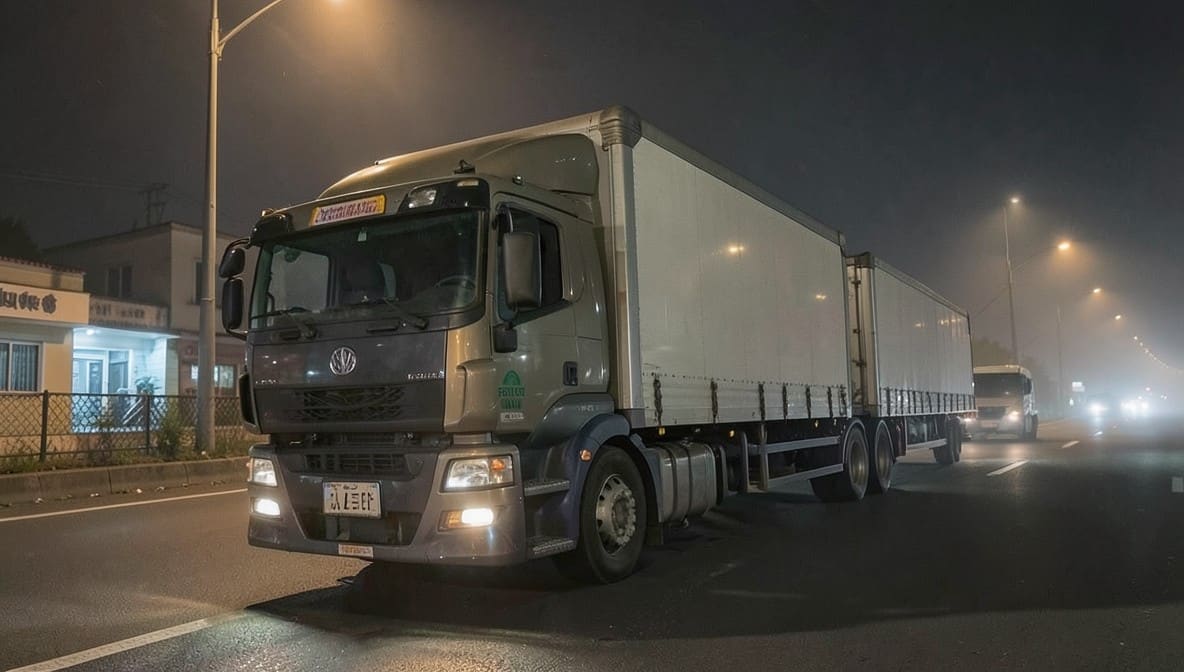
The Madhya Pradesh High Court has clarified that death due to cardiac arrest during long-haul driving, if causally linked to the physical and mental strain of employment, qualifies as an accidental death arising out of and in the course of employment under the Employees' Compensation Act, 1923. This ruling reinforces the principle that physiological injuries without external trauma can still attract compensation if employment is a material contributing factor.
Background & Facts
The Dispute
The appellants, legal heirs of the deceased Sheikh Habib, filed a claim petition before the Commissioner for Workmen's Compensation, Labour Court, Chhindwara, seeking compensation under the Employees' Compensation Act, 1923. The deceased was employed as a professional truck driver by M/s Omega LTRading Company. On the intervening night of 21-22.04.2004, while driving a tractor (registration No. MP-22-B-3949) on a route from Chhindwara, Madhya Pradesh, to Andhra Pradesh, he suffered a cardiac arrest and died. The Commissioner rejected the claim, holding that death did not occur "in the course of employment" as the deceased was resting at the time of death.
Key Facts
- The deceased, aged 45, was employed as a professional heavy vehicle driver since 2002
- On 21.04.2004, he commenced a long-distance journey from Chhindwara to Andhra Pradesh, approximately 1,152 km
- He was driving continuously for over 18 hours before halting near a hotel to rest
- He had taken dinner and retired to sleep around midnight
- He was found dead the next morning without signs of external injury
- Post-mortem report confirmed cardiac arrest as cause of death, with no evidence of trauma or poisoning
- Witness Ram Singh, co-traveller, testified that the deceased was driving without interruption until the halt
- The deceased had no prior history of heart disease
Procedural History
- 21-22.04.2004: Death of Sheikh Habib during employment
- 2005: Claim petition filed before Commissioner for Workmen's Compensation, Chhindwara (Case No. 6/WCA Fatal/2005)
- 23.12.2009: Commissioner dismissed claim, holding no nexus between employment and death
- 07.07.2010: Madhya Pradesh High Court admitted the appeal on the substantial question of law regarding causal nexus
- 13.05.2026: Judgment delivered by Justice Ratnesh Chandra Singh Bisen
Relief Sought
The appellants sought: (1) setting aside of the Commissioner’s order dated 23.12.2009; (2) declaration that death arose out of and in the course of employment; and (3) remand for determination of compensation amount under Schedule I of the Employees' Compensation Act, 1923.
The Legal Issue
The central question was whether the death of a professional truck driver due to cardiac arrest during a long-haul journey, while resting at the roadside, constitutes an accidental death arising out of and in the course of employment under the Employees' Compensation Act, 1923, even in the absence of external injury.
Arguments Presented
For the Appellant
Counsel relied on Shakuntala Chandrakant Shreshti v. Prabhakar Maruti Garvali (2007) 11 SCC 668 and Param Pal Singh v. National Insurance Company (2013) 3 SCC 409 to argue that a causal connection between employment and death suffices for compensation, even if the injury is internal. He emphasized that the nature of the deceased’s job - continuous long-distance driving - imposed extreme physical and mental strain, which directly contributed to cardiac failure. He cited Mallikarjuna G. Hiremath v. Oriental Insurance Co. Ltd. and Smt. Sundarbai v. Ordnance Factory to establish that physiological injuries caused by occupational stress qualify as "accidents" under the Act.
For the Respondent
Counsel contended that since the deceased was resting and not actively driving at the time of death, the incident did not occur "in the course of employment." He relied on the post-mortem report showing no external injury and the witness statement indicating the deceased had parked and slept. He argued that National Insurance Co. v. Moliya Devi required direct causation, which was absent here, and that mere temporal proximity to employment is insufficient.
The Court's Analysis
The Court undertook a comprehensive review of judicial precedents to determine the scope of "accident" and "injury" under the Employees' Compensation Act. It held that the term "accident" is not confined to external events but includes internal physiological failures if they are precipitated by employment-related strain.
"Accident means an untoward mishap which is not expected or designed by the workman. ... Accident may be an event happening internally to a man and in such cases 'accident' and 'injury' coincide. Such cases are illustrated by bursting of an aneurism, failure of heart and the like while the workman is doing his normal work."
The Court emphasized that the burden of proof lies on the claimant, but it is discharged if the evidence establishes a greater probability that employment contributed to the injury. The deceased’s role as a professional driver, required to undertake arduous journeys exceeding 1,000 km, was deemed inherently stressful. The Court noted that the deceased was not on a personal errand but was actively engaged in the employer’s business, and the halt was incidental to the journey.
The Court further relied on Param Pal Singh, which held that if the work contributes to or accelerates a physiological condition, compensation is payable. The absence of external injury was held irrelevant, as the Act does not require trauma. The Court concluded that the nature of the employment - constant driving, fatigue, mental alertness, and physical endurance - created a zone of special danger, making the cardiac arrest an occupational hazard.
The Commissioner’s failure to appreciate the cumulative strain of long-haul driving and the professional nature of the deceased’s duties was deemed a material error in appreciation of evidence.
The Verdict
The appeal was allowed. The order dated 23.12.2009 of the Commissioner for Workmen's Compensation was set aside. The matter was remanded to the Commissioner for determination of the quantum of compensation payable to the claimants in accordance with Schedule I of the Employees' Compensation Act, 1923, within three months from the date of receipt of the certified copy of this order.
What This Means For Similar Cases
Cardiac Events During Long-Haul Driving Are Compensable
- Practitioners must now argue that professional drivers, especially those engaged in interstate or long-distance transport, are exposed to occupational hazards that can trigger cardiac events
- Medical evidence of stress-induced cardiac failure, even without trauma, is sufficient if supported by work logs, route details, and duration of driving
- The absence of external injury cannot be used to deny compensation under the Act
Employment-Related Strain Qualifies as "Accident"
- The judgment establishes that "accident" under the Act includes internal physiological breakdowns caused by the nature of employment
- Employers must now assess the physical demands of jobs involving prolonged exertion, shift work, or travel
- Claimants in similar cases should focus on establishing the cumulative strain of duties, not just the moment of collapse
Burden of Proof Is Reasonable, Not Absolute
- The claimant need not prove causation beyond doubt; a balance of probabilities suffices
- Courts will consider the totality of circumstances: job nature, duration of work, absence of pre-existing conditions, and work schedule
- Employers seeking to deny claims must provide credible evidence of non-employment causes, not merely rely on the absence of trauma