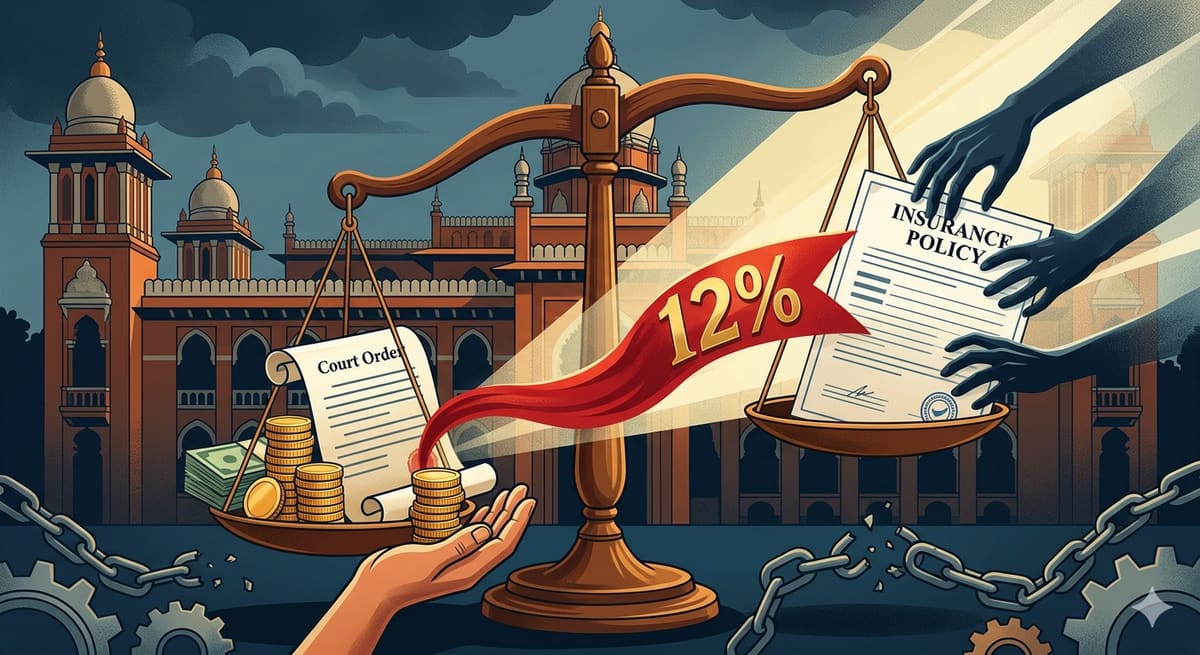
The Gujarat High Court clarified that an insurer cannot be compelled to pay interest on workmen's compensation where the employer-liability policy expressly excludes interest, thereby modifying the earlier order of the Labour Court and limiting the insurer's liability to the principal compensation amount.
Background & Facts
The Dispute
The appellant, Oriental Insurance Company Ltd, issued an employer-liability insurance policy to respondent No.3, the employer, covering work-related injuries of its employees. In Workmen Fatal Case No.6 of 2012, the Commissioner for Workmen Compensation Act and Judge, Labour Court, Junagadh, dated 20.08.2015, directed the insurer to pay compensation of Rs.5,34,504 along with interest at 9% per annum from the date of the incident till realization.
Key Facts
- The insurance policy contains an "Exception" clause, specifically clause-(f), stating that the insurer is not liable for any interest or penalty imposed on the insured for failure to comply with the Workmen's Compensation Act, 1953.
- The appellant argued that the policy does not contractually bind it to pay interest, relying on the Supreme Court decision in New India Assurance Company Ltd. v. Harshadbhai Amrutbhai Modhiya (2006) 5 SCC 192.
- The respondent (employer) contended that interest is a statutory component of the compensation award and should be borne by the employer, not the insurer.
Procedural History
- 20.08.2015: Labour Court, Junagadh, ordered the insurer to pay Rs.5,34,504 plus 9% interest per annum.
- 2017: The insurer filed a First Appeal (No. 2228 of 2017) under section 30 of the Employees' Compensation Act, 1923, challenging the interest liability.
- 24/08/2026: Gujarat High Court delivered the judgment, partially allowing the appeal.
Relief Sought
The appellant sought a declaration that it is not liable to pay interest on the compensation amount and that the interest component of the Labour Court's order be set aside.
The Legal Issue
Whether, under an employer-liability insurance policy that contains an explicit exclusion clause for interest, the insurer is liable to pay interest on workmen's compensation awarded under the Employees' Compensation Act, 1923.
Arguments Presented
For the Appellant
- The policy’s clause-(f) expressly excludes liability for interest or penalty, and therefore the insurer is not contractually bound to pay interest.
- Citing New India Assurance Co. Ltd. v. Harshadbhai Amrutbhai Modhiya, the appellant argued that an insurance contract must be interpreted according to its natural and ordinary meaning, and an exclusion clause defeats any implied liability for interest.
- The appellant maintained that the Labour Court erred in imposing interest without reference to the policy terms.
For the Respondent
- The respondent argued that interest is a statutory component of compensation under the Employees' Compensation Act and that the employer, as the insured, remains liable for it.
- It submitted that the policy’s exclusion pertains only to penalties imposed on the insurer, not to statutory interest owed by the employer.
- The respondent relied on the principle that statutory obligations cannot be contracted out of by an insurer.
The Court's Analysis
The Court began by examining the insurance policy, noting that clause-(f) under the "Exception" heading expressly states: "any interest and/or penalty imposed on the insured on account of his/their failure to comply with the requirement laid down under the W.C. Act, 1953". The Court held that this language clearly indicates that the insurer did not assume the risk of paying interest or penalty.
"Thus, evidently, the appellant-Insurance Company is not liable to pay any interest on the amount of compensation."
The Court then referred to the Supreme Court’s reasoning in New India Assurance Co. Ltd. v. Harshadbhai Amrutbhai Modhiya, emphasizing that insurance contracts are to be construed according to the ordinary meaning of their terms and that an exclusion clause, if clear, defeats any implied liability. The Court observed that the policy was an employer-liability policy and that the employer had not purchased a separate cover for interest or penalty.
Applying the principle of contractual interpretation, the Court concluded that the insurer could not be saddled with a liability it had not contracted for. It further noted that the Labour Court had failed to consider the policy terms and the Supreme Court precedent, thereby committing a legal error.
Consequently, the Court held that the direction to pay interest to the insurer was illegal and should be set aside. The employer, as the insured, remained liable for the statutory interest.
The Verdict
The appeal was partly allowed. The Gujarat High Court modified the Labour Court’s order, directing the insurer to pay only the principal compensation of Rs.5,34,504. The respondent (employer) was ordered to pay interest at 9% per annum from the date of the incident (20.08.2015) until realization. Any excess amount deposited by the insurer is to be refunded via NEFT or RTGS. No costs were awarded, and the record is to be sent to the trial court.
What This Means For Similar Cases
Exclusion Clauses Control Liability
- Insurers must ensure that policies expressly state whether interest or penalties are covered.
- Courts will give effect to clear exclusion clauses, preventing implied liability for statutory interest.
Employers Remain Statutorily Liable
- Even when an employer purchases an employer-liability policy, statutory interest on compensation remains the employer’s responsibility unless specifically insured.
- Practitioners should advise employers to obtain separate coverage for interest if they wish to avoid this liability.
Reliance on Supreme Court Precedent
- The New India Assurance principle that insurance contracts are to be interpreted like any other contract is reaffirmed.
- Counsel should cite this precedent when challenging imposed liabilities that conflict with policy terms.
Drafting Recommendations
- Include explicit language regarding interest and penalty coverage.
- Consider adding a rider for statutory interest if the employer wishes the insurer to bear that risk.
- Review existing policies for ambiguous clauses that could be interpreted against the insurer.