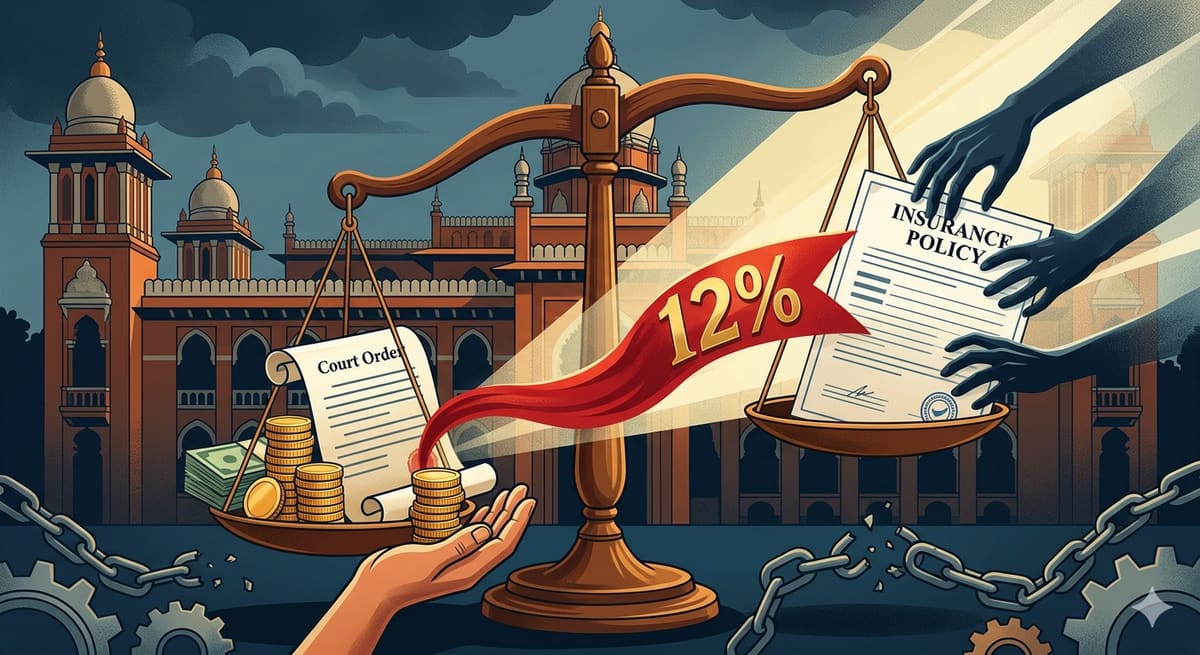
The Allahabad High Court has clarified that an insurer’s liability under the Employees Compensation Act, 1923 is not automatically extinguished by alleged violations of insurance policy terms. The judgment affirms that the statutory duty to compensate dependents of a deceased worker arises independently of contractual insurance conditions, provided the death occurred in the course of employment.
Background & Facts
The Dispute
The dispute arose from the death of a worker, Sri Suresh, who was driving a tanker truck engaged in the transportation of goods. The vehicle was insured by The New India Assurance Co. Ltd. under a motor vehicle insurance policy. The worker died in an accident while performing his duties. His dependents filed a claim petition under the Employees Compensation Act, 1923 seeking compensation.
Key Facts
- The deceased worker was employed by the owner of the tanker truck, whose name is not disclosed in the judgment
- The accident occurred on or before 18.04.2012, the date of the Workmen’s Compensation Commissioner’s award
- The tanker was carrying hazardous goods at the time of the accident
- The insurance policy held by the owner did not contain an endorsement permitting the carriage of hazardous materials
- The insurer contended that this absence of endorsement constituted a breach of policy conditions, thereby voiding its liability
- The claimants (respondents) were the legal heirs of the deceased worker
- No dispute existed regarding the worker’s employment or that the death occurred during the course of employment
Procedural History
- Date of accident: Not explicitly stated, but occurred prior to 18.04.2012
- 18.04.2012: Workmen’s Compensation Commissioner awarded compensation to the claimants, holding the insurer liable
- Date of appeal filing: First Appeal From Order No. 2573 of 2012 filed before the High Court
- Date of hearing: Before Justice Pankaj Bhatia, Allahabad High Court
- Date of judgment: 14 May 2026
The Parties' Positions
For the Appellant (The New India Assurance Co. Ltd.)
The insurer argued that the tanker was being used to transport hazardous goods without the required policy endorsement, in violation of the Motor Vehicles Act and the terms of the insurance contract. It contended that such a breach rendered the policy void ab initio and therefore, it could not be held liable under the Employees Compensation Act.
For the Respondents (Sri Suresh’s Dependents)
The claimants maintained that the statutory obligation under the Employees Compensation Act is independent of the insurance policy’s terms. They argued that the insurer’s liability arises from the employer’s statutory duty to compensate, and the insurer, having undertaken the risk by issuing the policy, must discharge that liability regardless of policy breaches.
Relief Sought
The appellant sought to set aside the award dated 18.04.2012 in its entirety, arguing that no liability attached to it due to policy violation. The respondents sought confirmation of the award and payment of compensation.
The Legal Issue
The central question was whether an insurer’s liability under the Employees Compensation Act, 1923 is extinguished when the insured vehicle is operated in violation of the terms of the insurance policy, particularly in the absence of an endorsement for carrying hazardous goods.
Arguments Presented
For the Appellant
The appellant relied on the principle that insurance contracts are governed by the terms agreed upon, and any breach - especially one involving statutory violations under the Motor Vehicles Act - invalidates coverage. It cited general principles of contract law and insurance jurisprudence to argue that liability cannot be imposed where the risk insured was not lawfully or contractually covered.
For the Respondent
The respondents contended that the Employees Compensation Act is a welfare statute designed to ensure swift and certain compensation to workers or their dependents. They argued that the insurer’s liability under Section 3 of the Act is statutory and not contingent on the insurer’s contractual obligations. The insurer, having accepted premiums and issued the policy, cannot evade liability by invoking policy breaches against third-party beneficiaries (the dependents).
The Court's Analysis
The Court examined the nature of liability under the Employees Compensation Act, 1923, and distinguished between contractual obligations under an insurance policy and statutory obligations imposed on employers and their insurers. The Court noted that the Act creates a no-fault liability regime, where compensation is payable irrespective of negligence, and the insurer’s role is to ensure the employer’s statutory obligation is met.
"The liability of the insurer under the Employees Compensation Act is not derived from the contract of insurance alone, but from the statutory mandate under Section 3 of the Act. The insurer stands in the shoes of the employer for the purpose of discharging this liability."
The Court further held that while policy violations may entitle the insurer to seek recourse against the policyholder (the owner), such violations cannot be used to defeat the claim of the worker’s dependents, who are not parties to the insurance contract and are protected by the welfare objectives of the Act.
The Court rejected the appellant’s contention that the absence of an endorsement for hazardous goods automatically nullified the insurer’s liability under the Act. It emphasized that the insurer’s duty to compensate arises upon proof of employment and death in the course of employment - both of which were established.
The Verdict
The appellant’s appeal was partially allowed. The Court modified the award dated 18.04.2012 to grant the insurer the liberty to recover the compensation amount paid to the claimants from the owner of the tanker, provided the insurer can establish a breach of policy conditions after giving the owner a hearing. The insurer must pay the compensation to the claimants within two months from the date of judgment. Any amount already deposited by the insurer shall be released to the claimants upon application. The remainder of the award remains intact.
What This Means For Similar Cases
Insurer’s Liability Is Statutory, Not Contractual
- Practitioners must argue that insurers cannot invoke policy exclusions to deny compensation under the Employees Compensation Act
- Dependents are protected third-party beneficiaries under the Act, regardless of policy breaches
- The insurer’s recourse lies against the employer or owner, not the claimant
Policy Violations Do Not Automatically Void Compensation Claims
- Even if a vehicle is used in violation of the Motor Vehicles Act or insurance policy (e.g., no endorsement for hazardous goods), the statutory duty to compensate remains
- Courts will prioritize the worker’s right to compensation over technical insurance defenses
- Insurers must pay first, recover later - subject to proving breach and affording the owner a hearing
Procedural Safeguards for Recovery
- Insurers seeking recovery from owners must initiate separate proceedings
- Recovery cannot be automatic; the owner must be heard before any claim for reimbursement is enforced
- This judgment establishes a two-step process: pay claimants first, then pursue contractual remedies