Topic

Arrest Procedure

Arrest procedure in Indian law governs the lawful conditions and mandatory steps police must follow before detaining a person, particularly under Section 41 CrPC and Article 22(1) of the Constitution, as reinforced by the Arnesh Kumar doctrine.

24 articlesLatest September 2026
BNSS Sections 36, 47, 48 | Arrest Invalid Without Witness Signature, Specific Grounds & Family Notice of Grounds; Bail Granted in NDPS Case : Gauhati HC
Case Law Analysis
|Gauhati High Court

BNSS Sections 36, 47, 48 | Arrest Invalid Without Witness Signature, Specific Grounds & Family Notice of Grounds; Bail Granted in NDPS Case : Gauhati HC

The court ruled that the arrest memo's missing witness signature, vague grounds of arrest, and failure to inform the family of the specific grounds - as mandated by BNSS Sections 36, 47, and 48 - rendered the arrest illegal. Bail was granted in an NDPS case where the accused was also unrepresented during remand proceedings.


Detention without transit remand violates Article 22(2) & BNSS §528 - Arrest declared illegal | CGHC
Case Law Analysis
|Chhattisgarh High Court

Detention without transit remand violates Article 22(2) & BNSS §528 - Arrest declared illegal | CGHC

The Chhattisgarh High Court set aside the magistrate’s orders remanding Jitesh Anand to police and judicial custody, declaring his arrest unlawful for breaching Article 22(2) and Section 528 of the Bharatiya Nagarik Suraksha Sanhita. The decision underscores that any detention without a valid transit remand is unconstitutional, mandating immediate release on bail.

Article 22(1) + BNSS Section 47 | Written Notice to Relatives Mandatory for Arrest Validity in POCSO Cases : Kerala HC
|Kerala High Court

Article 22(1) + BNSS Section 47 | Written Notice to Relatives Mandatory for Arrest Validity in POCSO Cases : Kerala HC

The Kerala High Court ruled that failure to serve written notice of arrest to a relative renders the arrest illegal under Article 22(1) and BNSS Section 47, even in serious POCSO cases. This sets a critical precedent: procedural compliance is non-negotiable, and bail cannot be denied merely because of the gravity of the offense when fundamental rights are violated at arrest.

Section 26 HSSNSC Act 2025 | Arrest Without Commissioner's 'Reasons to Believe' Violates Constitutional Safeguards : Allahabad HC
Case Law Analysis
|Allahabad High Court

Section 26 HSSNSC Act 2025 | Arrest Without Commissioner's 'Reasons to Believe' Violates Constitutional Safeguards : Allahabad HC

Allahabad High Court quashed an arrest under the Health Security Se National Security Cess Act 2025, ruling that procedural compliance under Section 26 mandates the Commissioner-not a subordinate-to record 'reasons to believe' for arrest. The judgment reinforces that failure to adhere to this safeguard renders the arrest illegal, violating Articles 21 and 22 of the Constitution, and sets a precedent for strict adherence to statutory procedural requirements in custodial matters.

BNSS Section 36 | Absence of Witness Signature on Arrest Memo Valid If Section 48 Notice Served to Family : Gauhati HC
Case Law Analysis
|Gauhati High Court

BNSS Section 36 | Absence of Witness Signature on Arrest Memo Valid If Section 48 Notice Served to Family : Gauhati HC

Gauhati HC rules that an arrest under BNSS remains lawful even without a witness signature on the arrest memo, provided Section 48 notice is duly served to the accused's family. The judgment prioritizes substantive compliance over procedural technicalities, impacting arrest validity in criminal proceedings under the new criminal laws.

BNSS Section 35(3) | Mandatory Notice Before Arrest in Offences Up to 7 Years: Arnesh Kumar Guidelines Remain Binding Under New Criminal Code : Uttarakhand HC
Case Law Analysis
|Uttarakhand High Court

BNSS Section 35(3) | Mandatory Notice Before Arrest in Offences Up to 7 Years: Arnesh Kumar Guidelines Remain Binding Under New Criminal Code : Uttarakhand HC

Uttarakhand High Court reinforces that Investigating Officers must issue a notice under BNSS Section 35(3) before arresting individuals in offences punishable up to seven years, aligning with the Arnesh Kumar guidelines. The ruling mandates procedural compliance, ensuring accused persons are not arbitrarily detained without prior notice, safeguarding natural justice in criminal investigations.

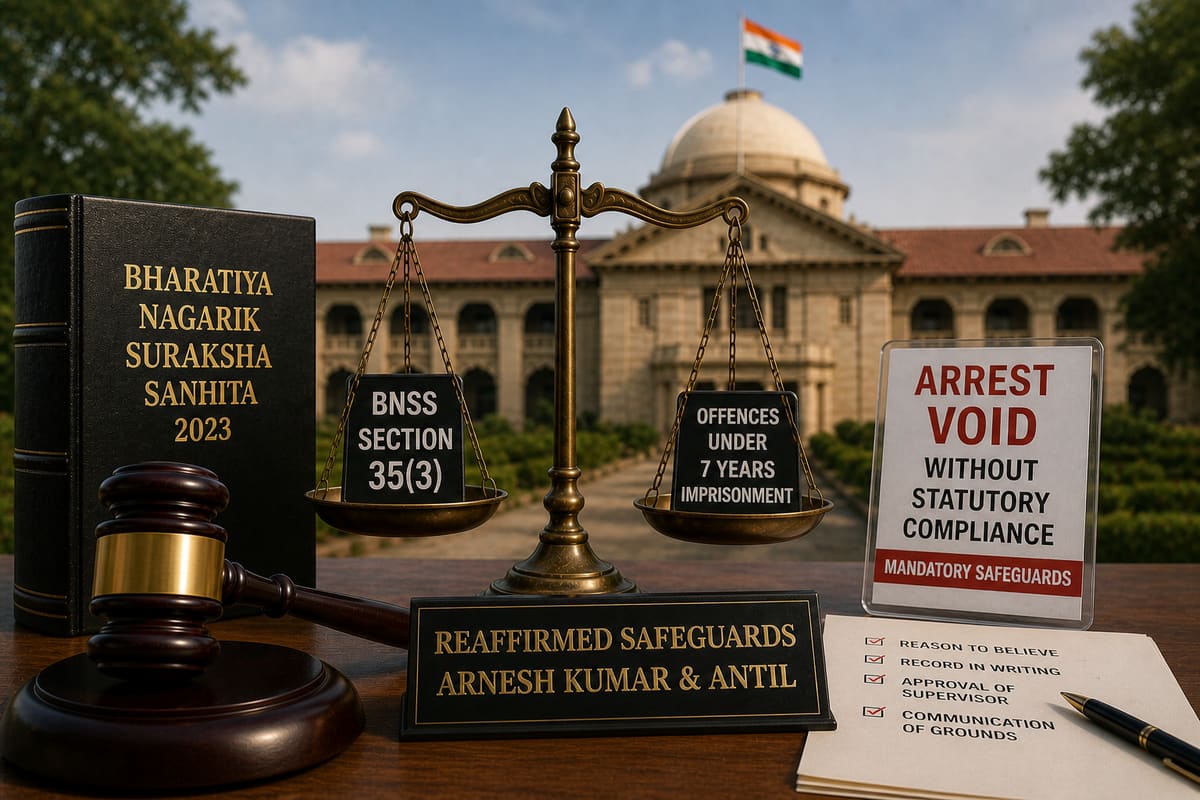
BNSS Section 35(3) | Arrest for Offences Under 7 Years Imprisonment Void Without Statutory Compliance: Allahabad HC Reaffirms Arnesh Kumar & Antil Safeguards
Case Law Analysis
|Allahabad High Court

BNSS Section 35(3) | Arrest for Offences Under 7 Years Imprisonment Void Without Statutory Compliance: Allahabad HC Reaffirms Arnesh Kumar & Antil Safeguards

Allahabad HC rules that arrests for offences punishable by less than seven years imprisonment are illegal unless BNSS 2023's Section 35(3) safeguards are strictly followed. The court mandated compliance with Arnesh Kumar and Satender Kumar Antil guidelines, reinforcing procedural protections against arbitrary arrests and ensuring natural justice for accused persons.

BNSS Section 35(3) | Mandatory Pre-Arrest Notice Not Waived by Non-Cooperation: Telangana HC
Case Law Analysis
|Telangana High Court

BNSS Section 35(3) | Mandatory Pre-Arrest Notice Not Waived by Non-Cooperation: Telangana HC

Telangana High Court reinforces that Section 35(3) of the Bharatiya Nagarik Suraksha Sanhita (BNSS) mandates a notice before arrest for offences punishable with less than seven years, irrespective of the accused's non-cooperation. The ruling underscores that due process cannot be bypassed, even if the accused evades investigation, setting a critical precedent for arrest procedures under the new criminal law framework.

Article 22(1) Mandates Grounds of Arrest Communication | Non-Compliance Vitiates NDPS Detention : Uttarakhand HC Grants Bail
Case Law Analysis
|Uttarakhand High Court

Article 22(1) Mandates Grounds of Arrest Communication | Non-Compliance Vitiates NDPS Detention : Uttarakhand HC Grants Bail

Uttarakhand High Court ruled that failure to communicate grounds of arrest under Article 22(1) of the Constitution renders detention illegal, even in NDPS cases with statutory bail restrictions. The Court emphasized that procedural lapses, including implausible explanations for missing CCTV footage, undermine the prosecution's case and justify bail.

Article 22(1) Compliance Met via Arrest Memo Even Without Separate Written Grounds: Uttarakhand HC Post-Mihir Rajesh Shah
Case Law Analysis
|Uttarakhand High Court

Article 22(1) Compliance Met via Arrest Memo Even Without Separate Written Grounds: Uttarakhand HC Post-Mihir Rajesh Shah

Uttarakhand High Court rules that Article 22(1) of the Constitution is satisfied if the grounds of arrest are communicated in writing through the arrest memo, even without a separate document, provided the arrest occurred before the Supreme Court's 2025 Mihir Rajesh Shah ruling. This decision clarifies the procedural safeguards for arrests, impacting law enforcement and accused rights in pre-2025 cases.

Article 22(1) Compliance | Arrest Memo Alone Suffices as Grounds of Arrest Communication : Uttarakhand HC
Case Law Analysis
|Uttarakhand High Court

Article 22(1) Compliance | Arrest Memo Alone Suffices as Grounds of Arrest Communication : Uttarakhand HC

Uttarakhand High Court rules that an arrest memo containing factual allegations fulfills the constitutional requirement under Article 22(1) to communicate grounds of arrest, eliminating the need for a separate written document. This judgment simplifies arrest procedures for law enforcement while ensuring accused persons are informed of the charges against them.

Section 41 CrPC | Mandatory Compliance Required Before Arrest in Cyber Fraud Cases: MP HC Upholds Arnesh Kumar Guidelines
Case Law Analysis
|Madhya Pradesh High Court

Section 41 CrPC | Mandatory Compliance Required Before Arrest in Cyber Fraud Cases: MP HC Upholds Arnesh Kumar Guidelines

Madhya Pradesh High Court reinforces that non-compliance with Section 41 CrPC-requiring prior notice and satisfaction of arrest conditions-invalidates arrest even in cyber fraud cases involving substantial sums. The ruling extends Arnesh Kumar principles to digital offenses, mandating strict adherence to procedural safeguards before detention.

BNSS Section 35(3) | Mandatory Notice & Written Reasons Required Before Arrest in Offences Below 7 Years : Telangana HC Reaffirms Arnesh Kumar Safeguards
Case Law Analysis
|Telangana High Court

BNSS Section 35(3) | Mandatory Notice & Written Reasons Required Before Arrest in Offences Below 7 Years : Telangana HC Reaffirms Arnesh Kumar Safeguards

Telangana High Court rules that police must issue a notice and record written reasons before arresting accused in offences punishable by less than seven years under BNSS Section 35(3). The judgment reinforces that arrest is not automatic even during investigation, aligning with the Arnesh Kumar principles to prevent arbitrary detention and uphold due process for non-bailable offences.