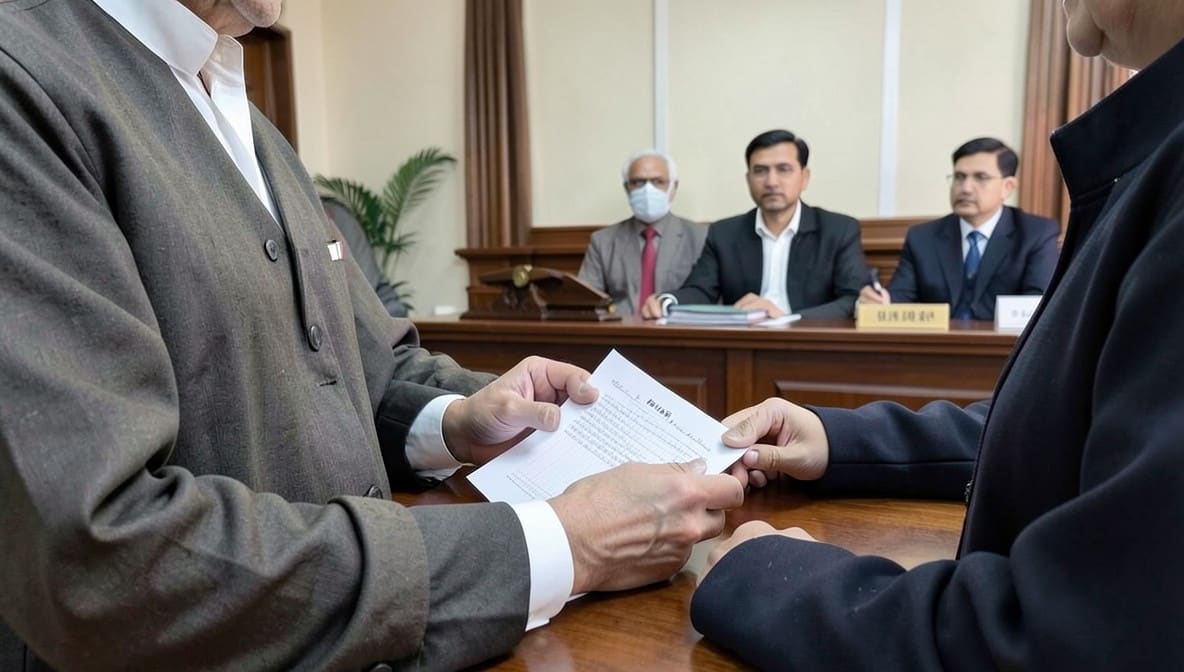
The Gauhati High Court has clarified that the absence of witness signatures on an arrest memo under the Bharatiya Nagrik Suraksha Sanhita (BNSS), 2023 does not automatically invalidate an arrest, provided the statutory notice to family or nominated persons under Section 48 BNSS is timely and properly served. This ruling reinforces procedural compliance over technical non-compliance in arrest protocols.
Background & Facts
The Dispute
The petitioners, Rofikul Islam and another, were arrested on 26.02.2026 in connection with Jakalabandha Police Station Case No. 21/2025 under Sections 220, 25, and 29 of the Narcotic Drugs and Psychotropic Substances (NDPS) Act, 1985. The arrest followed the recovery of a commercial quantity of contraband from their possession. The petitioners sought regular bail, challenging the legality of their arrest on the ground that the arrest memo lacked attestation by any family member or respectable person of the locality, as mandated under Section 36 BNSS.
Key Facts
- The arrest occurred on 26.02.2026 at Village Tepkai, PS Baguwon, District Goalpara, Assam
- A commercial quantity of narcotics was recovered during the arrest
- The arrest memo was prepared but bore no signature of any witness as required under Section 36(b)(i) BNSS
- The prosecution did not dispute the absence of witness signatures
- On the same day of arrest (26.02.2026), a notice under Section 48 BNSS was served upon the wife of the first petitioner
- The notice included: date, time, place of arrest, place of detention (Jakalabandha PS), and grounds of arrest
- The wife acknowledged receipt of the notice by signing it
- No representation was made by the petitioners regarding non-receipt of notice or denial of right to inform a relative
- The petitioners were produced before a Magistrate on 27.02.2026
Procedural History
- 26.02.2026: Arrest made; arrest memo prepared without witness attestation; Section 48 BNSS notice served on wife
- 27.02.2026: Petitioners produced before Magistrate
- 05.04.2026: Bail application filed before Gauhati High Court (Bail Appln./993/2026)
- 30.04.2026: Judgment reserved
- 15.05.2026: Judgment pronounced
Relief Sought
The petitioners sought regular bail on the grounds that their arrest was illegal due to non-compliance with Section 36 BNSS, particularly the absence of witness attestation on the arrest memo. They also contended that the procedural irregularity prejudiced their right to legal representation and family notification.
The Legal Issue
Whether the absence of witness attestation on the arrest memo under Section 36 of the Bharatiya Nagrik Suraksha Sanhita (BNSS), 2023 renders the arrest illegal, if the mandatory notice under Section 48 BNSS informing the arrestee’s family or nominated person has been duly served and acknowledged.
Arguments Presented
For the Petitioner
Learned counsel for the petitioners relied on D.K. Basu v. State of West Bengal (1997) 1 SCC 416, arguing that the absence of witness attestation on the arrest memo violates the procedural safeguards established by the Supreme Court and now codified under Section 36 BNSS. He contended that the arrest memo is a foundational document for legal accountability, and its non-compliance with mandatory attestation requirements renders the arrest procedurally defective and potentially illegal. He further argued that the failure to secure a witness signature undermines the integrity of the arrest process and deprives the arrestee of a meaningful opportunity to challenge the legality of detention.
For the Respondent
The Additional Public Prosecutor submitted that while the arrest memo lacked witness signatures, the essential purpose of Section 36 BNSS - ensuring transparency and accountability - was fully satisfied by the timely service of Section 48 BNSS notice to the arrestee’s wife on the day of arrest. The notice contained all critical details: time, place, and grounds of arrest, and was duly acknowledged. The prosecution emphasized that no prejudice was caused to the petitioners, and the recovery of a commercial quantity of narcotics justified the denial of bail under Section 37 NDPS Act.
The Court's Analysis
The Court undertook a detailed textual and purposive interpretation of Section 36 and Section 48 BNSS, distinguishing between procedural form and substantive compliance. It observed that while Section 36(b)(i) mandates attestation of the arrest memo by a family member or respectable local, Section 36(c) provides a conditional alternative: if the memo is not attested by a family member, the arrestee must be informed of his right to have a relative or friend notified.
"The requirement of attestation by a member of the family of the arrestee or a respectable member of the locality where the arrest is made is diluted by Clause (c) of Section 36 by requiring that the arrestee must be informed that he has a right to have a relative or a friend or any other person named by him to be informed of his arrest, in which case the attestation of the memorandum of arrest by at least one witness as described above is not mandatory."
The Court held that Section 48 BNSS serves as the operational mechanism to fulfill the intent of Section 36(c). The service of notice upon the wife, with her acknowledgment, satisfied the twin objectives of transparency and accountability. The Court noted that the purpose of the arrest memo is not merely formalistic but to ensure that the deprivation of liberty is documented and communicated to those who may safeguard the arrestee’s rights.
The Court further clarified that the witness under Section 36 need not be physically present at the scene of arrest; their role is to attest the memorandum, not to witness the act of arrest. The notice under Section 48, when properly served and acknowledged, fulfills the same evidentiary and procedural function.
The Court distinguished two prior decisions of coordinate benches - Amirul Islam @ Nengra v. State of Assam and Dr. Sangeeta Dutta v. State of Assam - on the ground that in those cases, no Section 48 notice was served at all. Here, the notice was not only served but acknowledged.
The Court also emphasized that Section 62 BNSS mandates that arrests must be made strictly in accordance with the Sanhita. However, non-compliance with a procedural requirement does not automatically invalidate the arrest if the substantive purpose is achieved. The Court concluded that the arrest was lawful, and the recovery of a commercial quantity of contraband triggered the stringent conditions under Section 37 NDPS Act, making bail inappropriate.
The Verdict
The petition for regular bail was dismissed. The Court held that the absence of witness signatures on the arrest memo under Section 36 BNSS does not vitiate the arrest where Section 48 BNSS notice has been duly served and acknowledged by the arrestee’s family. The petitioners’ arrest was lawful, and given the recovery of a commercial quantity of narcotics, the rigors of Section 37 NDPS Act apply. No grounds for bail were established.
What This Means For Similar Cases
Procedural Compliance Trumps Technical Defects
- Practitioners must now argue that non-compliance with Section 36 BNSS (witness attestation) is not fatal if Section 48 notice is timely served and acknowledged
- Courts will assess whether the purpose of accountability and notification was fulfilled, not whether the form was mechanically followed
- Arrests in remote areas or where family members are absent are not automatically illegal if Section 48 notice is properly executed
Section 48 BNSS Is a Critical Safeguard
- The Section 48 notice must contain: date, time, place of arrest, place of detention, and grounds of arrest
- Acknowledgment of receipt by the family member is essential - unsigned notices will not suffice
- Police must maintain proof of service (e.g., signed receipt, delivery log) to rebut challenges under Section 36
- Failure to serve Section 48 notice remains a ground for challenging arrest legality
Bail Under NDPS Act Remains Stringent
- Recovery of commercial quantity triggers Section 37 NDPS Act - bail is the exception, not the rule
- Procedural irregularities alone cannot override the statutory bar on bail under Section 37 unless they render the arrest void ab initio
- Defense counsel must now focus on proving that Section 48 notice was not served or was defective, not merely that the arrest memo lacked signatures