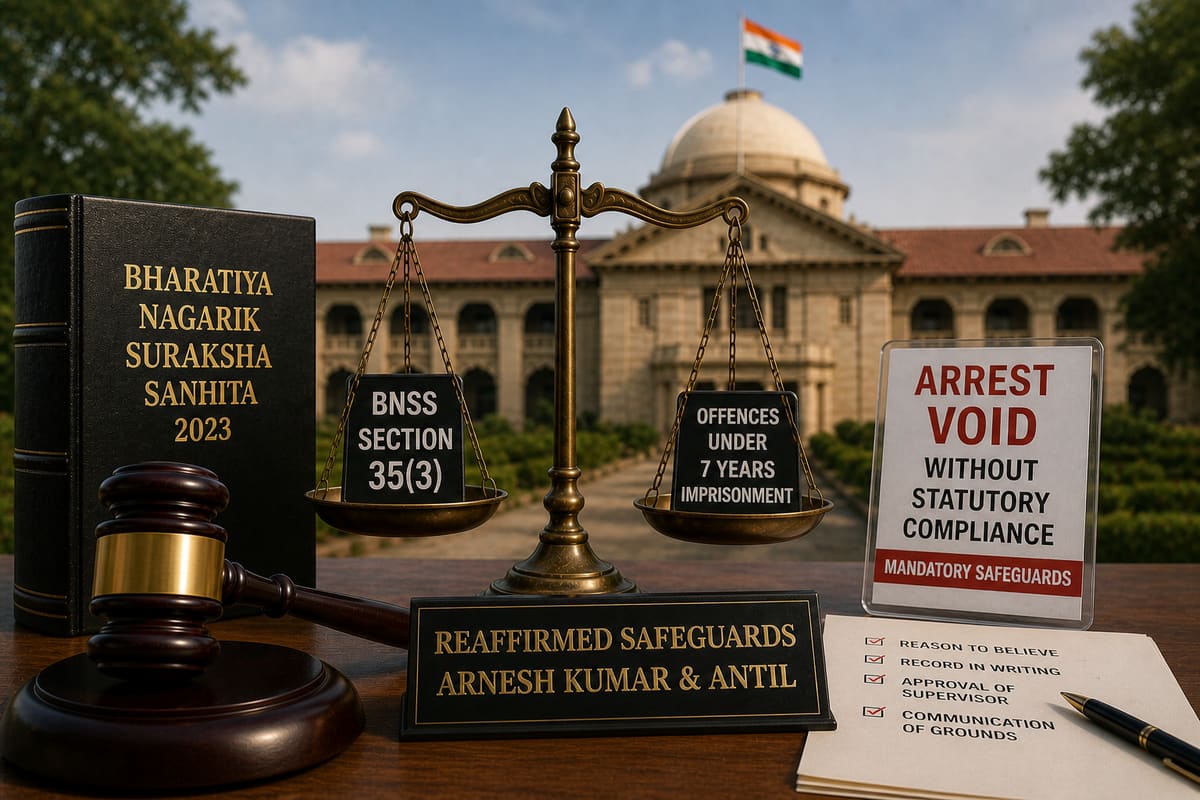
The Allahabad High Court has reaffirmed that arrest cannot be automatic or routine for offences punishable by less than seven years’ imprisonment, reinforcing the Supreme Court’s directive that procedural safeguards under the Bhartiya Nagrik Suraksha Sanhita, 2023 must be strictly followed. This judgment provides critical clarity for law enforcement and defence practitioners navigating pre-arrest compliance obligations.
Background & Facts
The Dispute
The petitioners, Mushir Ali and six others, were named as accused in FIR No. 0114 of 2026, registered at Police Station Kasimpur, District Hardoi, under Sections 85 and 115(2) of the Bhartiya Nyaya Sanhita, 2023 (BNS), and Sections 3 and 4 of the Dowry Prohibition Act. The petitioners did not challenge the maintainability of the FIR itself but sought protection from arrest, arguing that the offences attract a maximum punishment of less than seven years and thus fall within the protective ambit of Supreme Court rulings in Arnesh Kumar v. State of Bihar and Satender Kumar Antil v. CBI.
Key Facts
The FIR was registered on 28.03.2026.
The alleged offences under BNS Sections 85 and 115(2) carry a maximum punishment of five years’ imprisonment.
The offences under Sections 3 and 4 of the Dowry Prohibition Act carry a maximum punishment of five years and three years respectively.
No allegation of flight risk, tampering with evidence, or threat to witnesses was made in the FIR or supporting materials.
The petitioners are residents of Hardoi district and have no prior criminal record.
Procedural History
28.03.2026: FIR No. 0114 of 2026 registered at Police Station Kasimpur, Hardoi.
Before 29.03.2026: Petitioners became aware of impending arrest proceedings.
29.03.2026: Writ petition filed before the Allahabad High Court (Lucknow Bench) seeking protection from arrest.
29.04.2026: Hearing conducted before a Division Bench.
Relief Sought
The petitioners sought a direction to restrain the respondents from effecting arrest without complying with the mandatory procedural requirements under Section 35(3) of the Bhartiya Nagrik Suraksha Sanhita, 2023, and in accordance with the Supreme Court’s rulings in Arnesh Kumar and Satender Kumar Antil.
The Legal Issue
The central question was whether an arrest can be effected against persons accused of offences punishable by less than seven years’ imprisonment without first satisfying the conditions laid down in Section 35(3) of the Bhartiya Nagrik Suraksha Sanhita, 2023, and without applying the principles laid down in Arnesh Kumar v. State of Bihar and Satender Kumar Antil v. CBI.
Arguments Presented
For the Petitioner
Learned counsel for the petitioners submitted that the offences in question carry a maximum punishment of less than seven years, and therefore, the mandate of Section 35(3) of BNSS 2023 - which mirrors the earlier provisions of Sections 41 and 41-A of CrPC - must be strictly followed. He relied on Arnesh Kumar v. State of Bihar (2014) 8 SCC 273, which held that arrest is not mandatory for such offences, and Satender Kumar Antil v. CBI (2022) 10 SCC 51, which emphasized that arrest must be a last resort and only if conditions under Section 41(1) of CrPC are met. He further cited the recent Supreme Court decision in Satender Kumar Antil v. CBI, 2026 INSC 115, which reiterated that arrest is impermissible unless the investigating officer records reasons in writing that the conditions under Section 35(1)(b) of BNSS 2023 are satisfied.
For the Respondent
The Additional Government Advocate for the State did not contest the applicability of the Supreme Court’s precedents. He conceded that the offences under the FIR attract punishment of less than seven years and that no material was placed before the Court to suggest that the petitioners were likely to abscond, tamper with evidence, or threaten witnesses. He submitted that the State did not oppose the prayer for protection from arrest, provided the petitioners undertook to cooperate with the investigation.
The Court's Analysis
The Court observed that the offences under Sections 85 and 115(2) of BNS, 2023, and Sections 3 and 4 of the Dowry Prohibition Act, carry maximum punishments of five years and below, squarely placing them within the category of offences for which arrest is not automatic. The Court noted that Section 35(3) of BNSS 2023, which replaces Sections 41 and 41-A of CrPC, mandates that no arrest shall be made unless the investigating officer has reason to believe that the conditions under Section 35(1)(b) are satisfied, and even then, arrest must be undertaken only if it is absolutely warranted.
"The investigating officer must record reasons in writing as to why arrest is necessary, and mere existence of an FIR does not justify detention."
The Court emphasized that the Supreme Court in Arnesh Kumar and Satender Kumar Antil had laid down a clear framework to prevent arbitrary arrests, particularly in cases where the punishment is not severe. It held that the principles are not mere guidelines but binding legal mandates. The Court further noted that the State had not adduced any evidence to suggest that the petitioners posed a threat to the investigation or public order. The absence of such grounds, coupled with the non-serious nature of the offences, rendered arrest unjustified under the statutory scheme.
The Court also clarified that the recent judgment in Satender Kumar Antil (2026 INSC 115) did not dilute but reinforced the earlier holdings, requiring strict adherence to procedural safeguards even in cases where the accused are not yet summoned.
The Verdict
The petition succeeded. The Court directed that no arrest shall be made against the petitioners in connection with FIR No. 0114 of 2026 unless the conditions under Section 35(3) of the Bhartiya Nagrik Suraksha Sanhita, 2023 are strictly complied with. The petitioners are directed to appear before the Investigating Officer whenever required for cooperation in the investigation. Failure to comply with such lawful summons shall render the protection under this order liable to be withdrawn upon application by the prosecution. The Court further directed that the Investigating Officer shall record reasons in writing for any proposed arrest, in accordance with Section 35(1)(b) of BNSS 2023.
What This Means For Similar Cases
Arrest Is Not Automatic for Non-Heinous Offences
Practitioners must now insist on written reasons from investigating officers before any arrest is made in cases involving offences punishable by less than seven years.
Courts will not tolerate blanket arrests based solely on the registration of an FIR.
Defence counsel should routinely invoke Arnesh Kumar and Satender Kumar Antil in bail applications and anticipatory bail petitions.
Cooperation Replaces Custody as Default
The Court’s directive to cooperate with investigation without arrest sets a new norm: voluntary appearance is now the standard, not the exception.
Petitioners must maintain contact with investigating officers and respond to summons promptly; failure may result in immediate withdrawal of protection.
This creates a procedural pathway for accused persons to avoid custody while ensuring investigation proceeds.
Procedural Compliance Is Non-Negotiable
The requirement to record written reasons under Section 35(1)(b) is mandatory, not directory.
Any arrest without such documentation is liable to be set aside.
Prosecutors must now prepare and maintain a compliance checklist for every arrest in non-severe cases.