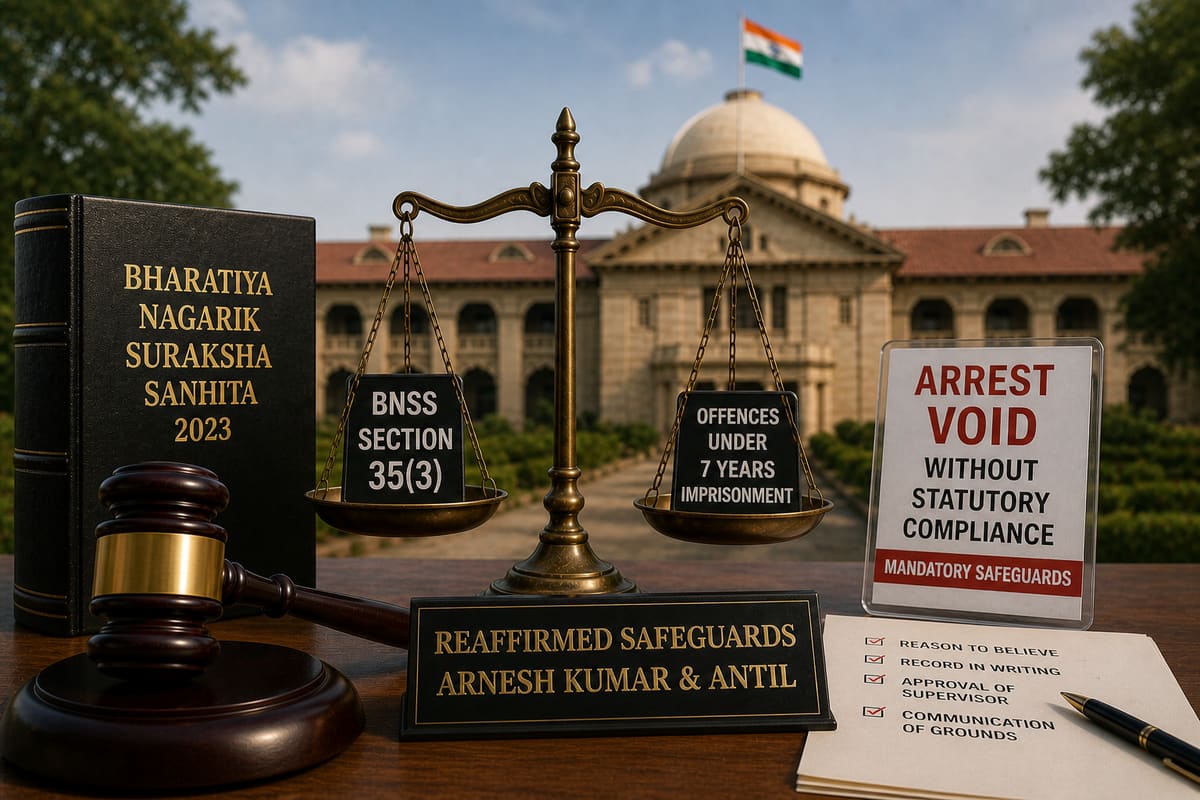
The Telangana High Court has reinforced that police cannot proceed with arrest in non-bailable offences punishable by less than seven years without strictly adhering to mandatory procedural safeguards under the Bharatiya Nagarik Suraksha Sanhita, 2023, and the binding precedent of Arnesh Kumar v. State of Bihar. This order clarifies that procedural compliance is not optional - it is a constitutional imperative.
Background & Facts
The Dispute
The petitioners, eight individuals, were named in FIR No. 21 of 2026 registered at PS Rudrur, Nizamabad, for alleged offences under Sections 292, 118(1), 351(2) read with Section 3(5) of the Bharatiya Nagarik Suraksha Sanhita (BNSS). The complainant, Gouti Kalyani, accused them of criminal intimidation and assault. The petitioners contended they were falsely implicated and had no involvement in the alleged acts.
Procedural History
The case progressed rapidly toward arrest without procedural compliance:
- 22 February 2026: FIR registered under BNSS Sections 292, 118(1), 351(2) read with 3(5)
- No prior notice or inquiry: Investigating Officer proceeded without applying Section 35(3) BNSS
- Threat of arrest: Petitioners feared imminent arrest despite offences carrying imprisonment below seven years
- 20 March 2026: Criminal Petition filed under Section 528 BNSS seeking quashing and stay of proceedings
Relief Sought
The petitioners sought:
- Quashing of FIR No. 21 of 2026
- Stay on further proceedings, including arrest
- Direction to the police to follow mandatory procedural requirements under BNSS
The Legal Issue
The central question was whether Section 35(3) of the Bharatiya Nagarik Suraksha Sanhita, 2023 mandates police to issue notice and record reasons before arresting an accused in offences punishable by less than seven years, and whether the Arnesh Kumar principles continue to apply under the new criminal code.
Arguments Presented
For the Petitioner
Learned counsel argued that:
- The offences invoked carry a maximum punishment of less than seven years, triggering the procedural safeguards under Section 35(3) BNSS
- The Investigating Officer failed to issue notice, record reasons for arrest, or consider alternatives to arrest as required
- The arrest would violate Article 21 and the triple test laid down in Arnesh Kumar v. State of Bihar
- The FIR lacks prima facie evidence of intent or participation by the petitioners
For the Respondent
The Public Prosecutor conceded that the offences initially registered carried imprisonment below seven years. However, he submitted that additional charges under Sections 74, 79, and 115(2) BNSS had since been added, potentially altering the nature of the case. He argued that investigation was ongoing and arrest was necessary to prevent tampering.
The Court's Analysis
The Court examined the text of Section 35(3) BNSS, which states: "Where a person is accused of an offence punishable with imprisonment for less than seven years, the police officer shall not arrest such person without first issuing a notice under Section 35(1) unless the officer has recorded reasons in writing for such arrest."
"The legislative intent behind Section 35(3) is clear: to prevent arbitrary arrests in less serious offences and to ensure proportionality in state action."
The Court held that the addition of other sections during investigation does not negate the initial classification of the offences as non-serious. The presumption of innocence and right to liberty remain paramount. The Court distinguished State v. Accused (2024), where arrest was justified due to flight risk, noting no such circumstances were alleged here.
The Court reaffirmed that Arnesh Kumar remains good law under BNSS, as its principles are rooted in constitutional rights, not merely the repealed CrPC. The Investigating Officer’s failure to comply with Section 35(3) was a procedural violation of due process.
The Verdict
The petitioners prevailed. The Court held that arrest cannot be made without compliance with Section 35(3) BNSS in offences punishable by less than seven years. The Court directed the Investigating Officer to follow due procedure and posted the matter for further hearing on 20 July 2026.
What This Means For Similar Cases
Arrest Is Not Automatic Even Under BNSS
- Practitioners must now argue that Section 35(3) BNSS applies to all offences punishable by less than seven years, regardless of whether they are bailable or not
- Police cannot rely on the mere registration of an FIR to justify arrest
- Failure to issue notice under Section 35(1) and record written reasons renders arrest illegal
Procedural Compliance Trumps Investigative Convenience
- The Court rejected the argument that "ongoing investigation" justifies bypassing procedure
- Evidence collection can proceed without arrest; custody is not a default tool
- Petitioners can now file Section 528 BNSS petitions to challenge non-compliance at the earliest stage
Arnesh Kumar Remains Binding Under New Code
- The triple test (gravity, flight risk, tampering) continues to govern arrest decisions under BNSS
- Courts will scrutinize whether arrest was truly necessary, not merely convenient
- Lawyers should cite Arnesh Kumar in all pre-arrest challenges under BNSS, even where the old CrPC no longer applies